feature
Swamp featured post, a Swamp Media favorite.
Hundreds Join Trump at ‘Exclusive’ Dinner, With Dreams of Crypto Fortunes in Mind Inside the most controversial crypto-political gala of the year
Former President Donald Trump, a man whose name has long been synonymous with political upheaval and media frenzy, took a bold new step into the world of digital finance by hosting an ultra-exclusive dinner at his Trump National Golf Club in Virginia. The catch? Entry wasn’t bought with political connections alone—it required a substantial investment in his very own meme coin: $TRUMP. Roughly 220 guests secured their seats at the table, not by conventional donation, but by holding significant amounts of $TRUMP cryptocurrency, a digital token launched by Trump’s allies just weeks earlier. According to blockchain data, the average portfolio among attendees exceeded $1.7 million in value. For some, this was an opportunity to mix with political royalty. For others, it was a calculated investment in the most unpredictable commodity of all: Trump himself. The Birth of a Coin and the Rise of a Cult Investment $TRUMP launched amid a flurry of speculation, hype, and inevitable satire. Initially brushed off as another flash-in-the-pan memecoin, it quickly gained traction among Trump’s base—and speculators hoping to cash in on the growing nexus between politics and digital assets. Its value surged, then fluctuated wildly, echoing the nature of its namesake’s political career. Yet, the real fireworks came not from the coin’s performance but from what came next: an invitation-only gala for the coin’s most loyal whales. The dinner, promoted discreetly through Trump-aligned channels, promised access, influence, and the ultimate prize—face time with the man himself. Guests, Glamour, and Golden Promises Inside the grand ballroom, guests included a strange mix of blockchain entrepreneurs, MAGA influencers, and at least one former professional athlete. Notable among them was Justin Sun, the embattled founder of the TRON blockchain, who reportedly purchased over $40 million in $TRUMP coins. His presence sparked concern due to his legal controversies abroad and his strategic ties to crypto markets in Asia. Even more curious was the appearance of former NBA star Lamar Odom—perhaps symbolic of the blurred lines between fame, finance, and politics in Trump’s ever-expanding orbit. Each attendee received a personalized NFT minted on the Ethereum blockchain, featuring a golden-hued animation of Trump in a superhero stance with slogans like “Make Crypto Great Again.” These tokens are already fetching outrageous bids on digital auction sites. Ethical Red Flags and the Smell of “Pay-to-Play” As expected, the event has ignited fierce backlash. Ethics watchdogs and legal experts have raised serious concerns about the blending of Trump’s business ambitions with his political persona. Critics allege that the event was effectively a pay-for-access scheme—an unregulated, blockchain-powered version of the political slush fund. Senator Elizabeth Warren, a long-time advocate for tighter crypto regulation, condemned the dinner, stating, “This is not about innovation. It’s about laundering political influence through a coin.” Foreign influence remains another hot-button issue. Blockchain analysis suggests that several top holders of $TRUMP are foreign nationals, including individuals based in Dubai, Singapore, and Eastern Europe. While not illegal under current law, the optics—particularly for a former (and possibly future) commander-in-chief—are troubling. The Trump Defense: Freedom, Finance, and Futurism In his keynote address, Trump dismissed the criticism. “This isn’t about politics,” he said to a roaring ovation. “This is about freedom. It’s about building your own destiny without government interference. And it’s about making America rich again—starting with you.” To supporters, this rhetoric rang true. Trump positioned $TRUMP as a financial tool to decentralize power, giving “the people” a stake in what he called “a movement, not just a currency.” Detractors, however, see it as something darker: a monetized cult of personality sold under the guise of innovation. Where Do We Go From Here? What happens when political power becomes tokenized—literally? Trump’s foray into cryptocurrency raises a host of uncomfortable questions about campaign finance, conflict of interest, and national security. There is currently no clear legal precedent for what happens when a politician launches a token and directly profits from its success. Moreover, this event may pave the way for other political figures to follow suit, creating a future where influence is bought not with votes or policies, but with digital tokens and exclusive invites. Whether $TRUMP will endure as a serious financial instrument or crash like so many meme coins before it remains to be seen. But for now, it has created a new model—one where politics, wealth, and technology are no longer just connected. They’re indistinguishable.
By Kaleem Ullahabout a year ago in The Swamp
Western Media and the Double Standard in Portraying Black Men
In the digital age, media narratives significantly shape public perception. However, a persistent issue remains: the portrayal of Black men in Western media often reflects deep-seated biases and double standards. These portrayals not only influence societal attitudes but also have tangible effects on the lives of Black individuals.
By Mohammad Ashiqueabout a year ago in The Swamp
" Trump returns to Riyadh "
Riyadh, Saudi Arabia — May 2025 In a move that has captured international attention, former U.S. President Donald J. Trump made a high-profile visit to Saudi Arabia in May 2025, reigniting discussions about U.S. foreign policy, global diplomacy, and the evolving relationship between Washington and Riyadh. The visit, his first since leaving the White House, was marked by both symbolism and substance, offering insights into Trump's ongoing political influence and his vision for America's role in the Middle East. The visit comes amid shifting global dynamics and internal political momentum in the United States, with Trump maintaining a significant presence in the American political landscape. His arrival in Riyadh—hosted with royal fanfare by Crown Prince Mohammed bin Salman—served as a diplomatic spectacle and a platform for serious discussions on regional security, economic cooperation, and strategic alliances. Echoes of 2017, with a New Agenda Trump’s 2025 visit draws inevitable comparisons to his first overseas trip as president in 2017, which also began in Riyadh. At that time, he emphasized unity in the fight against extremism and unveiled a historic $110 billion arms deal. Eight years later, Trump’s return to Saudi Arabia carried a different tone—less about making first impressions and more about reinforcing long-standing ties. This time, the former president met with Saudi leaders to discuss shared concerns over escalating tensions in the Gulf, the evolving role of Iran, and the lingering effects of regional conflicts in Yemen and Syria. Trump was also briefed on Saudi Arabia’s ongoing Vision 2030 projects—massive reforms aimed at modernizing the Kingdom’s economy, society, and infrastructure. Security and Defense Cooperation High on the agenda were matters of defense and regional security. Trump, known for his emphasis on a strong military partnership during his presidency, reiterated the importance of U.S.-Saudi collaboration in counterterrorism and intelligence sharing. Though no official agreements were signed during the visit, sources within the Saudi Ministry of Defense reported discussions about future joint military exercises and potential procurement deals involving U.S. defense contractors. The former president’s visit included a closed-door session with senior Saudi defense officials and U.S. business executives, suggesting that the trip may lead to renewed security cooperation even outside official government channels. Economic Partnerships and Private Sector Diplomacy Another major component of the visit was economic diplomacy. Trump attended the U.S.-Saudi Business Forum in Riyadh, where he gave a keynote address promoting American enterprise, energy collaboration, and investment in Saudi infrastructure. He praised the Kingdom’s progress on its Vision 2030 goals and encouraged U.S. companies to take part in the transformation of Saudi cities and industries. Key sectors under discussion included renewable energy, artificial intelligence, tourism, and digital infrastructure. Trump's presence helped draw attention to several new partnerships between American firms and Saudi state-backed ventures—deals that, while not yet finalized, represent billions of dollars in potential investment. Political Undertones and Global Optics While the visit was framed as a private diplomatic mission, its political undertones were unmistakable. As Trump continues to play a dominant role in U.S. political discourse—either as a former president or a prospective candidate—his international engagements are scrutinized through a political lens. The 2025 visit to Riyadh, therefore, served not only as a gesture of goodwill toward a longtime ally but also as a platform for Trump to project leadership on the global stage. International media outlets noted the sharp contrast between Trump’s visit and the foreign policy approach of the current U.S. administration, particularly in areas such as arms sales, human rights, and climate cooperation. Analysts suggest that Trump’s return to Saudi Arabia could influence American diplomatic posture in the region, especially if his political aspirations materialize further. Cultural and Symbolic Moments Beyond politics and policy, the visit was rich with symbolism. Trump was received with traditional Saudi hospitality, including a private audience with King Salman, a tour of Diriyah—the birthplace of the Saudi state—and attendance at a gala hosted by the Royal Court. He also visited the King Abdulaziz Center for World Culture and participated in a roundtable with Saudi youth leaders and entrepreneurs. These symbolic gestures were widely covered by regional media, portraying the visit as a reaffirmation of friendship and mutual respect between the two nations. Conclusion: A Strategic and Symbolic Visit Donald Trump's 2025 trip to Saudi Arabia was more than just a return to familiar territory—it was a calculated display of diplomacy, business outreach, and geopolitical messaging. While no major policy breakthroughs were announced, the visit reinforced the enduring relationship between the U.S. and Saudi Arabia and emphasized Trump's continued interest in shaping that partnership. Whether seen as a private citizen wielding influence or a political figure staging a comeback, Trump's presence in Riyadh reminded the world of the complexities of American diplomacy and the personal relationships that often drive it. As the Middle East navigates a new era of challenges and opportunities, the U.S.-Saudi relationship—long shaped by leaders on both sides—remains a central force in the region’s future.
By Kaleem Ullahabout a year ago in The Swamp
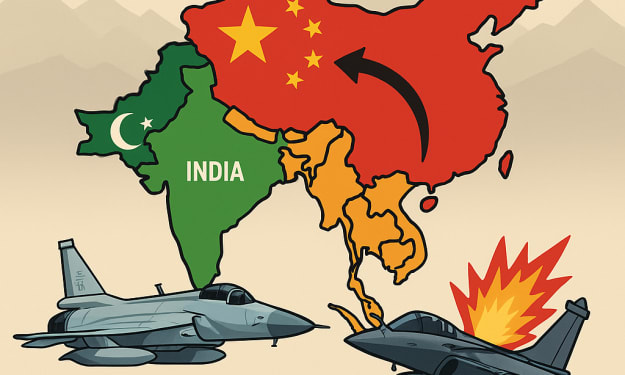
How China Got Benefit from Pakistan and India Conflict
In a dramatic turn of events during a recent India-Pakistan conflict, the Pakistan Air Force (PAF) reportedly downed a French-made Rafale fighter jet using the JF-17 Thunder, a multi-role combat aircraft developed jointly by China and Pakistan. Though official confirmation is still pending, the symbolic value of this event is already resonating across global defense and strategic communities.
By Zakir Ullahabout a year ago in The Swamp
The Reality Behind the Pahalgam Attack: Unraveling the Security and Sovereignty Crisis in India
The recent attack in Pahalgam, Jammu and Kashmir, has once again exposed deep vulnerabilities in India’s internal security framework. Known for its natural beauty and spiritual significance, Pahalgam has become an unfortunate symbol of the broader tensions simmering in the Kashmir Valley. The attack not only resulted in tragic loss of life but also triggered national anxiety, raising fresh questions about India’s security preparedness, political direction, and regional stability. The Attack and Its Immediate Fallout Initial reports indicate that the attack targeted security personnel and possibly civilian pilgrims. Pahalgam, which lies along the Amarnath Yatra route, has historically been a sensitive area during pilgrimage season. Despite heavy security deployment, the assailants managed to strike, highlighting lapses in surveillance and intelligence. In response, authorities initiated widespread security operations and placed the region on high alert. The attack sent shockwaves across the nation. Public outcry and political criticism followed, with opposition leaders questioning the government’s handling of Kashmir and demanding accountability. Gaps in Security Preparedness One of the most concerning aspects of the Pahalgam attack is the clear failure in anticipating and preventing such an incident. Despite years of counter-insurgency operations, India continues to face challenges in detecting threats before they materialize. The ability of militants to coordinate and execute attacks in highly monitored zones indicates gaps in local intelligence, coordination between agencies, and community engagement. Moreover, the over-reliance on militarized responses often alienates local populations, making it harder to build trust and gain actionable information from communities that are crucial to long-term peace efforts. Regional and Geopolitical Undercurrents India’s challenges in Kashmir are not purely domestic. Pakistan’s alleged support for insurgent groups operating in the region remains a core concern. Cross-border infiltration, proxy warfare, and the spread of radical ideologies are all factors that contribute to persistent instability. Beyond Pakistan, developments in Afghanistan post-2021 and growing Chinese interests in Ladakh have added complexity. With China actively asserting its presence in nearby regions and maintaining its territorial claims, India faces a dual-front strategic threat. These geopolitical pressures complicate India’s internal security calculations in Kashmir and demand a more nuanced, multidimensional response. Public Sentiment and National Unity Events like the Pahalgam attack deeply affect public sentiment across India. While there is often a surge of patriotism and support for security forces, there is also frustration over repeated lapses and political inaction. Many Indians feel a growing disconnect between the government’s strong national security rhetoric and the ground reality in conflict-prone regions. In Jammu and Kashmir itself, such incidents disrupt efforts at normalization, development, and integration. People who hope for peace and progress find themselves caught between militant threats and state crackdowns, often with limited access to justice or political representation. A Blow to India’s Sovereignty? Attacks like the one in Pahalgam go beyond immediate violence—they strike at the very notion of sovereignty and state control. For a country seeking global leadership and regional dominance, repeated security failures in a part of its own territory weaken its strategic credibility. Sovereignty isn’t just about geography—it’s about the state’s ability to ensure peace, justice, and development within its borders. On that front, India has work to do. The Path Forward: Beyond Military Response India must rethink its Kashmir policy in a comprehensive way. While a strong security apparatus is vital, it must be complemented by long-term social, economic, and political strategies. This includes: Improved intelligence sharing across agencies and regions. Increased community engagement, especially with youth, to counter radicalization. Infrastructure development that includes local voices and addresses real needs. Rebuilding trust through justice, dialogue, and transparent governance. International diplomacy to isolate hostile elements and apply pressure on state sponsors of terrorism. India’s leadership must show not just strength, but also wisdom and compassion. --- Conclusion The Pahalgam attack is a harsh reminder that the road to peace in Jammu and Kashmir remains difficult and dangerous. Yet, it also offers an opportunity—a moment to pause, reflect, and reset. Security alone cannot win this battle. Only a combination of vigilance, vision, and values can bring lasting stability to the region and uphold the promise of a united, sovereign India.
By Shah saab ITabout a year ago in The Swamp
The Canada Disability Benefit Is Failing the People Who Need It Most
We've been waiting for 2 years to see a poverty reduction program come to life for Canadians struggling with disabilities. The Canada Disability Benefit (CDB) was intended to be the historic step that would help to reduce and eventually end disability poverty from coast to coast. It's taken years of consultations, advocacy, and legislative debate; when the benefit finally passed into law in 2023, and was included in the 2024 federal budget, we thought we had finally seen a victory on the horizon.
By Autumn Stewabout a year ago in The Swamp
India is Done Playing Nice: A Not-So-Subtle Approach to Diplomacy
In what can only be described as the diplomatic equivalent of flipping the table during a chess match, India has apparently reached the end of its legendary patience following the tragic Pahalgam attack in Kashmir. World leaders like US President Donald Trump and Russian President Vladimir Putin have condemned the massacre that claimed 28 lives-a statement so obvious it barely qualifies as news. The timing of the attack during US Vice President J.D. Vance's visit to India seems almost theatrically convenient, as if terrorists consult international diplomatic calendars when planning their atrocities.
By The INFORMERabout a year ago in The Swamp
Why Everyone Is Suddenly So Interested in the US Bond Markets
A few years ago, when you mentioned the bond market at a dinner party, you probably got a few blank stares before someone moved on to stocks, real estate, or Bitcoin, which were easier to understand. However, fast forward to the present day, and the bond market in the United States has suddenly become the topic of conversation. People are spending a lot of time researching yields, treasury auctions, and the dreaded "inverted yield curve"—from financial analysts on YouTube to everyday conversations on Reddit. But the sudden interest: why?
By Nuhan Habibabout a year ago in The Swamp