congress
A handy guide to all Congress happenings on both sides of the aisle. Thank goodness for this political body that keeps Presidential power in check.
"Superpowers at a Crossroads: The Future of U.S.–China Relations in 2025"
Superpowers at a Crossroads: The Future of U.S.–China Relations in 2025 How the World’s Two Giants Are Shaping a New Global Order In the ever-shifting landscape of international politics, few relationships carry as much weight—or as much risk—as that between the United States and China. These two global giants, wielding unmatched economic, military, and technological influence, stand at a pivotal crossroads in 2025. Their interactions do more than affect their own nations; they ripple across continents, shaping global markets, alliances, security frameworks, and the future of international cooperation. A Relationship Built on Competition and Codependence Since China’s economic liberalization in the late 20th century, the U.S.–China relationship has oscillated between cautious engagement and intense rivalry. The U.S. played a key role in China’s accession to the World Trade Organization in 2001, hoping economic integration would encourage political openness. But instead of liberalization, China grew more assertive, and its rise has challenged American primacy on multiple fronts. Today, the two countries are deeply economically intertwined yet politically estranged. Bilateral trade still amounts to hundreds of billions of dollars annually, but tariffs, export bans, and national security concerns have fractured the trust that once underpinned cooperation. The U.S. accuses China of intellectual property theft, unfair trade practices, and currency manipulation, while China views America’s actions as attempts to contain its rightful ascent. The Taiwan Flashpoint and Military Tensions No issue exemplifies the fragility of U.S.–China relations more than Taiwan. Beijing considers the self-governing island a breakaway province and has not ruled out the use of force to achieve reunification. The U.S., while maintaining a "One China" policy, continues to support Taiwan’s democratic system and provides arms to bolster its defense. Military tensions in the South China Sea and Taiwan Strait have escalated, with close encounters between naval forces and increased military drills. The Indo-Pacific region has become a theater for strategic posturing, with the U.S. strengthening alliances with Japan, South Korea, Australia, and India through forums like the Quad. The Battle for Technological Dominance Beyond territorial disputes, the U.S.–China rivalry is increasingly defined by the race for technological supremacy. From 5G networks and artificial intelligence to semiconductors and quantum computing, both nations are investing heavily to outpace the other. The U.S. has restricted Chinese tech firms like Huawei from accessing advanced chip technologies, citing security concerns. In response, China has accelerated efforts to achieve self-sufficiency in critical sectors. This tech arms race is not just economic—it's ideological. It reflects broader concerns about data governance, surveillance, digital freedom, and the role of the state in shaping innovation. The outcome will determine whose standards and values dominate the next generation of global infrastructure. Climate: The One Area of Potential Cooperation Amid the competition, climate change remains a rare domain of shared interest. As the world’s two largest carbon emitters, the U.S. and China hold the key to meaningful global climate progress. While their climate diplomacy is often marred by broader tensions, both countries have signaled willingness to collaborate on clean energy, emissions reduction, and green technology. In late 2024, the two sides resumed high-level climate talks, focusing on methane reduction and sustainable finance. Although modest, such engagements hint at the possibility of compartmentalized cooperation—where both sides work together on existential global issues, even as strategic rivalry continues elsewhere. A New Global Order in the Making As we move further into 2025, it’s clear the old world order—centered on unchallenged U.S. dominance—is giving way to a multipolar reality. China is carving out a leadership role in the Global South, offering an alternative to the Western model through infrastructure programs like the Belt and Road Initiative. Meanwhile, the U.S. is reinvigorating alliances and promoting a rules-based international order. The world is watching as these two superpowers navigate a path forward. Will they settle into a “cold peace” of managed competition, or stumble into open confrontation? Can multilateral institutions mediate their differences, or will new blocs emerge? Conclusion The U.S.–China relationship is not merely bilateral—it is global in consequence. How these nations choose to engage with each other will shape the trajectory of war and peace, cooperation and conflict, progress and peril. In 2025, with stakes higher than ever, the world’s two giants must decide: will they lead the world together—or pull it apart?
By World politics about a year ago in The Swamp
"The Shifting Landscape of World Politics in 2025"
China’s Expanding Influence in Asia and Beyond In 2025, China's rise as a global superpower is no longer a prediction — it is a living reality. The once unipolar world order dominated by the United States is now being reshaped by a multipolar dynamic, with China playing a leading role. From economic investments and military advancements to diplomatic strategies and cultural outreach, China's influence is stretching far beyond its borders, fundamentally altering global geopolitics. Economic Expansion Through the Belt and Road Initiative At the heart of China’s global strategy lies the Belt and Road Initiative (BRI), a massive infrastructure and investment project launched in 2013. Now in its second decade, the BRI has connected more than 140 countries through roads, railways, ports, and digital infrastructure. It has allowed China to secure trade routes, gain access to critical resources, and extend its economic presence into regions traditionally dominated by Western powers. In Asia, countries like Pakistan, Sri Lanka, and Laos have become heavily reliant on Chinese investments. For instance, the China-Pakistan Economic Corridor (CPEC) has not only enhanced trade between the two nations but also given China strategic access to the Arabian Sea. Meanwhile, in Africa and Latin America, China continues to fund infrastructure projects and offer loans that come with fewer political strings than Western aid — although critics warn of a potential “debt trap” diplomacy. Military Modernization and Strategic Posturing China's military, particularly the People’s Liberation Army Navy (PLAN), has undergone rapid modernization. The South China Sea remains a central point of tension, as Beijing continues to assert its claims over disputed territories, building artificial islands and militarizing them despite international criticism and rulings from The Hague. Beyond its immediate region, China has increased its presence in the Indian Ocean, with a military base in Djibouti and regular naval deployments in strategic chokepoints. Its expanding blue-water navy is designed not only to protect trade routes but also to project power far from its shores. This has raised concerns in neighboring countries and drawn the attention of the United States and its allies. Diplomacy with “Chinese Characteristics” Beijing’s diplomatic approach combines traditional statecraft with economic leverage and soft power. Through platforms like the Shanghai Cooperation Organization (SCO) and the recently revived BRICS bloc, China seeks to reshape global governance structures to be less Western-centric. It champions “non-interference” in domestic affairs — a stance attractive to many authoritarian regimes — and presents itself as a counterbalance to U.S. influence. China has also stepped up its role as a mediator in international conflicts. In 2023, it brokered a landmark diplomatic thaw between Iran and Saudi Arabia, demonstrating its growing clout in the Middle East. Such actions position Beijing not just as a global power, but as a global peace broker — a role long monopolized by the West. Cultural Soft Power and Global Narratives Beyond economics and military might, China is actively promoting its culture and political ideology. With state-run media like CGTN and Xinhua expanding their global reach, and Confucius Institutes established in dozens of countries, China is investing in shaping public opinion overseas. The narrative emphasizes harmony, mutual development, and respect for sovereignty — subtly contrasting with what Beijing portrays as Western hypocrisy and interventionism. At the same time, digital platforms like TikTok (owned by Chinese company ByteDance) have become part of China’s soft power arsenal. Though primarily entertainment platforms, they subtly contribute to cultural normalization and influence among global youth. Challenges and Pushback Despite its success, China’s rise is not without resistance. Several countries have grown wary of its economic dominance and political motives. In Southeast Asia, nations like Vietnam and the Philippines are strengthening ties with the U.S. and forming regional alliances to counter Chinese assertiveness. In Europe and the U.S., concerns about human rights, intellectual property theft, and cyber-espionage continue to strain relations with Beijing. Moreover, the “China model” — combining authoritarian governance with capitalist economics — is viewed with suspicion in democratic societies, especially as Beijing tightens its grip on Hong Kong and cracks down on dissent at home. Conclusion: A New World Order in the Making As we move deeper into the 21st century, China’s expanding influence is reshaping not only Asia but the global balance of power. Whether one views this transformation with optimism or concern, it is clear that the world must adapt to a future where China is a central actor. How other nations respond — with cooperation, competition, or confrontation — will determine the course of global politics for decades to come.
By World politics about a year ago in The Swamp
India and Pakistan Face Off Over Kashmir Terror Attack: Is South Asia Headed for a Major Conflict?
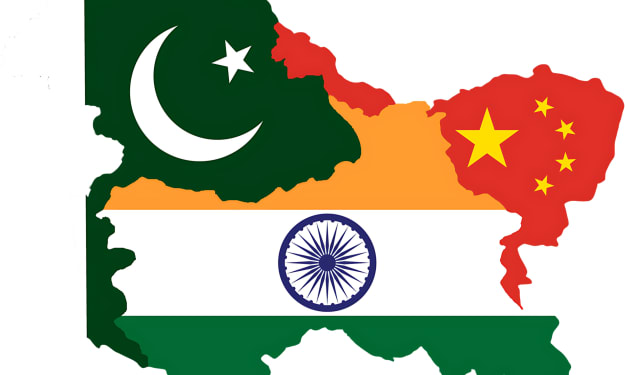
rorist attack in Indian-administered Kashmir. The April 22 attack in the scenic town of Pahalgam, a popular destination for Hindu pilgrims, killed at least 26 people and injured dozens more. Claimed by a militant group called *The Resistance Front*, the incident has triggered a wave of retaliation from the Indian government and a strong counter-response from Pakistan, bringing the nuclear-armed neighbors to the brink of confrontation once again. As of late April 2025, both countries have taken dramatic diplomatic, military, and strategic measures that signal a sharp deterioration in relations. This sudden breakdown comes amid an already tense regional atmosphere and raises fears of yet another armed conflict over the disputed territory of Kashmir. The Kashmir Flashpoint: A History of Violence and Dispute The Kashmir region has long been a hotbed of conflict between India and Pakistan, dating back to the partition of British India in 1947. Both nations claim the region in full, but each controls a portion—India administers Jammu and Kashmir, while Pakistan governs what it calls Azad Kashmir. Over the decades, this unresolved territorial dispute has led to three full-scale wars and countless skirmishes along the Line of Control (LoC), the de facto border dividing the two parts of Kashmir. What makes this current situation particularly dangerous is the nature of the attack and its aftermath. The targeting of Hindu pilgrims in Pahalgam has not only shocked India but also inflamed religious and nationalistic sentiments. It is being seen not just as an act of terrorism, but a symbolic attack on India’s cultural and religious heritage. India has accused Pakistan of backing the militant group responsible for the attack, citing long-standing evidence of cross-border terrorism. While Pakistan denies any involvement, the Indian government insists that such organizations operate with impunity in Pakistani territory, using it as a base to strike inside India. India’s Strong Response: Diplomatic and Military Escalation In response to the Pahalgam attack, Indian Prime Minister Narendra Modi’s administration moved swiftly. Within hours, high-level security meetings were convened, and within days, India initiated a series of sweeping actions: Suspension of the Indus Waters Treaty: This landmark water-sharing agreement, brokered in 1960 by the World Bank, has withstood decades of conflict. Its suspension is a rare and bold move that signals how deeply New Delhi views the current crisis. Cancellation of all Pakistani visas: India has revoked all visas issued to Pakistani nationals, effectively shutting down travel and cultural exchanges between the two countries. Expulsion of Pakistani diplomats: Several Pakistani officials were ordered to leave India, and New Delhi recalled its own diplomats from Islamabad. Military freedom of action: The Indian Army has been given “full operational freedom” to respond to provocations along the LoC, indicating the possibility of cross-border operations or retaliatory strikes. These steps mark one of the most severe diplomatic breakdowns between the two countries in recent memory. They also suggest that India is preparing for a range of responses, including potential military retaliation. Pakistan's Reaction: Strategic Posturing and International Appeals Pakistan, in turn, has responded aggressively. Prime Minister Shehbaz Sharif condemned India’s actions and accused New Delhi of using the attack as a pretext to justify harsh measures against Kashmiris and provoke war. Pakistan’s countermeasures include: Closure of airspace to Indian aircraft, affecting both commercial and military flights. Suspension of bilateral agreements, including aspects of the 1972 Simla Agreement, which governs peaceful conflict resolution between the two nations. Mobilization of military forces along the LoC, accompanied by increased patrols and strategic deployments. Capture of an Indian soldier, who allegedly crossed the border accidentally, adding further strain to military relations. Pakistan has also appealed to international bodies such as the United Nations and the Organization of Islamic Cooperation (OIC) to intervene diplomatically. Islamabad claims India is inflaming the situation and using the tragedy to distract from alleged human rights abuses in Jammu and Kashmir. Global Concern: Calls for Restraint Amid Nuclear Risk Given that both India and Pakistan possess nuclear weapons, the situation has alarmed the international community. The United States, European Union, United Nations, and other key players have issued urgent calls for de-escalation and a return to diplomacy. U.S. Secretary of State Marco Rubio has announced plans to speak directly with his counterparts in New Delhi and Islamabad. The goal, according to the State Department, is to prevent any further deterioration of the situation and to encourage dialogue. Meanwhile, China—an ally of Pakistan and a regional power with interests in Kashmir—has issued a cautious statement urging restraint and peace, without clearly siding with either nation. The potential for regional spillover remains high, especially if either country initiates a military strike. Media and Public Opinion: Nationalism on the Rise The media on both sides of the border have intensified nationalist rhetoric. In India, television networks are calling for strong retaliatory action, echoing sentiments of revenge and justice for the victims of the Pahalgam massacre. In Pakistan, state media presents India’s actions as unjustified aggression and highlights the humanitarian crisis in Kashmir. Social media is flooded with polarized hashtags like #StandWithIndia, #StopTerror, #FreeKashmir, and #StopIndianAggression, reflecting deep divisions and the powerful role of digital platforms in shaping public opinion. What Lies Ahead: Dialogue or Confrontation? As the crisis unfolds, the coming days will be critical. If India proceeds with military retaliation, the chances of a wider conflict grow significantly. Past confrontations, like the Balakot airstrike in 2019 and the surgical strikes in 2016, suggest that India may consider limited but high-impact operations to punish militant bases in Pakistan. However, such actions could prompt massive retaliation from Pakistan, potentially leading to a cycle of violence neither side can easily control. The international community will need to act swiftly to mediate, but peace will ultimately depend on whether both governments prioritize stability over political gains. Conclusion The recent terror attack in Kashmir has reopened deep wounds between India and Pakistan, putting South Asia on a knife’s edge. With diplomatic ties unraveling and military forces mobilizing, the risk of escalation is real and immediate. Whether cooler heads prevail or the situation devolves into open conflict will depend on the choices made by leaders in New Delhi, Islamabad, and global capitals in the days to come. India-Pakistan Conflict
By NextGen Mobile Techabout a year ago in The Swamp
An Open Letter to President Donald J. Trump: A Call to Restore Stability and Leadership to America April 29, 2025. AI-Generated.
Dear President Trump, As your administration navigates unprecedented challenges—economic uncertainty, global tensions, and deepening divisions at home—it is critical to reflect on the path forward. While your commitment to American workers and “America First” principles has resonated with many, the current trajectory of tariffs, isolationist policies, and erratic governance risks undermining the very goals you seek to achieve. This letter urges you to reassess key policies, prioritize pragmatic solutions over ideological battles, and lead the nation toward unity, stability, and renewed prosperity.
By David Snamabout a year ago in The Swamp
Donald Trump’s 100 Days in the Oval Office. AI-Generated.
As Donald Trump marks his 100th day in office during his second presidential term, the global economy braces for the ripple effects of his aggressive trade policies and domestic reforms. While supporters hail his focus on “America First” populism, critics warn that his tariff-driven agenda, paired with sweeping immigration crackdowns and fiscal austerity, risks plunging the U.S. into a self-inflicted recession. This analysis dissects the early impacts of Trump’s policies, their geopolitical ramifications, and the mounting concerns among economists.
By David Snamabout a year ago in The Swamp
Pahalgam Terror Attack: A Tragedy That Shook the Nation
On April 22, 2025, the serene Baisaran Valley near Pahalgam in Jammu and Kashmir was shattered by a brutal terrorist attack, marking one of the deadliest assaults on civilians in India since the 2008 Mumbai attacks. The massacre claimed 26 lives and left over 20 injured, predominantly targeting Hindu tourists from various Indian states and a few foreign nationals. The Resistance Front (TRF), an offshoot of the Pakistan-based Lashkar-e-Taiba, claimed responsibility, citing opposition to alleged demographic changes in the Kashmir Valley.
By Kratika Saxena2 years ago in The Swamp
How India’s Threat to Block Rivers Could Devastate Pakistan.. AI-Generated.
How India’s Threat to Block Rivers Could Devastate Pakistan. Tensions between India and Pakistan have long simmered due to historical, territorial, and political disputes. Among the most pressing and potentially devastating of these is the conflict over water — specifically, the rivers that flow from India into Pakistan under the Indus Waters Treaty (IWT). India's repeated threats to block or divert these rivers could have catastrophic consequences for Pakistan, a country that relies heavily on these waters for agriculture, energy, and human consumption.
By Adnan Rasheed2 years ago in The Swamp
As Trump claims he has his timetable for war, the number of casualties from the Kyiv strike grows
Following his remarks regarding Volodymyr Zelenskyy, UK Conservative Party head Kemi Badenoch declined to comment on whether Britain could still view Trump as an ally. "President Zelenskyy is a hero, and we need to do everything we can to support Ukraine to end this war," Badenoch told reporters on Thursday.
By Francis Dami2 years ago in The Swamp