
Saudi Arabia Bought the World’s Most Expensive Bodyguards. Then a Missile Hit Riyadh.
The attack wasn’t just a Houthi strike. It exposed the fatal flaw in a kingdom that outsourced its own survival.
After Two Loud Blasts Before Dawn
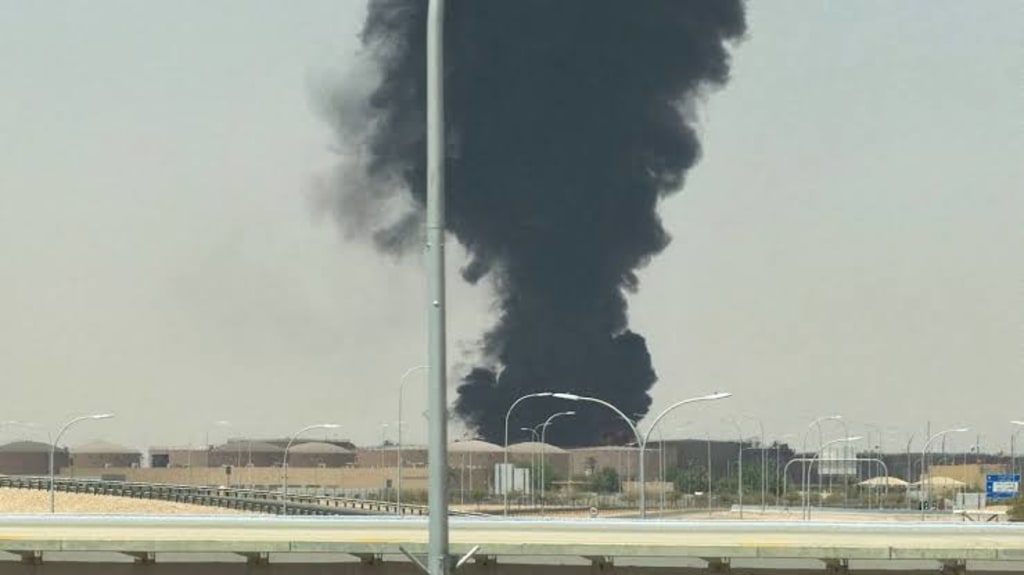
In the early hours of September 19, 2026, residents of Riyadh were awakened by two loud explosions.
Black smoke rose near King Khalid International Airport. Flight-tracking websites showed severe delays. The Royal Saudi Air Defense Forces later announced it had intercepted a ballistic missile, but acknowledged the Houthis had also attempted to attack Baysh, Taif, Farasan, and Yanbu.
Houthi spokesman Yahya Saree said that evening that the group had used "a large number of ballistic missiles, cruise missiles, and drones" to attack "sensitive targets" in Riyadh and Saudi Aramco facilities in Yanbu. His stated reason: Saudi Arabia had carried out 732 airstrikes in Yemen.
Mouslimi, a Yemen expert at Chatham House, called it a "huge" escalation and said the Houthis "will not stop there."
This was the first time since the escalation in July that the Houthis had extended their strikes from southern Saudi Arabia to the heart of the capital. Saudi Arabia has spent so much money, signed so many agreements, and hired so many "bodyguards." Yet the sky over its capital still cannot stop a single missile.
I
To understand the impact of this attack, we need to go back to 2023.
That year, with China's mediation, Saudi Arabia and Iran agreed to restore diplomatic relations, reopen embassies, and end seven years of severed ties. An Iranian Foreign Ministry spokesman said the agreement "can not only help safeguard the interests of both countries but also promote regional peace and stability," and specifically thanked China for its "important role" in the mediation.
For Saudi Arabia, the strategic value of this reconciliation was self-evident. Crown Prince Mohammed bin Salman's Vision 2030, proposed in 2016, aims to free the Saudi economy from its sole dependence on oil and shift toward investment, tourism, logistics, and technology. The precondition for all of this is stability: foreign investors need a regional environment not threatened by missiles, tourists need a sense of safety, and a logistics hub needs unimpeded routes.
Saudi-Iranian reconciliation should have been the most solid security foundation for Vision 2030.
But events did not follow that path. Saudi Arabia then chose a path more reliant on "great-power transactions": investing heavily in the Trump administration, trying to exchange bound interests for U.S. security endorsement, and developing a tacit understanding with Israel on regional affairs. This path meant that Saudi Arabia staked its own security on the United States.
The problem is that the American card is depreciating.
II
Saudi Arabia asked the United States for help and got silence.
Two Yemeni government officials said that requests for assistance made by Saudi Arabia and the Yemeni government to Washington had "so far received no substantive response." One Yemeni official said bluntly: "The government is disappointed that the Trump administration is unwilling to join the ongoing fight against the Houthis. Requests for assistance made to Washington appear to have been ignored."
The reason is not complicated. In its six-month war with Iran, the United States had significantly depleted its own interceptor missile stockpiles. Saudi Arabia's most important ally and arms supplier was experiencing the pains of a war of attrition and could not attend to Riyadh's air-defense needs.
So Saudi Arabia turned to another "bodyguard": Pakistan.
In September 2025, Pakistan and Saudi Arabia signed a Strategic Mutual Defense Agreement. Its terms stipulated that an attack on either side would be regarded as aggression against both. Pakistan's defense minister even hinted that the agreement in effect placed Saudi Arabia under Pakistan's "nuclear umbrella."
Pakistan then deployed a force of about 8,000 to 13,000 troops to Saudi Arabia, including a squadron of JF-17 Thunder fighter jets and Chinese-made HQ-9 air-defense missile systems, to strengthen the air-defense shield for Saudi oil fields and refineries. The equipment is operated by Pakistani soldiers, but "the huge funding, logistics, and fuel support are fully financed by Saudi Arabia."
It is a clear transaction: Saudi Arabia pays; Pakistan provides people and equipment.
But this agreement was defensive in orientation from the start. Its core function is to prevent Saudi Arabia from "suddenly dropping dead," not to give Saudi Arabia the capital to take the initiative. While deploying troops, Pakistan has also been loudly playing the role of core mediator and peacemaker in the U.S.-Iran war, trying to maintain a balance among all parties. A bodyguard who also wants to be a mediator is unlikely to take a bullet for his employer.
The Mecca Joint Defense Agreement signed in August is more delicate. Under it, Saudi Arabia, Turkey, and Pakistan agreed that an attack on one would meet a joint response. After the attack on Riyadh, Turkish Foreign Minister Hakan Fidan said Turkey would honor its commitment and "might provide Saudi Arabia with military-technical assistance." But analysts generally believe that, because the Middle East situation is so complex, the three countries may not be able to effectively fulfill this obligation in every scenario, and that the agreement is "still in the gestation stage."
What Saudi Arabia has bought with its money is a security system that looks beautiful but works poorly.
III
The Houthis chose this moment to escalate, with precise tactical calculations.
Since the conflict restarted in mid-July, the Houthis' attack pattern has shown clear selectivity: avoiding Saudi Arabia's core oil-producing region in the east and concentrating on southern urban centers. This approach has dual considerations: geographically closer to Yemen, it saves scarce long-range strike weapons; at the same time, it targets energy and fuel supply networks in densely populated cities such as Jizan and Abha, and can cause immediate chaos in Saudi Arabia's domestic-demand economy.
But the deeper target is Vision 2030 itself. Yonhap reported that, according to expert analysis, the Houthis' strategic calculation "aims to deter Saudi military involvement in Yemen while striking core national economic projects such as Vision 2030."
Missiles cannot reach Riyadh's financial district, but they can hit investors' confidence in Saudi Arabia's "security premium."
Saudi Arabia's vulnerability goes far beyond this. After the Strait of Hormuz was effectively blockaded by Iran, Saudi Arabia's most important alternative export route is the East-West Pipeline across the country. It is about 1,200 kilometers long, carries crude from the Persian Gulf coast to Yanbu port on the Red Sea for export, and has a daily capacity of about 5 million barrels.
This pipeline is Saudi Arabia's only channel to bypass Hormuz.
Yanbu port is now one of the key targets of this round of Houthi attacks. China and India together account for about half of Yanbu port's shipments, receiving about 1.5 million barrels of crude per day. Once Yanbu port's operations are disrupted, it affects not only Saudi fiscal revenue but also the stability of the global energy market's supply chain.
Saudi Arabia's strategic dilemma is fully exposed here: Hormuz in the east is choked by Iran, Bab el-Mandeb in the west is threatened by the Houthis, and two energy corridors are under pressure at the same time. This is exactly the geopolitical configuration Vision 2030 least wants to see. A transformation plan that depends on stability, investment, and an open economy is squeezed between two chokepoints that could snap at any moment.
IV
A popular narrative holds that Saudi Arabia has thrown itself into China's arms and that China should protect Saudi Arabia. This narrative both overestimates China's military power-projection capacity in the Middle East and misreads China's role in the region.
China builds roads. It does not act as a bodyguard.
When Iran's blockade of the Strait of Hormuz made crude transportation difficult, China did not send warships to escort. Instead, it privately made direct contact with the Houthis to negotiate safe passage for Chinese oil tankers through Bab el-Mandeb. According to reports, at least four tankers loaded with Saudi crude and bound for China have passed through Bab el-Mandeb. The ship-by-ship safe passage mechanism established between China and the Houthis allows tankers departing from Yanbu to reach Asia in 16 days, rather than taking 50 days to detour via the Suez Canal and Africa.
This is corridor management. It is not military intervention.
When the Houthis advanced along the Red Sea coast and Saudi oil exports were at risk, Saudi Arabia sought China's help. Three people familiar with the matter said China then urged Iran to help restrain the Houthis. China did not send troops, but through its network of relations with Iran, it provided Saudi Arabia with a diplomatic channel.
China also made a farther-reaching move: sending an air force expeditionary wing to Egypt to guard the Suez Canal, Saudi Arabia's last outlet to the sea.
These moves share one common feature: China lays alternative routes rather than entering the fray directly. What China is doing is ensuring that even if Saudi Arabia's geopolitical environment deteriorates, oil can still be shipped out and trade can still be maintained. This prepares for the worst; it does not prevent the worst from happening.
For China, Middle Eastern oil supply is a core concern of energy security. Data from March 2026 show that after Saudi Arabia transshipped crude via the East-West Pipeline to Yanbu port, India and China together received about 1.5 million barrels per day, replacing volumes previously loaded along the Persian Gulf coast. The stability of this supply chain directly bears on China's energy security.
But China's road-building has a fundamental precondition: once the road is built, you have to be willing to walk on it yourself.
V
Saudi Arabia's air-defense system can intercept a missile. It cannot intercept strategic passivity.
The problem is not interception capability. It is a structural flaw in Saudi Arabia's security strategy.
Saudi Arabia's security model is essentially an outsourcing system. For decades it was outsourced to the United States; now it is trying to outsource to Pakistan and Turkey, while expecting China to provide some kind of implicit guarantee. Every outsourcing comes with huge financial input: investing in the United States, providing loans and oil discounts to Pakistan, and purchasing port and infrastructure cooperation from China. But every outsourcing fails to solve a fundamental problem: no one cares about your security more than you do.
America's credibility in the Middle East is being marginalized. The Pakistani military's funding and logistics are fully financed by Saudi Arabia. This means Pakistan's military presence depends heavily on continued Saudi payments, rather than an unshakable alliance obligation. The "attack on one, joint response" clause of the Mecca Joint Defense Agreement sounds generous, but analysts point out that the agreement is still in the gestation stage.
All these external guarantees cannot change one fact: Saudi Arabia's geography dictates that it must face both Hormuz in the east and Bab el-Mandeb in the west. The safety of these two chokepoints ultimately depends on the quality of Saudi Arabia's relations with Iran, with the Houthis, and with the region as a whole. It does not depend on how many air-defense systems Riyadh has bought.
The economic logic of Vision 2030 requires Saudi Arabia to become a stable regional commercial center: attracting foreign investment, developing tourism, and building a logistics hub. But a country that needs foreign troops to protect its oil facilities will find it hard to prove to investors that it is a "stable commercial center."
The way out is to reduce dependence on external bodyguards. Finding a more powerful bodyguard will not work. This means: being a good neighbor, no longer seeking to be a regional hegemon; stopping interference in other countries' internal affairs and no longer exporting religion; focusing on building the East-West Pipeline and becoming a key fulcrum of the Belt and Road rather than a participant in geopolitical contest.
China can help Saudi Arabia pave these paths by providing markets, technology, and diplomatic channels. But Saudi Arabia must decide for itself whether to walk on them.
The explosions in Riyadh before dawn did not expose an air-defense gap, but a strategic question: when you hand your security over to others for safekeeping, you never know what will happen before the next dawn.
About the Creator
Jin
Writer of reamstories
https://reamstories.com/jin
Enjoyed the story? Support the Creator.
Subscribe for free to receive all their stories in your feed. You could also become a paid subscriber, letting them know you appreciate their work.
Comments
There are no comments for this story
Be the first to respond and start the conversation.