
Russia Says It Can Restart Nord Stream. Germany’s Far Right Is Listening.
One tweet, one surviving pipe, and three barriers that make a comeback almost impossible.
I. One Tweet, Two Audiences
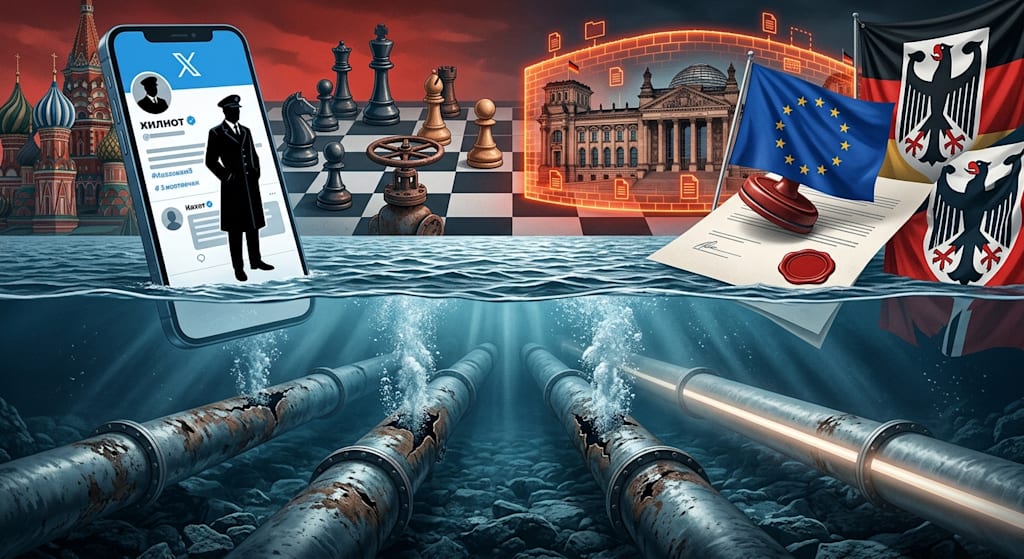
On September 26, 2026, Kirill Dmitriev typed a line in English on X: “Completely true. We will jointly restart the Nord Stream pipeline. The Alternative for Germany represents the voice of the German people.”
He is a Russian presidential envoy and the chief executive of the Russian Direct Investment Fund. The tweet he was responding to came from Tino Chrupalla, co-chair of the Alternative for Germany (AfD). Chrupalla called for an international investigation into the destruction of the Nord Stream pipeline and for its repair and restart.
Dmitriev had addressed the AfD on X a week earlier. On September 19, he wrote: “Germany’s energy and industrial suicide must end.” He named Mecklenburg-Vorpommern, the landfall point of the Nord Stream pipeline in Germany. A state parliament election was approaching there, and the AfD and the Social Democrats were neck and neck in the polls.
A previous Reuters exclusive provided more background. Dmitriev, along with AfD co-chairs Chrupalla and Weidel, was preparing a meeting planned for 2027 on restoring Russian gas supplies to Germany. Dmitriev is also one of Putin’s main representatives in negotiations with the U.S. side to end the Russia-Ukraine war.
His role spans economic cooperation and diplomatic negotiation. The timing, audience, and signal of this tweet matter more than whether the idea can be carried out.
II. The One Surviving Pipeline
The phrase “restart Nord Stream” easily creates an impression: that the entire pipeline system can be switched back on like a light. The technical reality is much narrower.
The explosions of September 26, 2022 damaged three of the four lines of Nord Stream 1 and Nord Stream 2. Russia’s Prosecutor General’s Office opened a case for an “act of international terrorism.” Four years later, Germany’s Federal Prosecutor’s Office concluded that the explosions were carried out by a Ukrainian group whose members included trained diver Volodymyr Z. and Serhiy Kuznetsov. Kuznetsov was arrested in Italy in August 2025, extradited to Germany in November of that year and held in custody, indicted by federal prosecutors in July 2026, and scheduled to appear in court on October 14. A Croatian court also approved Volodymyr Z.’s extradition to Germany in September 2026.
These legal proceedings are gradually converging along leads pointing toward Ukraine. The progress of the investigation and the physical state of the pipelines are two independent lines of fact. The three damaged lines have been soaking on the Baltic seabed for four years. A confidential feasibility report completed within the German government concluded that repair would be “extremely difficult and expensive.” The report also confirmed that the only intact line among the four is Line B of Nord Stream 2. In theory, it could be restarted after a small number of legal formalities, with an annual capacity of about 28 billion cubic meters.
This surviving pipeline is the material basis for all “restart” discussions. Three layers of things are pressing down on it.
III. The Chancellor Says No; the Firewall Remains
The German federal government’s position can be summarized in a sentence from Merz in a May 2026 interview with Die Zeit: “Nord Stream 2 currently has no operating permit, and that situation is not expected to change.” Deputy government spokesman Buchner was equally direct: restoring Nord Stream 2 is “not under discussion.” Energy and Finance Minister Reiche said she would do everything possible to ensure that Nord Stream’s return “does not become reality.”
Within Germany, other voices exist. Some within the CDU have called for considering activating the surviving line if Russia reaches a peace agreement in Ukraine and the West begins to ease sanctions. Bundestag Vice President Kubicki has also expressed support for activating Nord Stream 2 to prevent an energy crisis. These voices are currently marginal. Their existence shows that the Nord Stream issue has some room for maneuver in German politics. Whether that space opens or closes depends on the course of the war in Ukraine, not on the AfD’s campaign slogans.
The AfD’s poll ratings are at a historic high. The latest polls in September 2026 show the AfD at 29 percent, while Merz’s Union has fallen to 19 percent. AfD co-chair Weidel was re-elected with more than 81 percent of the vote and proposed turning the party into a “new people’s party.” Even with its poll lead, the “firewall” maintained by Germany’s mainstream parties against the AfD has not been dismantled. A party advocating Nord Stream’s restart will, in the foreseeable future, find it difficult to obtain the coalition partners needed to govern at the federal level.
The election campaign in Mecklenburg-Vorpommern shows how this issue plays with voters. The Nord Stream pipeline makes landfall in that state, and memories of the era of cheap energy are most concrete here. The AfD has put “restart Nord Stream” in its campaign platform. It is targeting voters who look at their energy bills and remember when the pipeline was running, not policymakers in Berlin.
IV. A Ban Already in Force
An even harder barrier than German domestic politics lies in Brussels.
On January 26, 2026, the European Parliament and Council adopted Regulation 2026/261. The regulation provides for a phase-out of Russian gas imports: a full ban on Russian LNG by the end of 2026 and a full ban on pipeline gas by the autumn of 2027. The regulation entered into force on February 3, 2026, with phased bans beginning to apply on March 18.
Even if the German government one day changed its position and the AfD one day entered a governing coalition, restarting the Nord Stream pipeline would still violate current EU law. In response to a European Parliament inquiry, the European Commission said it was “not aware of any formal or informal talks about a possible restart of the Nord Stream pipeline.”
The regulation contains an “emergency exemption clause” that can be invoked when sudden events threaten energy security. This clause was designed to respond to supply disruptions. It was not designed to open a back door for a sanctioned pipeline. Placing hopes for Nord Stream’s restart on invoking the emergency clause lacks a realistic basis in both law and politics.
V. Washington’s Position
Behind the Russia-Germany AfD interactions, there is another low-key thread.
In February 2026, Berliner Zeitung cited sources as saying that the United States could play a key role in a potential restart of the Nord Stream pipeline. Washington’s idea is for American investors to buy gas from Russia and resell it to Europe under an American brand. The French monthly Le Monde diplomatique called the informal contacts around Nord Stream “back-channel diplomacy.” The operator of the Nord Stream 2 pipeline, owned by Gazprom, was ruled by a Swiss court to be allowed to continue seeking new investors. Otherwise it would enter bankruptcy proceedings. A potential American buyer told the media that the acquisition was “an opportunity to bring Europe’s energy supply under American and European control.” Russian Foreign Minister Lavrov confirmed in March 2026 that “there are indeed discussions about the Nord Stream gas pipeline.”
Two parallel lines of contest exist around Nord Stream’s fate. One is the public political interaction between Dmitriev and the AfD, aimed at influencing German domestic opinion and elections. The other is U.S.-Russia contact outside public view, involving control of the pipeline and a reshuffling of Europe’s energy architecture. The first is high-profile but lacks an execution path. The second is low-key but could produce substantive consequences. Confusing the two easily leads to overly simple conclusions.
VI. Back to That Tweet
Dmitriev said that “the Alternative for Germany represents the voice of the German people.” The AfD leads in the polls, but it does not represent the position of the German federal government, the EU legal framework, or the technical reality of the pipeline itself.
The theoretical feasibility of one surviving pipeline is wrapped in three layers of barriers: Germany’s political firewall, the EU import ban, and the worsening corrosion of the three damaged pipelines on the seabed. The AfD’s use of “restart Nord Stream” as a core campaign demand has a clear electoral logic. Energy prices are one of German voters’ top concerns, and the Nord Stream pipeline has particular symbolic meaning in eastern Germany. In Mecklenburg-Vorpommern, the pipeline’s landfall is itself a political landmark.
The distance between electoral narrative and governing reality is the key aspect of Dmitriev’s statement. He said “we can jointly restart,” not “we will restart.” “Can” is a conditional. The conditions include approval by the German government, amendment of EU law, and at least three years of large-scale seabed repair work. A single social media post cannot set those conditions in motion.
In German politics in 2026, “Nord Stream restart” is more a banner than a blueprint. It marks a political dividing line: who is willing to return to energy symbiosis with Russia, and who insists on the decoupling path already taken. The one surviving pipeline lying quietly on the Baltic seabed will have to wait much longer before it is known whether what awaits it is restart or permanent submersion.
About the Creator
Jin
Writer of reamstories
https://reamstories.com/jin
Enjoyed the story? Support the Creator.
Subscribe for free to receive all their stories in your feed. You could also become a paid subscriber, letting them know you appreciate their work.
Comments
There are no comments for this story
Be the first to respond and start the conversation.