
Reorganising Parliament for the Twenty-First Century
Restoring Accountability, Common Sense and Public Trust
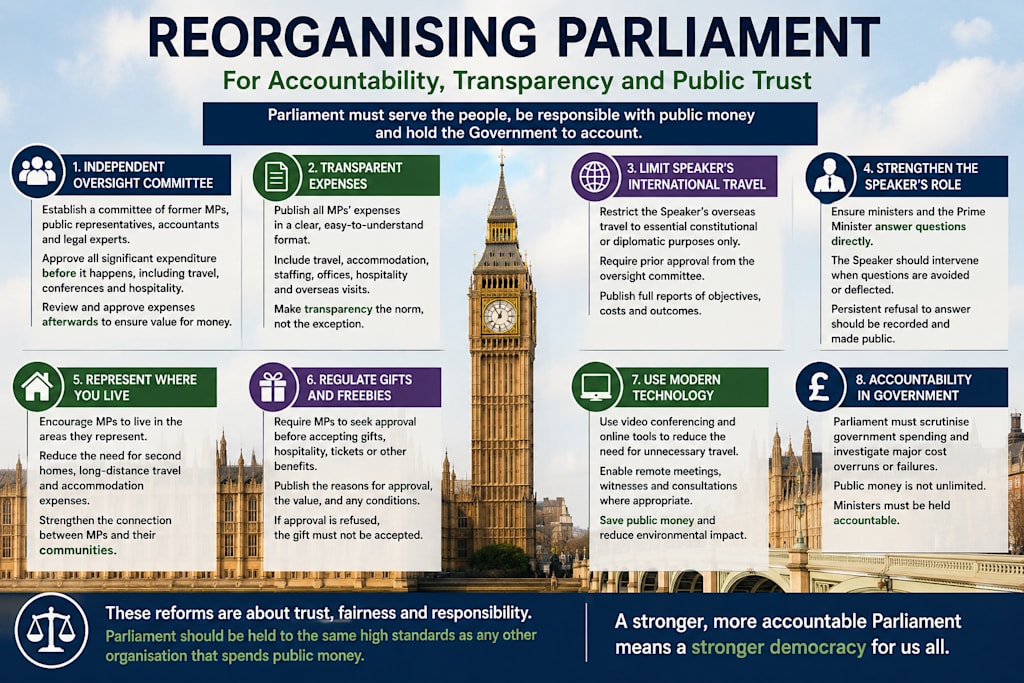
Parliament is one of the oldest democratic institutions in the world, yet many of its working practices would be unrecognisable in any modern business or public organisation. Every year, taxpayers fund millions of pounds in expenditure on salaries, travel, accommodation, overseas visits, offices, staffing, and countless other costs, yet many people believe there is insufficient independent oversight of how this money is spent. Public confidence has suffered for years because of repeated stories involving expenses, free gifts, overseas trips and the perception that politicians operate under a different set of rules from everyone else. Perhaps it is time to redesign Parliament so that it reflects the expectations of the people who pay for it.
One of the most significant reforms would be the creation of an Independent Parliamentary Oversight Committee. Rather than being dominated by serving politicians, this body should comprise respected former Members of Parliament from different political parties, former judges, senior accountants, business leaders, and members of the public with recognised experience in finance, ethics, and public administration. Their role would not be political. Instead, they would act as guardians of taxpayers' money.
Before any significant expenditure takes place, including overseas travel, conferences, fact-finding missions or expensive hospitality, Members of Parliament should be required to submit a business case explaining why the expenditure is necessary, what benefit it will bring to the United Kingdom and why alternative methods, such as video conferencing or delegation to embassy staff, would not achieve the same objective. Only after receiving approval from the committee should public money be committed.
The same principle should apply after the event. Expenses should not simply be reimbursed automatically. Every claim should be independently reviewed to ensure that the expenditure matched what had been authorised and represented value for money. Claims that fail to meet those standards should be rejected.
Transparency should become the default rather than the exception. A publicly accessible website should list every Member of Parliament's expenditure in a simple format that any taxpayer can understand. Travel, accommodation, staffing costs, office expenses, overseas visits and hospitality should all be published regularly with clear explanations. In the private sector, shareholders expect accountability from company directors. Taxpayers deserve no less from those elected to spend public money.
Another area that deserves serious examination is where Members of Parliament choose to live. While there will always be exceptions, there should be a strong expectation that MPs represent constituencies close to where they have established their homes and communities. This would reduce claims for second homes, hotels and long-distance travel while encouraging representatives to have a genuine understanding of the communities they serve. Living among the people who elected them would strengthen the connection between Parliament and the electorate.
The role of the Speaker also deserves careful review. The Speaker occupies one of the highest constitutional offices in the country and is expected to remain completely impartial. International travel undertaken by the Speaker should therefore be restricted to occasions where there is a clear constitutional or diplomatic purpose that cannot reasonably be fulfilled by another representative. Any overseas visit should require prior approval from the independent oversight committee, together with a published report explaining the objectives, costs, and outcomes.
Perhaps the Speaker's most important responsibility is to ensure that Parliament properly holds the Government to account. During Prime Minister's Questions and ministerial statements, MPs often ask straightforward questions, yet ministers frequently avoid giving straightforward answers. Instead, they deliver prepared political speeches or change the subject altogether.
Too often, the Speaker allows this to happen and moves on to the next question without requiring the minister or the Prime Minister to answer the actual question. If Parliament is to scrutinise the Government effectively, the Speaker should insist that questions receive relevant answers rather than allowing ministers to avoid accountability. The Speaker should have explicit authority to intervene whenever a question has clearly not been answered. Ministers and the Prime Minister should be required either to answer the question directly or explain why they are unable to do so. Persistent refusal should be formally recorded and published. Parliament exists to hold the Executive to account, not to provide opportunities for political theatre.
The acceptance of gifts, hospitality, sporting tickets and other benefits should also be brought under tighter control. While registers of interests already exist, many members of the public question whether simply declaring gifts is sufficient. Before accepting expensive hospitality, overseas travel funded by third parties or tickets to major sporting and entertainment events, Members of Parliament should obtain advance approval from the independent committee. The committee would consider whether accepting such benefits might reasonably create either a conflict of interest or the appearance of one.
Where approval is granted, the reasons should be published together with the estimated value of the gift and any conditions attached. Where approval is refused, the gift should not be accepted. This approach would help protect both Parliament and individual MPs from allegations of undue influence.
The committee should also conduct annual performance reviews of parliamentary expenditure, identifying opportunities to achieve savings without reducing democratic representation. Modern technology now makes many meetings possible through secure video links, reducing the need for unnecessary travel. Parliamentary committees could hear international witnesses remotely, experts could appear online, and many administrative meetings could be conducted without expensive journeys across the country or around the world.
There should also be greater financial accountability within government departments themselves. When ministers approve expensive projects that later fail or overrun their budgets by substantial amounts, Parliament should be able to investigate whether proper financial controls were followed. Public money should never be regarded as an unlimited resource simply because it comes from taxpayers.
Critics may argue that additional oversight would create bureaucracy, yet every major company already requires expenditure to be authorised before money is spent. Local councils, charities and public bodies all operate under financial controls designed to protect public funds. It is difficult to justify why Parliament itself should be subject to lower standards than organisations spending far less money.
Most Members of Parliament work hard and serve their constituents conscientiously. These reforms are not based upon the assumption that MPs are dishonest. Instead, they recognise that public confidence is strengthened when robust independent safeguards exist. Honest representatives have nothing to fear from greater transparency and accountability.
Trust in politics has declined steadily over recent decades. Restoring that trust requires more than promises. It requires visible reforms that demonstrate Parliament understands it is spending the public's money rather than its own. Independent financial oversight, genuine transparency, tighter regulation of gifts, stronger scrutiny of ministers and a renewed focus on local representation would not solve every problem, but they would send a powerful message that Parliament exists to serve the people rather than itself.
Democracy depends not only on free elections but also on public confidence that those elected act responsibly, honestly, and with respect for the taxpayers who fund the entire system. Reorganising Parliament along these lines would be a significant step towards rebuilding that confidence for future generations.
About the Creator
Alan Spencer
Have been an author and writer for over 20 years. Have been a journalist, editor, proofreader, and a designer and presenter of training courses. Have written over 100 articles, two books, and around 20 training courses.
Enjoyed the story? Support the Creator.
Subscribe for free to receive all their stories in your feed. You could also become a paid subscriber, letting them know you appreciate their work.
Comments
There are no comments for this story
Be the first to respond and start the conversation.