
Prince Harry's Work With Veterans Reveals a Purpose Beyond the Headlines
His recent visit to Ukraine brought renewed attention to a cause that has shaped his life for years: helping wounded service members find strength, support, and a future beyond injury.

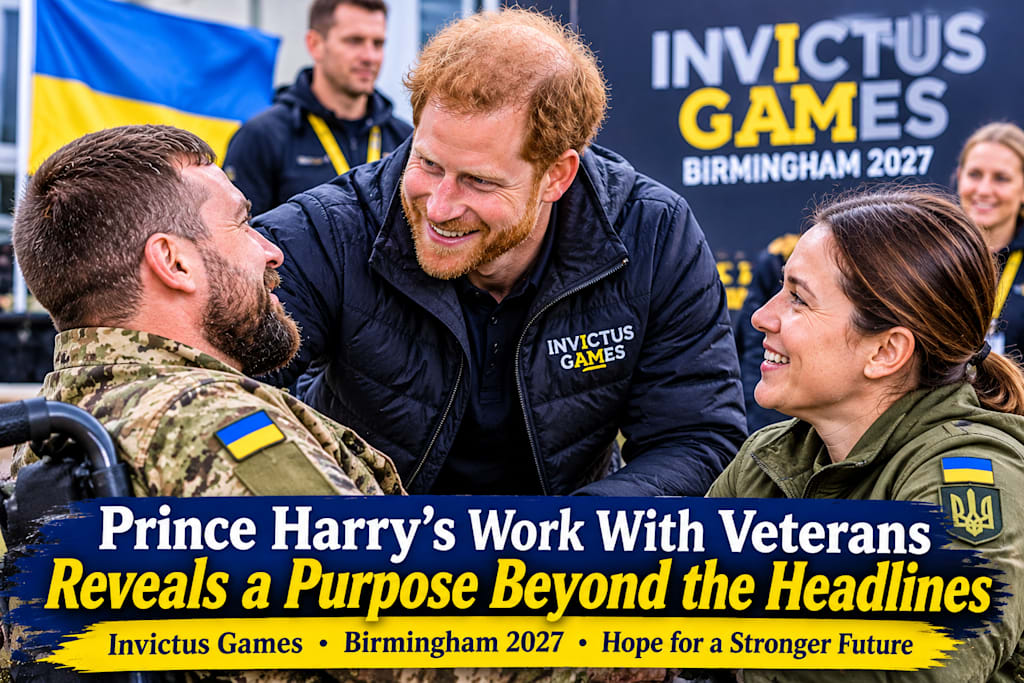
Prince Harry's name is rarely absent from the headlines. His relationship with the royal family, his life with Meghan Markle, and his decisions since stepping away from royal duties have generated years of public debate.
But there is another part of his story that has remained consistent: his connection to military veterans.
During his recent visit to Ukraine, Harry met injured service members and people involved in their rehabilitation. The visit was not simply a public appearance. It brought attention to the difficult realities faced by people whose lives have been changed by war—and to the work Harry has spent years supporting.
For him, the subject is personal. For the veterans he met, the challenges are immediate and deeply individual.
A connection shaped by military service
Harry served in the British Army for ten years, including deployments to Afghanistan. His experience gave him an understanding of military life that continued to influence his work after he left active service.
In 2014, he founded the Invictus Games, an international sporting event for wounded, injured, and sick service personnel and veterans.
The idea was to create a platform where recovery could be recognized as a journey rather than a single achievement. Through adaptive sports, competitors have opportunities to rebuild confidence, challenge themselves, and connect with people who understand their experiences.
The Games do not promise that sport can erase trauma or physical injuries. Instead, they offer an environment where participants can discover what remains possible.
That distinction matters. Recovery is rarely simple, and no two veterans experience it in exactly the same way.
Ukraine: meeting people behind the statistics
Harry's recent visit to Lviv brought him face-to-face with Ukrainian veterans affected by the ongoing war.
During the trip, he visited rehabilitation facilities and met people working to support injured service members. Ukraine has faced an enormous need for medical treatment, prosthetics, rehabilitation, and long-term assistance as the conflict continues.
Behind every statistic is a person whose life may have changed suddenly: someone learning to walk again, adapting to a prosthetic limb, returning to family life, or trying to find a new sense of purpose.
These experiences can be difficult to understand from a distance. Meeting people directly allows conversations to move beyond numbers and headlines.
Harry's visit also connected Ukraine's veteran community with the international network created through the Invictus Games. Ukrainian competitors are preparing to participate in Birmingham 2027, providing another opportunity to share their experiences with an international audience.
Why sport can matter after injury
For a wounded veteran, returning to sport may involve challenges that were unimaginable before an injury.
An activity that once seemed ordinary—running, swimming, cycling, or competing as part of a team—may require new equipment, different techniques, and months of rehabilitation.
Adaptive sport creates opportunities to participate according to an individual's abilities. It also provides something that can be difficult to find during recovery: a goal.
Training for a competition can help establish routines, encourage progress, and create connections with other participants.
The value is not limited to medals or results. Sometimes, the achievement is simply discovering a new ability, becoming more confident, or feeling part of a team again.
That is the principle at the heart of the Invictus Games.
The importance of being understood
Veterans returning to civilian life may face a range of challenges, including physical injuries, psychological difficulties, changes in employment, and adjustments within their families.
Support from medical professionals is essential, but connection can also play an important role.
Meeting someone who has experienced similar challenges may reduce feelings of isolation. A team can offer encouragement without requiring every experience to be explained. Family members can also find support from others who understand the pressures of caring for an injured loved one.
The Invictus Games bring these connections into a public setting, allowing participants to demonstrate their strength without reducing their experiences to inspirational slogans.
Their stories are often complicated. Recovery can include progress, setbacks, frustration, and hope—all at the same time.
Birmingham 2027: another opportunity to tell their stories
The next Invictus Games will take place in Birmingham, England, from July 10 to 17, 2027.
The event will bring together competitors from different countries, with sport providing a shared language across national and cultural differences.
For Harry, Birmingham represents another stage in the project he founded more than a decade ago. For competitors, it may represent months or years of preparation and a chance to meet others who have followed similar paths.
The Games will also give audiences an opportunity to hear stories that are often missing from everyday news coverage—stories about rehabilitation, determination, family support, and life after military service.
A purpose that continues
Prince Harry's public life has changed considerably over the years. His role within the royal family is different, his home life has evolved, and his work now spans several causes and organizations.
Yet his involvement with wounded veterans remains one of the most recognizable parts of his charitable work.
His recent visit to Ukraine returned that mission to the public conversation, but the significance of the work does not depend on a headline or a royal appearance.
It depends on the people receiving support, the families standing beside them, and the opportunities available as they rebuild their lives.
The Invictus Games cannot solve every challenge facing veterans. But they can provide a platform, a community, and a reminder that injury does not have to define the future.
And sometimes, the most meaningful form of support is not telling someone how strong they are.
It is standing beside them while they discover their strength for themselves.
Beyond the headlines, that may be the lasting purpose of Prince Harry's work with veterans.
About the Creator
Behind the Curtain
"Exploring the untold stories and hidden truths. From royal rumors to cultural deep dives, Behind the Curtain brings you bold, insightful narratives that spark curiosity and conversation."
Enjoyed the story? Support the Creator.
Subscribe for free to receive all their stories in your feed.
Comments
There are no comments for this story
Be the first to respond and start the conversation.