
Prince Harry’s Quiet Remembrance Sunday Appearance Sends a Powerful Message: The Moment That Spoke Without Words
While King Charles and Prince William stood before the nation at London’s Cenotaph, the Duke of Sussex chose a different setting. His unexpected appearance in a small English town has raised questions about remembrance, military service, and his place in Britain.

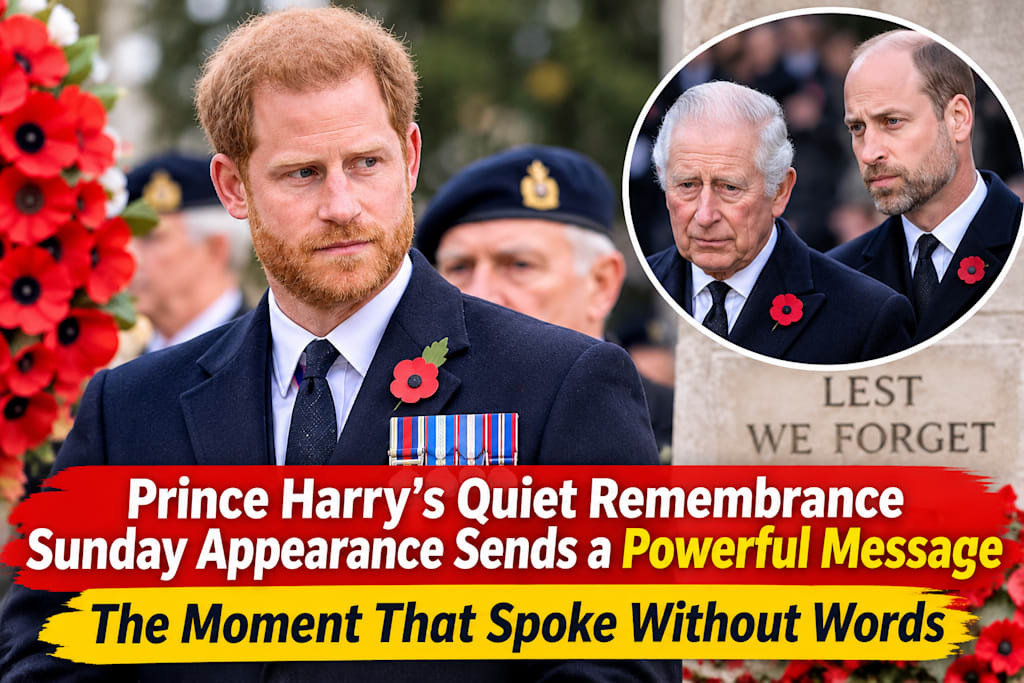
Sometimes the most meaningful public appearances are the ones that make the least noise.
There was no grand royal procession. No television cameras waiting for a speech. No official announcement telling the public where he would be.
Instead, Prince Harry was seen standing among ordinary residents in a small English town, wearing his military medals and a red remembrance poppy.
On Sunday, November 8, the Duke of Sussex quietly attended a Remembrance Sunday service in Brackley, Northamptonshire. Thousands of miles of headlines and years of family tension could not change the meaning of the day: remembering those who gave their lives in military service.
But Harry’s decision to attend a local ceremony, while the rest of the senior royal family gathered in London, made the moment especially significant.
A Different Kind of Remembrance
Across Britain, Remembrance Sunday is one of the most important dates on the national calendar.
Every year, people gather at war memorials to honor members of the armed forces who lost their lives in conflicts. At the Cenotaph in Whitehall, London, the King traditionally leads the national ceremony.
This year, King Charles III laid the first wreath, followed by his eldest son, Prince William. Other senior members of the royal family and national leaders also took part.
Harry, however, was not in London.
According to reports, he attended the service in Brackley, where photographs showed him standing among members of the public and speaking with local residents.
It was a striking contrast: one ceremony surrounded by the traditions of the monarchy, and another attended by a prince who chose to stand with a local community.
Yet both gatherings shared the same purpose.
Remembering those who served.
Why This Day Matters to Harry
For Prince Harry, military remembrance is not simply another royal tradition.
He spent approximately ten years in the British Army, reached the rank of Captain, and served two tours in Afghanistan.
His military experience became an important part of his identity. After leaving active service, he continued supporting veterans through the Invictus Games, the international sporting competition he founded for wounded, injured, and sick service personnel and veterans.
That background helps explain why Remembrance Sunday carries personal meaning for him.
The medals he wore in Brackley were more than decorations. They represented a chapter of his life that continues to shape his work and public identity.
Although Harry no longer performs official royal duties, his connection to military communities has remained visible through his charitable work.
His appearance was therefore not simply about being seen in Britain. It was also an opportunity to honor people whose experiences he understands personally.
Why Was He Not at the Cenotaph?
This is where the story becomes more complicated.
Harry and Meghan stepped back from their roles as senior working royals in 2020. Since then, their relationship with the royal institution has remained strained.
Although the couple returned to Britain in August 2026, they have not resumed working royal duties.
The distinction matters because the official Remembrance ceremony at the Cenotaph is closely connected to the King's constitutional and ceremonial role, as well as the responsibilities of working members of the royal family.
Harry's absence from the national ceremony was therefore not necessarily a surprise.
However, his decision to attend a local service offered a different way to participate.
Town & Country reported that a source close to Harry said he did not want to draw attention away from the national commemorations in London.
That explanation has an important implication: a public tribute does not always need to take place on the biggest stage.
The Welcome From Local Residents
Perhaps the most interesting part of Harry's appearance was the reaction in Brackley.
According to Town & Country, the chairman of the town's Royal British Legion thanked the prince for attending. The message praised the fact that Harry had made no formal announcement and had not requested special treatment.
He simply stood with the community, wearing his medals and paying his respects.
That detail gives the appearance a more personal dimension.
For a public figure whose every move can become a national conversation, choosing a quieter setting can carry its own significance.
There were no major announcements about the royal family. No claims of reconciliation. No dramatic statements about the future.
There was simply a man attending a remembrance service.
And perhaps that is why the moment attracted attention.
A Royal Family Still Moving on Separate Paths
The contrast between Harry's appearance and the London ceremony also reminded observers that the family situation remains unresolved.
King Charles and Prince William continued their public roles at the Cenotaph, while Harry attended a separate community event.
It would be easy to interpret the two ceremonies as another chapter in the royal family's divisions. But that interpretation risks overlooking the purpose of the day.
Remembrance Sunday is about the people who served and sacrificed, not about royal disagreements.
There is also no public evidence that Harry's attendance in Brackley represented a new agreement or reconciliation with his father or brother.
For now, the facts are simpler: the royal family marked the occasion in London, and Harry paid his respects in Northamptonshire.
The Meaning Behind a Quiet Moment
Prince Harry's appearance may not change the relationship between him and the royal family overnight.
It may not transform public opinion, either.
But it offered a reminder that service and remembrance can exist beyond official titles, royal ceremonies, and palace invitations.
A person does not need to stand at the center of a national event to honor those who came before them.
Sometimes, standing quietly among neighbors is enough.
And perhaps that is the most powerful part of Harry's Remembrance Sunday appearance: for a few moments, the attention was not on royal titles or family disagreements.
It was on the people who should never be forgotten.
What do you think of Harry's decision to attend a local Remembrance Sunday service rather than the national ceremony in London? Was it a respectful choice to keep the focus on remembrance, or should he have been included in the main royal event?
About the Creator
Behind the Curtain
"Exploring the untold stories and hidden truths. From royal rumors to cultural deep dives, Behind the Curtain brings you bold, insightful narratives that spark curiosity and conversation."
Enjoyed the story? Support the Creator.
Subscribe for free to receive all their stories in your feed.
Comments
There are no comments for this story
Be the first to respond and start the conversation.