
Prince Harry's Powerful Warning to Tech Companies: Children Deserve Protection Before It's Too Late
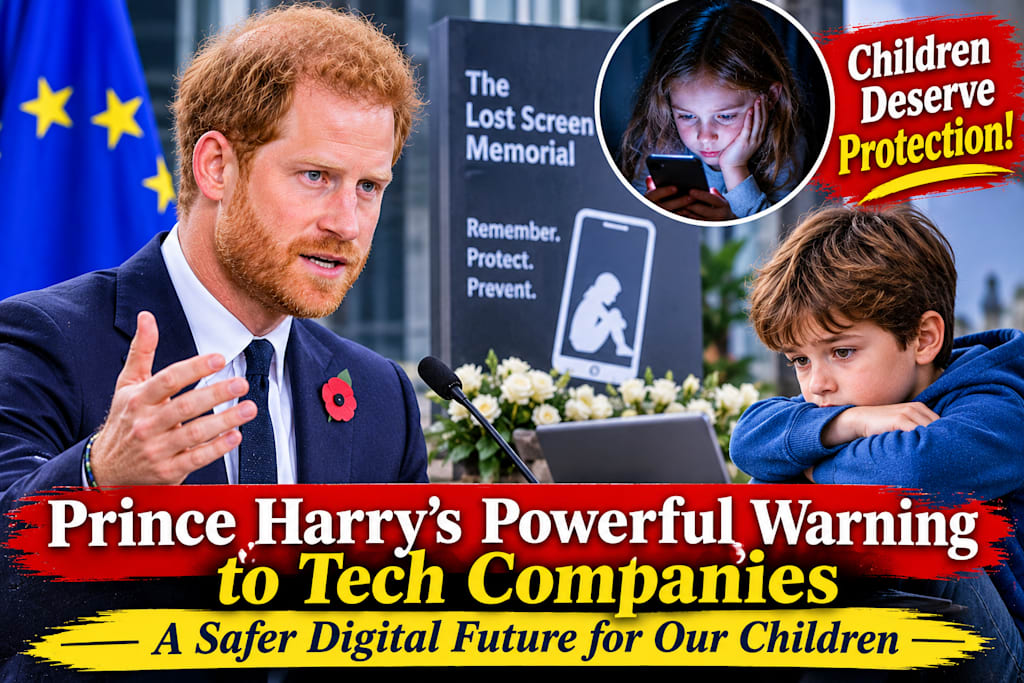
At a memorial in Brussels, the Duke of Sussex delivered a message that reaches far beyond the royal family: the digital world must become safer for the children growing up inside it.

A child can be sitting in a bedroom, surrounded by familiar walls, and still be exposed to dangers that parents cannot see.
A phone may look harmless. A social media account may appear ordinary. A video may seem like nothing more than entertainment. Yet behind a screen, children can encounter harmful content, manipulation, bullying, and experiences they may not know how to explain to an adult.
That is the issue Prince Harry brought into focus during his appearance in Brussels this November.
Rather than speaking about royal disagreements or his personal life, the Duke of Sussex used his platform to call attention to children's safety online—and to challenge technology companies to take greater responsibility for the environments they create.
His message was direct: protecting children in the digital world cannot remain an afterthought.
A memorial that tells stories technology cannot erase
Harry attended the opening of the Lost Screen Memorial at the European Parliament in Brussels on November 10.
The memorial honors children who have died following harm connected to social media and digital experiences. Its design features representations of smartphones, with images of children displayed on their screens—an unsettling reminder of how devices that have become part of everyday life can also be connected to painful experiences.
The purpose was not simply to remember those children. It was to encourage people to confront the consequences of online harm and consider how it can be prevented.
For parents, the subject can be frightening. Children increasingly use digital platforms for education, entertainment, communication, and friendships. The internet offers opportunities that previous generations never had, but it also presents risks that are difficult for families to monitor completely.
The memorial brought those realities into a public space where policymakers, technology representatives, and visitors could not easily ignore them.
Harry spoke as a father, not an expert
Harry's speech was especially personal.
He emphasized that he was not approaching the issue as a technology expert or politician, but as a father. That distinction shaped the tone of his message.
Parents do not need technical knowledge to understand the fear of discovering that their child has encountered something harmful. They want to know their children are safe, that someone will listen when problems occur, and that companies whose platforms children use are taking those concerns seriously.
Harry called for greater transparency, accountability, and responsibility from technology companies.
His message was not that technology should disappear from children's lives. The digital world is already part of modern childhood. The challenge is to make it safer, to give families meaningful support, and to ensure that protecting young users is treated as a priority.
When parents are left searching for answers
One of the most difficult issues raised during the event involved parents seeking information after losing children.
Harry highlighted cases in which bereaved parents faced barriers when trying to access information from their children's phones because of company privacy policies and restrictions.
For families already dealing with unimaginable grief, the struggle to obtain answers can become another source of pain.
The question is complicated. Digital privacy matters, and personal information must be protected. But families also need appropriate processes when serious circumstances require information to be examined.
The challenge for technology companies and policymakers is finding ways to protect privacy while responding compassionately and responsibly to families facing tragedy.
It is a conversation that deserves careful attention rather than easy answers.
Meghan was there, even though she did not speak
Meghan Markle was also present in Brussels with Harry.
The couple had originally been expected to speak together, but Meghan withdrew from the speaking program. She nevertheless attended the event alongside her husband.
Their appearance attracted additional media attention because it was their first public appearance following the news concerning Meghan's estranged father.
However, the memorial itself remained focused on children, digital safety, and the families affected by online harm.
For Harry, delivering the speech alone meant taking responsibility for the message at a moment when the subject had become especially personal for the couple.
It was a reminder that public advocacy can sometimes continue even when circumstances outside the event are difficult.
The responsibility of the digital world
The internet has changed childhood in ways that are still being understood.
Children can learn languages, discover science, create art, connect with friends, and explore interests through digital platforms. But the same technology can expose them to disturbing content, harmful interactions, and pressures they may struggle to manage.
Parents cannot solve every problem by simply taking away phones. Schools cannot address every risk through occasional lessons. And technology companies cannot treat safety as a responsibility that belongs entirely to families.
A more effective approach requires cooperation.
Parents need tools and clear information. Children need education about online risks and the confidence to seek help. Schools need resources. Governments need thoughtful policies. Technology companies need systems that respond to harm and are transparent about how they protect young users.
No single solution will make the internet completely safe. But meaningful improvements can reduce risks and make it easier for children to receive support when something goes wrong.
A message that deserves to continue beyond Brussels
Prince Harry's appearance may last only a few minutes in the news cycle, but the issue he addressed is much larger than one speech or one public figure.
Every day, families make decisions about screen time, social media, online games, privacy, and the age at which children should begin using digital platforms.
Many parents feel they are trying to keep up with technology that changes faster than the guidance available to them.
The Lost Screen Memorial asks people to pause and remember that behind discussions about algorithms, platforms, and policies are real children and real families.
That is what makes the conversation important.
The goal should not be to create fear about every phone or every online experience. It should be to make the digital world a place where children can learn, communicate, and grow without being left vulnerable to preventable harm.
Prince Harry's message in Brussels was ultimately a call for responsibility.
Technology may continue to advance. Children may continue to spend more of their lives online. But progress should never be measured only by what devices and platforms can do.
It should also be measured by how well they protect the people who use them.
A safer digital future will not be created by technology alone. It will depend on the choices made by the companies, governments, parents, and communities responsible for the next generation.
About the Creator
Behind the Curtain
"Exploring the untold stories and hidden truths. From royal rumors to cultural deep dives, Behind the Curtain brings you bold, insightful narratives that spark curiosity and conversation."
Enjoyed the story? Support the Creator.
Subscribe for free to receive all their stories in your feed.
Comments
There are no comments for this story
Be the first to respond and start the conversation.