
Poland locked its constitutional court. Then the president pushed his way in.
A decade of court packing, one legal shortcut, and a fight over who gets to stand inside the building.
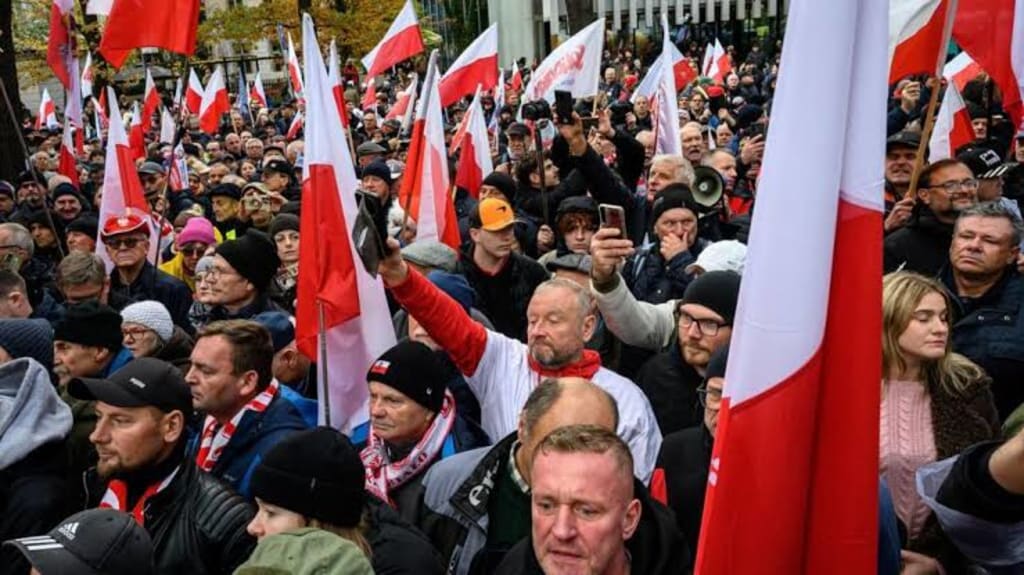
Warsaw, October 30, 2026. The door of the Constitutional Court was locked from the inside. Outside stood police officers in riot gear. Inside was the president of the court, Bogdan Święczkowski. Hours earlier, a judge elected by the parliamentary majority, Anna Korwin-Piotrowska, had invoked Article 130 of the Law on the Organization of Ordinary Courts, suspended Święczkowski and his deputy, and declared herself acting president. The court’s official social media account called it a “coup” and said the website had been illegally seized.
At the same time, a government plane bound for Senegal turned around. President Karol Nawrocki wrote on social media: “At a moment like this, the president must be in Poland.” By early morning he was at the court building. Television cameras showed him pushing past Korwin-Piotrowska and judges in the hallway, then squeezing into the main hall. Officers of the State Protection Service briefly scuffled with police enforcing the lockdown.
No one explained why a locked door, a shove, and a social media post should decide who controls the Constitutional Court. Everyone understood the same thing: whoever stands inside the building is, for that moment, on stage.
Ten years of filling
The fuse was lit in 2015. Law and Justice won a parliamentary majority and immediately collided with the outgoing Civic Platform government over appointments to the Constitutional Court. Civic Platform had appointed two judges before the election. Law and Justice refused to recognize them and appointed replacements. Law and Justice then challenged three judges the court had already recognized and filled the vacancies with its own candidates. The double appointments opened a spiral that ran for nearly a decade.
By the time Law and Justice lost power in 2023, most of the court’s fifteen judges had been appointed by the party or were close to it. The Court of Justice of the European Union and the European Court of Human Rights repeatedly criticized the court’s proximity to political power. Tusk returned to office in late 2023 promising to “restore the rule of law.” He found a court stacked by his predecessor and a directly elected president from the opposing camp, first Andrzej Duda, then Karol Nawrocki, with veto and appointment powers.
The reverse filling followed. If the parliamentary majority has the right to elect Constitutional Court judges, Tusk’s camp would use that right to dilute the Law and Justice majority. This year, parliament elected eight new judges. Nawrocki refused to swear in some of them, citing flawed appointment procedures. The new judges took an oath before parliament and argued that when the president obstructs without cause, a parliamentary oath is enough. Święczkowski and the court’s old leadership refused to recognize them and barred them from hearing cases. The court stopped working.
Both sides used procedure. Law and Justice used its parliamentary majority to fill the court. Tusk used his parliamentary majority to fill it back. Nawrocki refused to administer an oath. Święczkowski locked a door. Each step had a legal argument attached. Each step also chipped away at the idea that the court was anything more than a prize.
Article 130
The immediate legal basis for suspending the court’s president was Article 130 of the Law on the Organization of Ordinary Courts. The provision allows a judge to be temporarily suspended if his conduct “seriously undermines the dignity of the court or the essential interest of the office.” Korwin-Piotrowska cited it, accusing Święczkowski and his deputy of unlawfully blocking judges elected by parliament and deliberately delaying a full assembly of the court.
The problem is that the Law on Ordinary Courts governs ordinary courts, not the Constitutional Court. The discipline, suspension, and presidential powers of Constitutional Court judges have their own framework in the Polish Constitution and the Law on the Constitutional Court. Using a statute written for district and appellate judges to suspend the president of the Constitutional Court is, in legal doctrine, a cross-system application. Marcin Matczak, a lawyer long critical of Law and Justice’s judicial reforms, told the BBC that Święczkowski “may be the worst president in the history of the Constitutional Court,” but that the suspension had “no legal basis” and that its long-term consequences could be harder to repair than the party’s damage.
This does not make Święczkowski’s conduct clean. Refusing to recognize judges elected by parliament, barring them from the building, and turning the court into a paralyzed institution are also uses of procedure to produce a stalemate. But Tusk’s government produced a sharper precedent: if the executive can use an unrelated statute, a single judge’s order, and police officers to physically replace the court’s leadership, then the court’s boundary as an independent institution is no longer drawn by the constitution. It is drawn by whoever controls the Interior Ministry and the police.
Tusk defended the move with a sentence that was politically complete and constitutionally dangerous: “Restoring the rule of law is our duty. After years of lawlessness by Law and Justice, this is a difficult, sometimes painful process that requires decisive action. There is no other way.” The sentence sets “restoring the rule of law” above existing legal procedure. Law and Justice spent eight years using the same grammar, with “sovereignty” or “the will of the people” in the place of “the rule of law.”
Two mandates, one node
Poland is often described as a semi-presidential system. The label is contested. In comparative politics, Poland is sometimes classified as a parliamentary republic because the cabinet is responsible to parliament and the prime minister runs day-to-day government. The 1997 constitution narrowed presidential appointment powers. Others put it closer to semi-presidentialism because the president is directly elected and holds a veto and appointment powers. The label debate hides the operational problem: a directly elected president has an independent popular mandate, and so does a parliamentary majority.
In Germany or India, the president is not directly elected. The office is designed to be symbolic and restrained. When the president and the parliamentary majority come from different camps, convention requires the president not to use theoretical powers. In Poland, the president can tell the prime minister: I also have a mandate from the people. Nawrocki’s shove in the court hallway turned that claim into a visible act. The prime minister controlled the police and the administrative machine. The president’s body represented a second chain of legitimacy.
This is the structural root of the conflict. In France, a directly elected president who faces an opposing parliamentary majority can dissolve the National Assembly or appoint a prime minister who fits the majority, turning the conflict into a new popular vote. In Poland, the president cannot easily dissolve parliament, and the prime minister cannot remove the president. The prime minister is responsible to parliament, not to the president. Each side holds part of the power. Neither has a clear, institutionalized way to end the fight. So the fight does not resolve. It recurs, and each recurrence uses up more of the institution’s legitimacy.
The international split
The European Commission’s position was clear, and its clarity was awkward. A spokesperson said the election of the eight Constitutional Court judges “falls within the constitutional powers of the Polish parliament” and cited an interim measure issued by the European Court of Human Rights in May 2026 requiring Polish authorities not to obstruct judges elected by parliament. From Brussels, the story was an elected parliament facing a right-wing president’s obstruction. That fit the EU’s long criticism of Law and Justice.
The position avoided a question: the parliamentary majority’s power to appoint judges and the court’s integrity as an independent institution can collide. When the majority fills a court with police at the door, EU support for “parliamentary power” backs a process that may further weaken judicial independence.
The European Conservatives and Reformists condemned Tusk from the other direction. Co-chair Nicola Procaccini called the government’s action “a clear and serious violation of the rule of law” and “an attack on judicial independence and the constitutional guarantees of Poland.” The logic was consistent: if you opposed Law and Justice’s court packing, you should oppose Tusk’s reverse packing. But the group faced its own blind spot. During eight years of Law and Justice government, the European right rarely criticized Warsaw with the same force.
Washington was deliberately vague. US Ambassador Tom Rose called the situation “very serious” and “an unprecedented confrontation over the government’s use of state power and the independence and authority of constitutional bodies.” He urged restraint. He did not side with either camp. The reason is not hard to find. Nawrocki is not Marine Le Pen or Alternative for Germany. He studied the history of the Polish People’s Republic, was wanted by Russia over the removal of Soviet war memorials, supports a large increase in defense spending, and welcomes US troops in Poland. For traditional Atlanticist hawks, supporting Tusk’s police lockdown of a court is uncomfortable. Supporting Nawrocki’s blockade of judges elected by parliament is also uncomfortable. Silence and “restraint” became the only options that did not split the alliance.
The split exposed a larger problem. When a constitutional crisis runs between two camps that are both “geopolitically correct,” the international rule-of-law vocabulary loses its anchor. Brussels can back Tusk because he is pro-European. But his methods are not cleaner than some of Law and Justice’s operations. The European Conservatives and Reformists can back Nawrocki because he is nationalist and anti-Russian. But blocking judges elected by parliament is also a use of procedure to produce stalemate. Both sides speak the language of the rule of law while doing the work of power. Judicial independence, procedural restraint, and separation of powers become instruments in both narratives.
The body in the building
The image of Nawrocki squeezing into the court hall was compared to Lee Jae-myung climbing the wall of the National Assembly or Juan Guaidó at the border. The comparison captures something real. In a political conflict where legal procedure is contested and no neutral institution can say who is right, physical presence becomes a substitute for legitimacy. The president stands in the hall. The police stand outside. The prime minister speaks on television about restoring the rule of law. Each side tells its supporters: we are the lawful ones.
The price is a court that no longer functions as a referee. The authority of a constitutional court does not come from its building. It does not come from who stands inside. It comes from the willingness of other political actors to accept its rulings, a convention rather than a wall. When the government publicly questions the court’s legitimacy, when the president refuses to perform the constitutional function of administering an oath, when police are used to seal a judicial building, that convention is dismantled piece by piece. Polish public trust in the Constitutional Court had already been damaged by ten years of appointment wars. Even if this crisis ends in a compromise, the court’s image as a last resort will not recover quickly. A court that has been repeatedly shown to be physically controllable by political power will not be treated by political actors as a constraint.
What comes next
Tusk’s gamble may succeed. If it does, Poland will develop a new convention: a constitutional court can be marginalized by executive power in the name of restoring the rule of law. The next government, from any camp, can cite that convention. If it fails, the conflict between presidency and government will enter a longer, lower-intensity phase that consumes more institutional resources. The president keeps blocking appointments. The parliamentary majority keeps looking for the next legal gap. Police keep standing at a building entrance. The court keeps existing as a contested shell.
A worse outcome than either side winning is that both sides’ supporters learn the same lesson: procedure is rhetoric, and buildings and police are power. When enough people believe that, institutions stop being a framework that limits power. They become the ruins left behind when the shooting stops.
By noon the next day, the barricades were still in front of the court. A new shift of officers arrived. One of them set a paper cup of coffee on the hood of a police van. Inside, a cleaner wiped the floor where the scuffle had happened. Outside, police tape flapped against a lamp post. The court’s website was still frozen on the statement calling the takeover a coup.
About the Creator
Jin
Writer of reamstories
https://reamstories.com/jin
Enjoyed the story? Support the Creator.
Subscribe for free to receive all their stories in your feed. You could also become a paid subscriber, letting them know you appreciate their work.
Comments
There are no comments for this story
Be the first to respond and start the conversation.