
One Year Since India and Pakistan’s Secret War — And the Region Has Never Been More Dangerous
The world barely noticed the four-day conflict that nearly went nuclear in May 2025. A year later, both countries are rearming, threatening, and one miscalculation away from catastrophe.
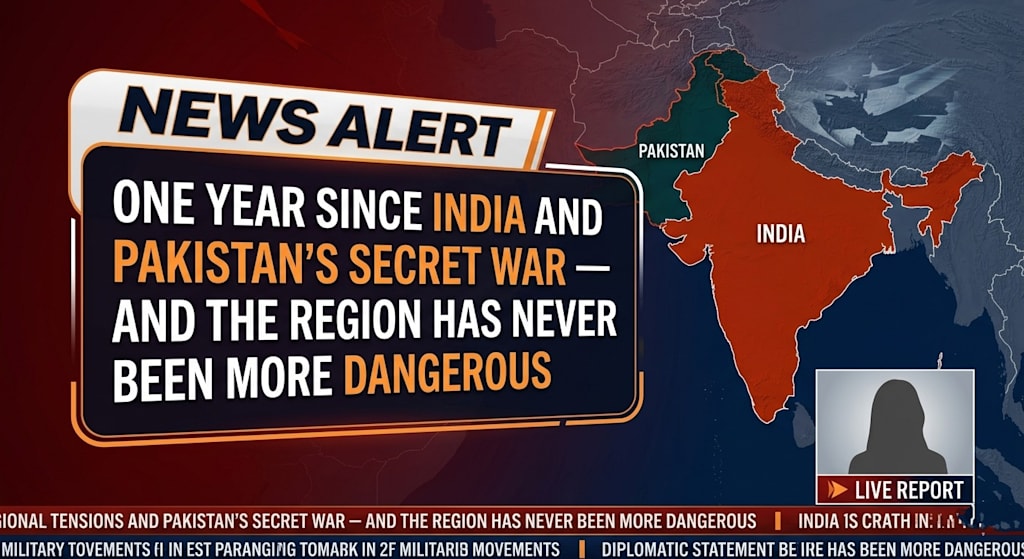
One Year Since India and Pakistan’s Secret War — And the Region Has Never Been More Dangerous
The world barely noticed the four-day conflict that nearly went nuclear in May 2025. A year later, both countries are rearming, threatening, and one miscalculation away from catastrophe.
A year ago this week, South Asia teetered on the edge of nuclear war.
Most of the global media was focused elsewhere. But in the space of four days in May 2025, India and Pakistan exchanged drone strikes, missile attacks, and air combat over one of the most contested borders on earth. It was brief. It was intense. And it ended only because international pressure — led largely by Washington — forced a ceasefire before things spiraled beyond control.
One year later, neither country has moved on. And the world should be paying much closer attention.
What Started It
The trigger was the Pahalgam attack of April 22, 2025, in which Pakistan-backed militants killed 22 civilians in Indian-administered Kashmir. India, under immense domestic pressure to respond, launched Operation Sindoor on May 7 — a series of cross-border strikes targeting what New Delhi described as militant infrastructure inside Pakistan and Pakistan-administered Kashmir.
Pakistan insisted civilian areas were hit and responded within days with Operation Bunyan-un-Marsoos, targeting Indian military installations. For four days, two nuclear-armed nations traded blows from the sky.
In the end, Pakistan sought a ceasefire. India, despite its aggressive opening move, found itself turning to Washington and international capitals to help manage an escalation it could no longer fully control.
What’s Changed in a Year
On the surface: not much. The Line of Control, the de facto border through Kashmir, remains tense. Both sides continue military posturing. The Indus Waters Treaty — a landmark 1960 water-sharing agreement — was suspended by India in the conflict’s aftermath and has not been restored.
Pakistan this week issued a stark warning: it will respond with “full force” to any future Indian attack. Its military says it remains prepared for “future battlespace” conditions. The language is deliberate — designed both for domestic audiences and as a signal to New Delhi.
India, meanwhile, is quietly overhauling its military structure, announcing a new Joint Operations Centre to address the command and coordination gaps exposed during the 2025 conflict. Observers note this is an acknowledgment that something went wrong during the four-day war — and New Delhi wants to be better prepared if there is a next time.
Why the World Cannot Look Away
Here is the cold, hard reality.
Both India and Pakistan possess nuclear weapons. A conventional conflict between them — even a brief one — has the potential to escalate in ways that no one can fully predict or control. The Council on Foreign Relations rated a renewed India-Pakistan conflict as having moderate likelihood going into 2026. An analyst writing this week put it bluntly: “A conflict between Pakistan and India is not confined to borders. It disrupts global trade routes, destabilises financial markets, threatens millions of civilians, and raises the spectre of nuclear risk that the international system is ill-prepared to handle.”
The world is stretched thin right now. Iran, Ukraine, global trade wars — there is barely enough diplomatic bandwidth to manage one major crisis, let alone two simultaneously. And that, ironically, is precisely when South Asia becomes most dangerous.
The warning shot of May 2025 should not be fading from memory. It should be a permanent reminder.
World affairs don’t always make headlines until it’s too late. If this piece gave you insight you didn’t have before, consider leaving a like or tip — it helps me keep writing on stories that matter.
About the Creator
Enjoyed the story? Support the Creator.
Subscribe for free to receive all their stories in your feed.
Comments
There are no comments for this story
Be the first to respond and start the conversation.