
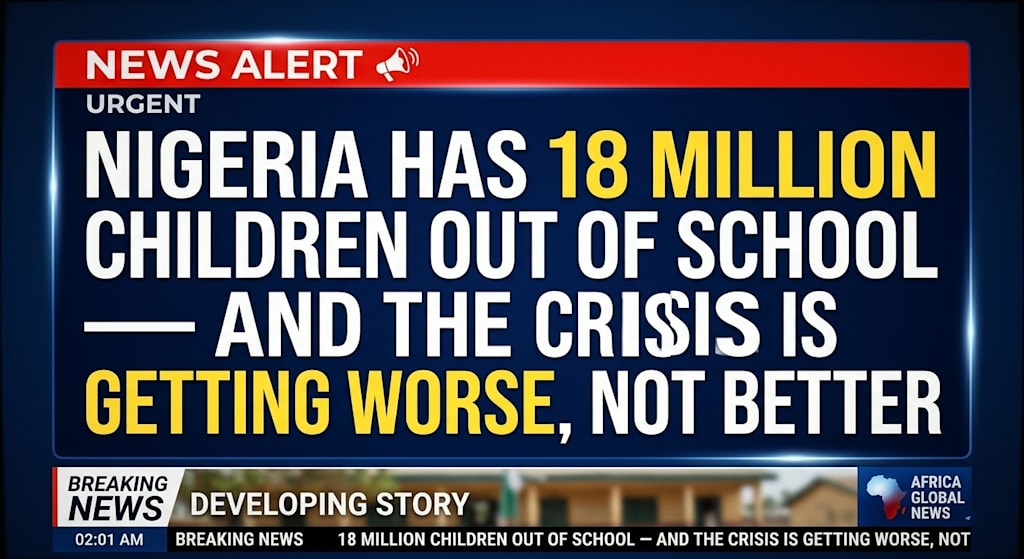
Nigeria Has 18 Million Children Out of School — And the Crisis Is Getting Worse, Not Better
The number is so large that it can be hard to take in: at least 18 million Nigerian children are currently out of school. That is not a rounded estimate or an advocacy figure. It comes from a 2024 UNICEF report that counted 10.2 million primary school-age children and 8.1 million junior secondary school-age children who are not enrolled or not attending school in Nigeria. It is the largest number of out-of-school children of any country on earth, and it has been growing.
The number is so enormous that it risks becoming abstract.
At least 18 million children in Nigeria are currently out of school. Not temporarily absent. Not on holiday. Not waiting for the next term to begin. Entirely outside the education system.
According to a 2024 report by UNICEF, approximately 10.2 million Nigerian children of primary school age and another 8.1 million of junior secondary school age are not enrolled in school or are not attending consistently. No other country in the world currently has a larger population of out-of-school children.
And despite years of government promises, international aid programs, and emergency interventions, the crisis continues to worsen.
A National Emergency Hiding in Plain Sight
The danger of statistics this large is that they can lose their emotional meaning.
But 18 million children is not merely a data point.
It represents classrooms that do not exist, futures interrupted before they begin, and an entire generation growing up without the educational foundation needed to compete in a modern economy.
If those children formed a country of their own, it would have a population larger than several African nations.
Instead, they are scattered across villages, displaced communities, urban slums, refugee settlements, and conflict zones — many spending their days working, wandering, surviving, or hiding from violence rather than learning to read and write.
Violence Has Turned Education Into a Risk
One of the biggest drivers of the crisis is insecurity.
In northwestern Nigeria, armed bandit groups have transformed school attendance into a dangerous act. Communities across Zamfara, Katsina, Sokoto, Kebbi, and parts of Kaduna have experienced repeated raids, kidnappings, and attacks targeting both civilians and educational institutions.
Parents have watched children abducted from dormitories and classrooms. Teachers have fled rural communities after repeated threats. Entire schools have shut down because local authorities could no longer guarantee safety.
The trauma runs deep.
For many families, sending a child to school no longer feels like a path toward opportunity. It feels like a gamble with their life.
Mass kidnappings over the past several years intensified that fear dramatically. The abduction of hundreds of schoolchildren by armed groups shocked the nation and exposed how vulnerable rural educational systems had become. Some communities responded by keeping children permanently at home. Others relocated them to relatives in safer cities — if they could afford to.
The result is a generation whose education has been suspended by fear.
Boko Haram’s Long Shadow
In northeastern Nigeria, the situation is even more devastating.
The insurgency involving Boko Haram and ISWAP has now lasted more than 17 years. The conflict has killed tens of thousands of people and displaced millions across Borno, Yobe, and Adamawa states.
But one of the insurgency’s most destructive consequences has been its attack on education itself.
The name Boko Haram is commonly interpreted as “Western education is forbidden.” Schools were not accidental casualties of the conflict; they were deliberate targets.
Classrooms were burned. Teachers were murdered. Students were abducted. Educational infrastructure collapsed across entire districts.
Many children who should have spent their formative years learning mathematics, science, and language instead grew up inside displacement camps or conflict zones where formal schooling barely existed.
For some, years of education were simply erased.
Poverty Keeps the Crisis Alive
Even in relatively peaceful areas, poverty remains the most persistent barrier to education.
Public education in Nigeria is theoretically free in many places, but the reality is more complicated. Families still face costs for uniforms, transportation, books, meals, exam fees, and supplies.
For households already struggling with inflation, unemployment, and food insecurity, those costs become impossible burdens.
Many children are pulled from school to work instead.
Some hawk goods on the streets. Others help on farms, work in markets, or take informal jobs to support family survival. In urban areas, economic hardship has pushed increasing numbers of children into street trading and domestic labor.
Education becomes a luxury families cannot sustain.
Girls Face an Even Steeper Battle
The crisis affects girls disproportionately.
In several northern states, cultural expectations, insecurity, and early marriage practices combine to reduce female school attendance dramatically. When resources are scarce, boys are often prioritized for education while girls are expected to remain home.
In conflict areas, parents may also fear sexual violence or abduction targeting girls traveling long distances to school.
The consequences are generational.
Girls denied education are more likely to marry early, face health risks associated with teenage pregnancy, remain economically dependent, and experience long-term poverty. Their future children are also statistically less likely to receive proper education and healthcare.
The cycle repeats itself across generations.
A Crisis With National Security Consequences
The education crisis is not only humanitarian.
It is also deeply tied to Nigeria’s long-term security and economic stability.
Young people without access to education or employment opportunities are more vulnerable to recruitment by criminal networks, extremist groups, and armed militias. In regions already suffering from insecurity, the absence of schools helps fuel the very instability keeping schools closed.
It becomes a self-reinforcing cycle:
Violence disrupts education. Lack of education deepens poverty and instability. Instability creates more violence.
Breaking that cycle requires more than speeches or temporary interventions.
The Gap Between Policy and Reality
Successive Nigerian governments have announced education reforms, budget commitments, and enrollment initiatives. Some state governments have genuinely expanded school feeding programs, built classrooms, and recruited teachers.
But implementation remains inconsistent.
Education advocates repeatedly warn that money allocated on paper often fails to reach the schools most in need. Rural communities continue operating with overcrowded classrooms, unpaid teachers, collapsing buildings, and almost no security infrastructure.
Meanwhile, humanitarian agencies warn that the crisis is approaching irreversible scale.
UNICEF and local advocacy groups are now calling for emergency-level intervention, arguing that Nigeria cannot treat 18 million out-of-school children as a normal developmental challenge.
Because this is no longer merely an education issue.
It is a question about what kind of future Nigeria is preparing for itself.
Right now, millions of children are growing up without the tools to fully participate in the country’s economy, democracy, or institutions.
And every year the crisis continues, the cost becomes harder — and more expensive — to reverse.
About the Creator
Enjoyed the story? Support the Creator.
Subscribe for free to receive all their stories in your feed.
Comments
There are no comments for this story
Be the first to respond and start the conversation.