
Netanyahu Just Said He Wants to Cut U.S. Military Aid to Israel to Zero. Strategically, It Makes Sense. Diplomatically, It Is a Bombshell. Here Is Why.
Israel currently receives $3.8 billion a year in U.S. military assistance — the largest such package to any country in the world. Netanyahu told CBS he wants to reduce that to zero. It sounds like breaking up with your biggest ally. It is actually something else entirely. Here is the strategic logic — and what it changes.
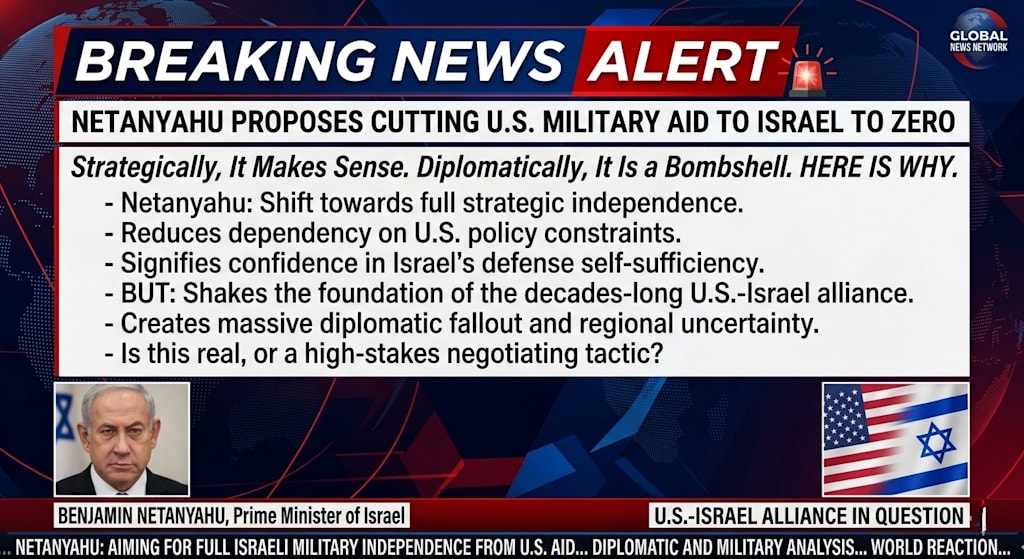
In an interview that has reverberated across global diplomatic circles this week, Israeli Prime Minister Benjamin Netanyahu told CBS News that the time has come for Israel to wean itself from U.S. military assistance — reducing the annual aid package of $3.8 billion, the largest American military assistance program to any country on earth, to zero. "It's time we weaned ourselves from the remaining military support" from the US, Netanyahu said, telling CBS that he wants to reduce the funding "to zero." The statement, which would have been politically unimaginable in any previous era of U.S.-Israel relations, is being interpreted by analysts and diplomats as simultaneously a statement of genuine strategic intent, a piece of domestic Israeli politics, and a carefully calculated signal to both Washington and the wider world about the state of the alliance after the Iran war.
The strategic logic is more coherent than the headline suggests. Israel's defence establishment has long maintained a complex position on U.S. military aid. On one hand, the annual $3.8 billion package — which comes with conditions requiring Israel to spend approximately 75 percent of the funds on American military equipment — has been a critical enabler of Israeli defence capability for decades. It provides funding for Iron Dome maintenance and expansion, the F-35 stealth fighter fleet, precision munitions, and a range of other systems that are central to Israeli security. On the other hand, those same conditions — the "buy American" requirements embedded in the aid package — constrain Israel's freedom to develop or purchase weapons from other sources, including its own highly capable domestic defence industry. An Israel that does not depend on American military aid is an Israel that can arm itself as it sees fit, sell its own weapons to whoever it chooses, and make military decisions without one eye on American political and congressional opinion.
"It's time we weaned ourselves from the remaining military support from the US." — Prime Minister Benjamin Netanyahu, CBS News, May 10, 2026
The Iran war has accelerated this logic. Throughout the two-month conflict, Israel has been conducting its own military operations — primarily against Hezbollah targets in Lebanon and against Iranian-linked infrastructure — alongside the American-led campaign against Iran's military and nuclear facilities. The U.S. and Israel have been co-belligerents in a sense, but they have also maintained separate command structures, separate targeting priorities, and separate diplomatic positions. The war has demonstrated both the depth of the operational partnership and the occasional tension between Israeli military objectives and American diplomatic constraints. Netanyahu's statement that Israel should achieve full military self-sufficiency is an assertion that Israeli security interests are best served by an alliance that is not conditioned on financial dependency.
The domestic political dimension is also relevant. Netanyahu is managing a coalition government that includes partners whose vision of Israel's future — and of Israel's relationship with the United States — diverges significantly from the centrist consensus that has characterised Israeli foreign policy for decades. For far-right coalition members, the idea of Israel as a fully sovereign, fully self-sustaining military power — not reliant on American political goodwill and not constrained by American legislative conditions — has significant ideological appeal. Netanyahu's CBS statement may be partly directed at these domestic constituencies as well as at the international audience.
The diplomatic impact in Washington is complex. On one level, American lawmakers and officials who have been critical of Israel's conduct in Lebanon and Gaza will note that the U.S. is significantly less able to influence Israeli military behaviour if the financial leverage of the aid package is removed. On another level, the Trump administration — which has consistently sought to project an image of America stepping back from the position of primary subsidiser of global security — may find Netanyahu's statement politically congenial. Trump himself has frequently questioned the logic of American aid to wealthy allies who could finance their own defence. The paradox is that Netanyahu's proposal effectively tells Trump: "We agree with you — and we don't need your money." That is either the end of dependency or the beginning of a more equal partnership. The outcome depends entirely on what replaces the transactional relationship the aid package has underpinned for five decades.
About the Creator
Enjoyed the story? Support the Creator.
Subscribe for free to receive all their stories in your feed.
Comments
There are no comments for this story
Be the first to respond and start the conversation.