
MPs Have Their Perks, but They Also Live with Danger
I have often criticised politicians, but Ann Widdecombe's death made me think about the other side of public life
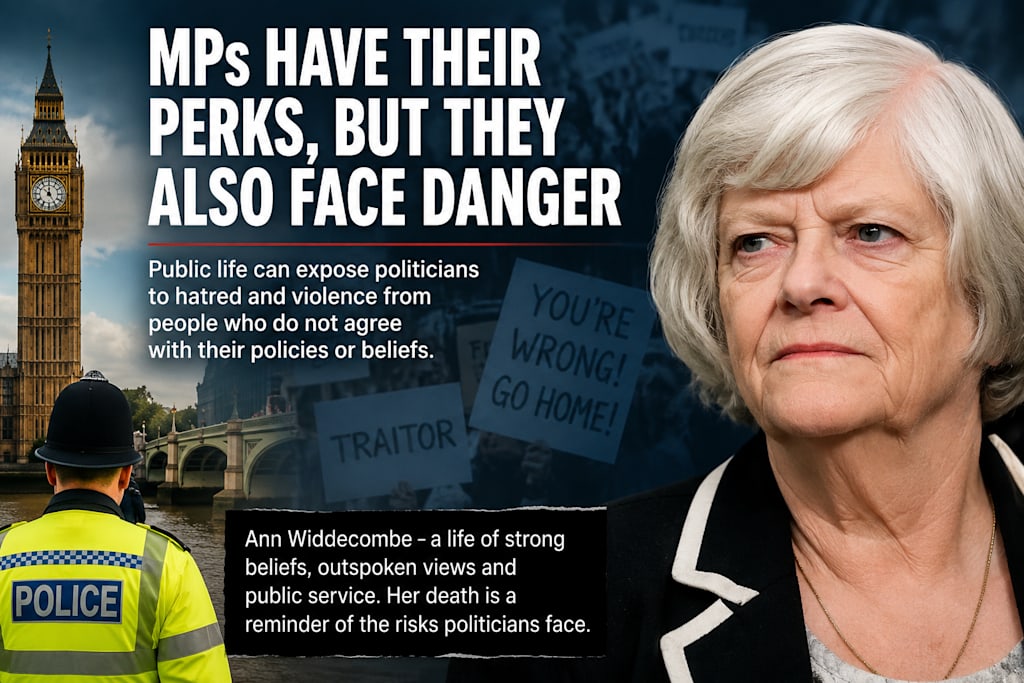
I have criticised Members of Parliament many times and will undoubtedly continue to do so. I have written about their expenses, their allowances, their free tickets, their hospitality and the various privileges that seem to come with political life. When somebody is being paid from the public purse, I believe the public has every right to question how their money is being spent. I still believe that.
However, the death of Ann Widdecombe has made me think about another side of political life that perhaps we do not consider often enough. MPs may have their perks, but they also have something that most of us do not have. Thousands, and sometimes millions, of people know their name, recognise their face and know exactly what they believe, and that can be dangerous!
Ann Widdecombe was never a politician who tried to hide her opinions. She was outspoken, direct and often controversial. She converted to Roman Catholicism in 1993 and was well known for her traditional Christian and socially conservative views. She opposed abortion, assisted dying and was an extreme opponent of LGBTQ+ equality; and was prepared to defend beliefs that were increasingly unpopular in some sections of society. Whether you agreed with her or not, you normally knew where Ann Widdecombe stood.
Now she is dead, and police are treating her death as murder. Investigators believe she was attacked at her home almost twenty-four hours before her body was discovered. At the time I am writing this, the police have not established a political or religious motive, and current reporting says terrorism and political motives have been ruled out at this stage. That distinction is important.
We must not claim that Ann Widdecombe was murdered because she was a Catholic or because somebody disagreed with her political beliefs when the police have not said that. However, her death has made me consider something slightly different. She could have been murdered because she was a Catholic or because somebody disagreed with her political beliefs, and that is the frightening reality faced by anyone who becomes a well-known political figure.
I can write an article criticising the Government, publish it and then make myself a cup of tea. Unless my readership suddenly increases dramatically, I am unlikely to have thousands of people outside my house who recognise me. An MP does not have that luxury.
Their photograph appears in newspapers. Their speeches are placed on the internet. Their opinions are repeated on television and social media. Their constituency office is usually publicly known, and until security concerns changed the way many MPs work, it was perfectly normal for politicians to advertise where and when they would meet members of the public. Think about that for a moment.
A politician expresses a controversial opinion on television and then sits in a room somewhere in their constituency meeting complete strangers. Most of those people will have genuine problems. They may need help with housing, immigration, benefits, planning or local services. The MP has no way of immediately knowing whether the next person through the door is an ordinary constituent or somebody who has spent months developing an obsessive hatred of them. Britain already knows what can happen.
Jo Cox was murdered in 2016. Sir David Amess was murdered in 2021 while holding a constituency surgery. Both deaths demonstrated the vulnerability of politicians who remain accessible to the public. We often complain that MPs are remote and disconnected from ordinary people, yet we also expect them to meet complete strangers in community halls, libraries, churches and constituency offices. If we surround every politician with armed police and airport-style security, we will accuse them of becoming a protected political class. If we do not protect them and somebody is murdered, we will ask why more was not done. I do not know the answer to this!
What I do know is that political disagreement appears to have become more personal and more aggressive. There was a time when you could say that you disagreed with a politician. Today, people are frequently described as traitors, fascists, communists, extremists or enemies simply because they hold a different opinion. Social media has made this much worse.
A politician can make a statement at nine o'clock in the morning and receive thousands of angry messages before lunchtime. Most of those messages may simply be people expressing their anger, and some may be offensive, and a few may contain threats. How does the politician know which threat is genuine?
If one hundred people write, "You deserve what is coming to you", perhaps ninety-nine are merely typing angry words from their bedrooms but the problem is the hundredth person. The police and security services have to identify that person before they act.
I have written critically about Keir Starmer, Ed Miliband and many other politicians. I strongly disagree with many government policies, and I believe some political decisions are damaging to Britain. I have every right to say that, but what I do not have is the right to physically attack somebody because they disagree with me. That should be obvious, but increasingly I wonder whether it is.
Political language has become so extreme that people are no longer simply described as wrong; they are portrayed as evil. Once you convince yourself that somebody is evil, an enemy or a threat to society, it becomes much easier to justify actions that would otherwise be unthinkable.
Politicians themselves are not entirely innocent in creating this atmosphere. Political parties use fear and anger because they motivate people. Newspapers know that outrage attracts readers and social media companies know that angry people stay online, click on posts and write comments. However, everyone benefits from the anger except society.
Ann Widdecombe was a Catholic with strong beliefs. I do not know whether those beliefs had anything whatsoever to do with her death and, based on the information currently available, nobody should claim that they did. However, her death raises an uncomfortable question. Could somebody be murdered in modern Britain simply because another person disagreed with their religious or political beliefs? We already know the answer is yes.
The murders of Jo Cox and Sir David Amess proved that political figures can become targets. History provides countless other examples of people being attacked because of their politics, religion or beliefs. Perhaps that is something we should remember the next time we criticise MPs.
Yes, they receive good salaries. Yes, there should be much greater scrutiny of expenses, gifts and hospitality. Yes, I still believe we need an independent body with real powers to examine how politicians spend public money, and none of that has changed.
What has changed slightly is my appreciation of the personal risk that comes with being a public figure. I can disagree with an MP and switch off the television. An MP cannot switch off the knowledge that, somewhere among the millions of people who have heard their views, there may be one person who believes disagreement is not enough.
Ann Widdecombe may ultimately prove to have been killed for reasons completely unrelated to her politics or her Catholic faith. The police investigation must establish the facts, and we should not invent a motive before they do, but she could have been murdered for her beliefs. That possibility alone should make us think that MPs have their perks and expenses, and the public should continue to scrutinise them, but they also live with a danger that most of us will never have to face.
About the Creator
Alan Spencer
Have been an author and writer for over 20 years. Have been a journalist, editor, proofreader, and a designer and presenter of training courses. Have written over 100 articles, two books, and around 20 training courses.
Enjoyed the story? Support the Creator.
Subscribe for free to receive all their stories in your feed. You could also become a paid subscriber, letting them know you appreciate their work.
Comments
There are no comments for this story
Be the first to respond and start the conversation.