
Lord Sadiq Khan - Many Londoners Will Wonder Why
When Public Honours Become Public Debate
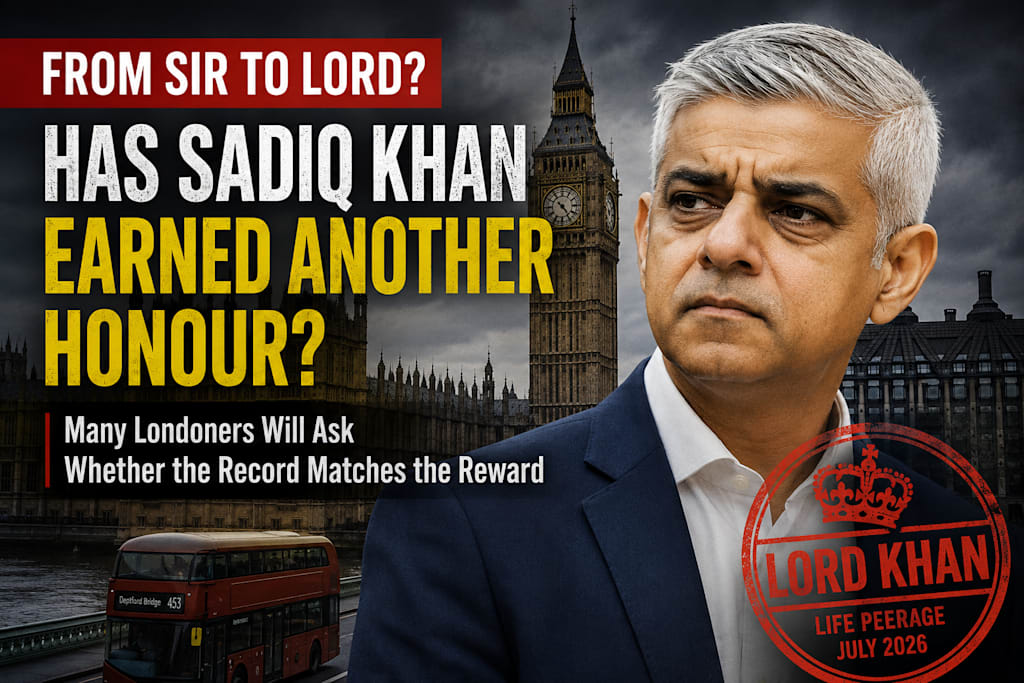
Sadiq Khan has received many honours during his political career. He became Sir Sadiq Khan after receiving a knighthood, and now, following the announcement of a life peerage, he will become Lord Khan and take a seat in the House of Lords. The appointment was announced by the Government as part of a new list of political peerages, meaning that he joins Parliament's upper chamber while continuing as Mayor of London.
For his supporters, the appointment is entirely justified. They point to his decade as Mayor of London, his three election victories, his leadership during the COVID-19 pandemic, his commitment to improving air quality and his efforts to promote London as one of the world's leading cities. They argue that long public service deserves recognition and that a life peerage is an appropriate way to acknowledge those achievements. Many others, however, will look at the announcement and ask a very different question. They will wonder what exactly has been achieved that merits yet another honour.
Whether one supports or opposes Sadiq Khan politically, few would argue that London is not the easier city in which to live today than it was when he first became Mayor in 2016. House prices remain beyond the reach of many young families, rents continue to consume a growing proportion of household incomes and many businesses complain about the increasing cost of operating in the capital. Transport fares have continued to rise, while road users have faced an expanding range of restrictions and charges.
Crime remains one of the issues that dominates public discussion. Although crime statistics fluctuate and some categories have fallen while others have risen, many Londoners say they feel less safe than they once did. Knife crime, robbery, antisocial behaviour and violence continue to receive widespread media attention, leaving many residents questioning whether enough progress has been made.
The expansion of the Ultra Low Emission Zone has also divided opinion. Supporters argue that cleaner air saves lives and improves public health. Critics believe the policy has placed additional financial pressure on motorists, tradespeople, charities and small businesses, many of whom rely on their vehicles to earn a living. Regardless of where one stands, there is little doubt that the policy has been one of the most controversial decisions of his mayoralty.
This is not to suggest that every problem facing London is the responsibility of one individual. The mayor operates within powers and budgets determined partly by central government, while wider economic conditions, population growth and international events all influence the challenges facing the capital. It would therefore be unfair to attribute every success or failure solely to one office holder.
Nevertheless, honours are not normally awarded for trying hard. They are intended to recognise exceptional public service and lasting achievement. That is why the announcement has generated such strong reactions. Many people believe honours should reflect measurable improvements in the lives of the public, rather than simply the length of time someone has held office.
The appointment also raises a broader constitutional question. Should serving politicians and mayors routinely be elevated to the House of Lords while still holding elected office? Some will say that experienced public servants have valuable knowledge to contribute to Parliament. Others will argue that political peerages reinforce the perception that Westminster rewards its own, regardless of whether the public believes those rewards have been earned.
Ironically, debate over the peerage may ultimately become more significant than the peerage itself. Every controversial honour invites people to ask whether the honours system still commands the confidence of those it is intended to serve. Once that confidence begins to weaken, every future appointment is examined through the lens of politics rather than merit.
Supporters of Lord Khan will see this as a fitting recognition of nearly a decade leading one of the world's greatest cities. His critics will see it as another example of politicians rewarding politicians while many ordinary Londoners continue to struggle with the everyday realities of housing costs, transport, crime and the cost of living.
History, rather than today's headlines, will provide the final judgement. Titles may be awarded by governments, but reputations are earned in the eyes of the public. Long after the speeches have been forgotten and the ceremonies have ended, Londoners themselves will decide whether Sadiq Khan leaves behind a city that is stronger, safer and more prosperous than the one he inherited. That verdict, rather than the title of Lord, is likely to be the honour that matters most.
About the Creator
Alan Spencer
Have been an author and writer for over 20 years. Have been a journalist, editor, proofreader, and a designer and presenter of training courses. Have written over 100 articles, two books, and around 20 training courses.
Enjoyed the story? Support the Creator.
Subscribe for free to receive all their stories in your feed. You could also become a paid subscriber, letting them know you appreciate their work.
Comments
There are no comments for this story
Be the first to respond and start the conversation.