
Israel and Lebanon Are About to Sit Down for Peace Talks — For the First Time in Over 40 Years
Washington has announced a third round of direct negotiations between Israel and Lebanon on May 14 and 15. With Hezbollah still firing rockets and 1.2 million people displaced, here is what is at stake — and why this moment is genuinely historic.
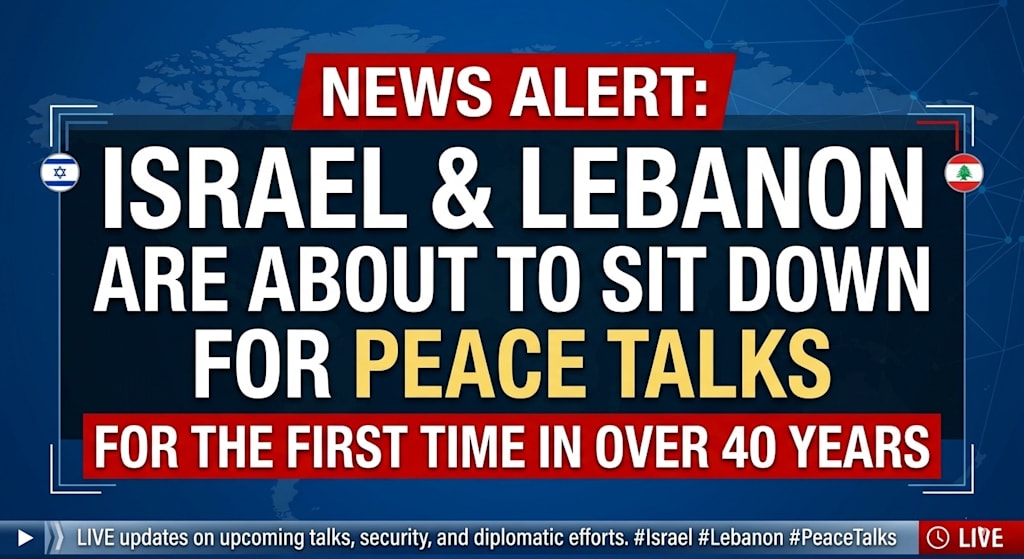
The last time Israel and Lebanon sat down for direct peace negotiations, it was 1983.
That agreement — the May 17 Agreement — collapsed within a year, never ratified by the Lebanese parliament, buried under the pressure of Syrian opposition and Hezbollah’s growing influence. For over four decades since, the two countries have existed in a permanent state of hostility: wars, cross-border raids, rocket fire, and an uneasy series of ceasefires that never held.
Now, for the first time in more than 40 years, direct negotiations between Israel and Lebanon are scheduled to resume — in Washington, on May 14 and 15.
This is not a minor diplomatic footnote. This is potentially the most significant peace process in the Middle East since the Abraham Accords.
How We Got Here
The road to these talks runs through the Iran war that began on February 28, 2026, when U.S. and Israeli strikes on Iran triggered a regional cascade. Hezbollah — Iran’s most powerful proxy and a dominant political and military force in Lebanon — entered the conflict by launching over 1,300 waves of attacks on Israel from Lebanese territory.
Israel responded with a full military campaign in southern Lebanon. The death toll climbed. Cities were struck. By the time a ceasefire was declared on April 16 by President Trump, more than 2,700 people had been killed in Lebanon and approximately 1.2 million people had been driven from their homes — many of them from southern Lebanese villages that have now been struck multiple times.
What made this moment different from previous cycles of violence was a shift inside Lebanon itself. The country’s new government — led by President Joseph Aoun and Prime Minister Nawaf Salam, elected in early 2025 — had already declared its intention to extend full state sovereignty across Lebanese territory and restrict the role of non-state armed actors. In plain language: the Lebanese government was signalling it was ready to confront Hezbollah’s parallel military structure.
That opening was what Washington had been waiting for.
What the Talks Will Cover
The State Department’s official announcement describes the May 14-15 talks as aimed at advancing a “comprehensive peace and security agreement that substantively addresses the core concerns of both countries.”
The agenda is ambitious. Discussions are expected to cover the delineation of the Israel-Lebanon border — which has never been formally agreed. They will address concrete pathways for humanitarian relief and reconstruction in devastated southern Lebanon. And critically, they will address “the full restoration of Lebanese state authority and the complete disarmament of Hezbollah.”
That last point is the hardest of all. Hezbollah has been armed, funded, and politically protected by Iran for decades. Its disarmament is not simply a military question — it is a question of Lebanese sovereignty, Iranian influence, and the future balance of power across the entire region.
Lebanese Prime Minister Nawaf Salam has stated publicly that his government is “committed to ensuring that weapons are solely in the hands of the state.” He has also been careful to clarify: Lebanon is not heading toward normalisation with Israel — it is heading toward a non-aggression pact. That distinction matters enormously for Lebanese domestic politics, where opinion on Israel remains deeply divided.
The Obstacles
Even as the talks were announced, the ceasefire was straining.
Just this week, Israel launched a major airstrike on Beirut’s southern suburbs — the first strike on the capital in weeks — killing the commander of Hezbollah’s elite Radwan Force. Hezbollah has continued attacking Israeli troops in southern Lebanon, accusing Israel of violating the ceasefire first. Secretary of State Marco Rubio openly acknowledged that “Hezbollah is still trying to derail negotiations with attacks on Israel and threats inside of Lebanon.”
The United States is trying to hold both things simultaneously: pressure Israel to de-escalate while using the window of Hezbollah’s weakened state to lock in a political agreement before the organisation rebuilds.
Whether that gamble succeeds will become clearer next week.
But if it does — if Israel and Lebanon can reach even a preliminary framework agreement — it would represent one of the most dramatic diplomatic achievements in the modern Middle East. One that nobody predicted just six months ago.
Washington. May 14. Mark the date.
About the Creator
Enjoyed the story? Support the Creator.
Subscribe for free to receive all their stories in your feed.
Comments
There are no comments for this story
Be the first to respond and start the conversation.