
Is AI Moving Too Fast? The Growing Backlash Nobody Saw Coming
As artificial intelligence rapidly expands across jobs, education, healthcare, and daily life, a growing global backlash is emerging—raising urgent questions about safety, control, and the future of human work.
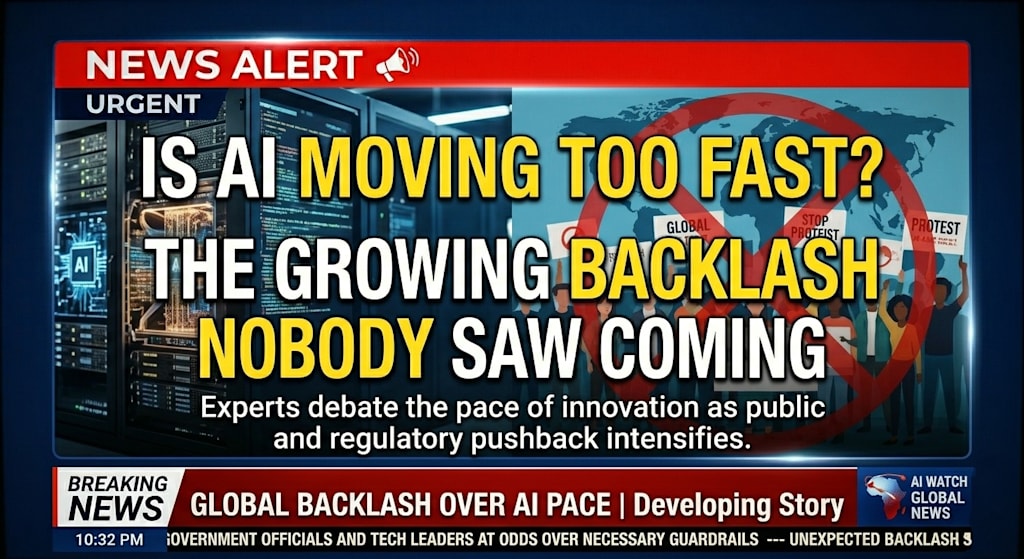
Is AI Moving Too Fast? The Growing Backlash Nobody Saw Coming
A Silent Shift Is Happening Across the World
A few years ago, artificial intelligence felt like a futuristic idea—something distant, experimental, and exciting. Today, it is everywhere.
It writes emails, generates images, powers search engines, helps students cheat (and learn), assists doctors in diagnosis, and even influences financial decisions.
But beneath the excitement, something else is beginning to emerge.
A quiet but growing backlash against AI is spreading across industries, schools, governments, and everyday users. And most people are not fully paying attention to it—yet.
The question is no longer “What can AI do?”
It is now becoming: “Are we moving too fast to control what we have created?”
⸻
The Rise of AI: From Innovation to Daily Dependency
Artificial intelligence is no longer optional—it is embedded in modern life.
Today, AI is used for:
* Customer service chatbots
* Automated hiring systems
* Social media algorithms
* Medical scanning tools
* Self-driving research systems
* Content creation tools
What used to take humans hours can now be done in seconds.
This speed has created massive efficiency—but also growing concern.
Because when technology evolves faster than society can adapt, imbalance begins to appear.
⸻
Why the Backlash Is Growing
The backlash against AI is not coming from one group. It is spreading across multiple sectors at once.
1. Job Security Anxiety
Workers in writing, design, customer support, and even tech are beginning to fear replacement.
Companies are adopting AI tools to reduce costs, which is raising a difficult question:
If AI can do the job faster and cheaper, what happens to human workers?
⸻
2. Education Disruption
Schools and universities are struggling to adjust.
Students now use AI to:
* Write essays
* Solve math problems
* Generate research summaries
Teachers are responding with confusion:
Is this learning—or automation of thinking?
⸻
3. Trust and Misinformation Problems
AI-generated content is becoming harder to distinguish from human-made content.
This raises concerns about:
* Fake news
* Deepfakes
* Manipulated political content
* False medical advice
The line between truth and simulation is becoming thinner.
⸻
4. Ethical Concerns
Who is responsible when AI makes a mistake?
* The developer?
* The company?
* The user?
* Or the machine itself?
Right now, there is no universal answer.
⸻
What Experts Are Saying
Many technology experts are not calling AI “dangerous”—but they are calling it unstable in its current phase of growth.
The main concern is not that AI is “bad,” but that:
society is evolving slower than the technology it has created.
This gap creates confusion, misuse, and unintended consequences.
⸻
Real-World Signs of AI Overload
Across the world, small but important signs are appearing:
* AI tools giving incorrect or misleading answers in critical situations
* Companies replacing human workers faster than expected
* Students becoming dependent on AI for basic thinking tasks
* Governments rushing to create regulations after problems arise
These are not isolated incidents anymore—they are patterns.
⸻
The Human Question at the Center of It All
At the heart of the AI debate is not technology.
It is humanity.
We are now forced to ask:
* What does it mean to think?
* What does it mean to work?
* What does it mean to create?
* And what should remain uniquely human?
These questions were once philosophical.
Now they are practical.
⸻
The Future: Control or Acceleration?
There are two possible directions the world could take:
1. Controlled AI Growth
Governments and institutions regulate AI carefully, ensuring balance between innovation and safety.
2. Uncontrolled Acceleration
Companies continue pushing AI forward rapidly due to competition and profit incentives.
Most experts believe reality will likely be somewhere in between—but the direction is still unclear.
⸻
Why This Matters Now More Than Ever
The AI conversation is no longer for tech experts alone.
It affects:
* Students
* Workers
* Business owners
* Governments
* Families
* Content creators
In short, everyone.
The decisions being made today will shape the next decade of human life.
⸻
Final Thought
Artificial intelligence is not slowing down.
The question is whether we are ready for how fast it is moving.
And perhaps the most important question of all is this:
Are we building a future where humans and AI grow together—or one where humans are forced to catch up?
About the Creator
Enjoyed the story? Support the Creator.
Subscribe for free to receive all their stories in your feed.
Comments
There are no comments for this story
Be the first to respond and start the conversation.