
Iran’s Leaders Are in New York. Back Home, the Planes Are Disappearing.
A foreign minister lands. A president prepares to speak. In Tehran, the departure boards are already going blank.
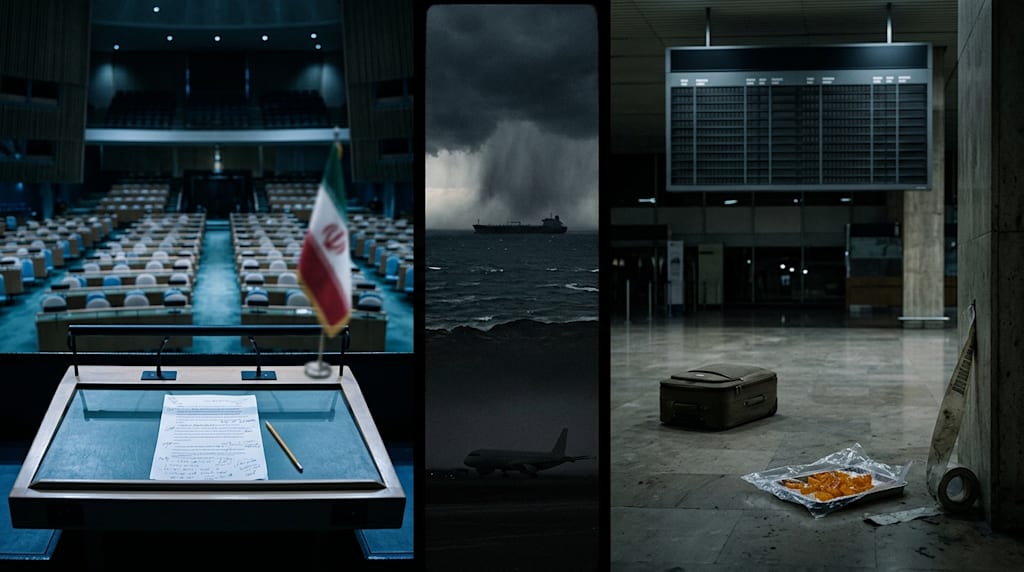
The Podium in New York and the Runway in Tehran
On the evening of September 21, New York time, on the electronic board at Terminal 4 of Kennedy Airport, next to the IR code there was no delay notice, only a small line of text: ARRIVED. Iranian Foreign Minister Abbas Araghchi came out of the arrival gate; accompanying staff carried two black briefcases. IRNA’s report had only one sentence: He has arrived. No welcome ceremony, no press questions.
At the same moment, in the departure hall of Imam Khomeini International Airport in Tehran, at the Mahan Air counter for the flight to Istanbul, a staff member taped a printed sheet of paper to the glass: FLIGHT CANCELLED. The corner of the paper curled up; the tape had been torn off in a hurry. Next to him, a vendor selling saffron candy pushed his tray further into the counter, making room for the people queuing to rebook.
Araghchi’s trip is to attend the high-level week of the 81st session of the United Nations General Assembly. The theme of this year’s General Assembly is “Restoring Trust, Managing Transformation: A United Nations That Delivers for All.” The high-level general debate runs from September 22 to 26, with another day on the 28th. Iranian President Masoud Pezeshkian is scheduled to address the General Assembly on the morning of September 23. Iranian Foreign Ministry spokesman Baghaei said that participating in the General Assembly is “a legal right, not a favor granted to us by someone.” IRNA placed this sentence in the third paragraph of its report, after the arrival news and before the visa issue.
The visa issue comes down to individuals. The United States approved visas for Pezeshkian and Araghchi but rejected applications from some members of the president’s media team. Iran called this an “unprecedented hostile act.” In Tehran, a reporter whose visa was denied put his passport back in a drawer. In the drawer was also the bulletproof vest he had used during his last war report. On the chest of the vest was an un-washable gray stain, left by the black rain that fell after the oil storage facility explosion on March 7.
Bessent’s Words
On September 21, U.S. Treasury Secretary Scott Bessent said in front of CNBC’s cameras: “On September 23, all Iranian airlines will be shut down around the world.” He then explained how it would be enforced: if an Iranian plane lands, you cannot refuel it, you cannot provide landing services, you cannot sell tickets, otherwise “you will be knocked out of the dollar system.” The sentence had no embellishment, no “possibly,” no “considering.” CNBC’s chyron put “shut down” in all caps.
The secondary sanctions worked through a simple choice. Foreign airports, fuel suppliers, and ticketing companies, as long as their business touched dollar clearing, had to choose between Iranian flights and the dollar system. Iraqi sources said Baghdad would suspend Iranian airline flights. Georgia banned Iranian airlines from its airspace. Mahan Air, at the request of the Turkish government, suspended flights to Turkey, after previously suspending routes to Istanbul, Ankara, and Muscat.
At the counter of a travel agency in Tehran, a clerk turned the international flight timetable to the last page for September and crossed out Istanbul, Ankara, and Muscat with a ballpoint pen. The pen ran out of ink; he shook it twice and kept crossing. A customer next to him asked, “Which route can still go?” The clerk did not look up: “We’ll see tomorrow.”
The head of Iran’s Civil Aviation Organization and the CEO of Imam Khomeini International Airport said that the sanctions did not mean planes would be grounded or airlines closed, and that foreign flights had not been restricted or cancelled because of them. But the changes on the airport display board came faster than the statements. Early on September 22, the status of the flight to Baghdad jumped from “Boarding” to “Cancelled.” Ground staff pulled the barrier tape across, and someone in the queue turned a suitcase on its side and sat on it like a stool.
Economic Fury
The aviation blockade is not a standalone move. On April 16, U.S. Defense Secretary Hegseth announced the launch of “Operation Economic Fury,” with the goal of “applying maximum economic pressure on Iran.” The measures include blocking Iranian government bank transactions and financial assets, and imposing secondary sanctions on third parties that buy Iranian oil. In early September, the U.S. Treasury sanctioned 27 Iranian airlines, a list that included Iran Aseman Airlines, Iran Air Tours, Kish Air, and Qeshm Air.
Bessent’s warning on September 21 added a global aviation enforcement mechanism to the operation. He did not use the word “sanctions”; he used “shut down.” In Washington, a reporter asked about humanitarian exemptions. Bessent did not take it. After the briefing ended, staff turned off the microphone. Half a cup of coffee was left on the table, water beads condensing on the outside of the paper cup.
The war entered its seventh month. On February 28, the United States and Israel launched a joint military strike on Iran. Iran’s Supreme Leader Ali Khamenei was killed in the air strike. Defense Council Secretary Ali Shamkhani, Islamic Revolutionary Guard Corps Commander-in-Chief Mohammad Pakpour, Defense Minister Aziz Nasirzadeh, and Armed Forces Chief of Staff Abdolrahim Mousavi died the same day. Iran then launched “True Promise-4,” firing missiles and drones at U.S. military bases in the Middle East and Israeli targets.
On March 4, the Iranian Navy frigate Dena was sunk by a U.S. Navy submarine in the Indian Ocean; 104 people on board died. On March 7, oil storage facilities in Tehran and other places were attacked by warplanes; the thick smoke from the explosions caused “black rain” containing oil to fall the next day. On March 8, Iran’s Assembly of Experts selected Mojtaba Khamenei as the new Supreme Leader. On April 7, Trump announced a two-week ceasefire agreement with Iran. On April 11, the two sides held their highest-level face-to-face talks since 1979 in Islamabad. No agreement.
Hormuz
As of September, the Strait of Hormuz was still blockaded by Iran. The United States imposed a counter-blockade on Iranian ports. At a dock on the northern shore of the strait, the captain of an oil tanker looked at the channel through binoculars at the same time every day. The freshwater tank on his ship was one-third full. When the supply truck came from shore, the driver brought a box of stomach medicine, saying the pharmacy had only this brand left.
The nuclear issue was stuck on the number of years. The U.S. side demanded that Iran suspend uranium enrichment for 20 years; Iran agreed to a maximum of 5. Trump rejected the proposal. In Tehran, a retired nuclear engineer folded his newspaper and put it under the glass of the coffee table. Under the glass was also an old photo from the 1980s, showing him standing next to centrifuges in a white coat, two pens in his pocket.
The humanitarian numbers were these. The United Nations said that since the war began, 3 million people had been displaced inside Iran. Many urban areas lacked effective air-raid sirens and bomb shelters. Mai Sato, the UN Human Rights Council’s Special Rapporteur on the situation of human rights in Iran, pointed out that the humanitarian situation inside Iran worsened, with large numbers of refugees and displaced people. U.S.-Israeli strikes hit schools, hospitals, sports stadiums, and residential areas. Iranian Foreign Ministry spokesman Baghaei condemned these acts as “committing serious crimes with no humanitarian spirit whatsoever.”
At a hospital in Shiraz, diesel drums were lined up outside the generator room. On the registration book at the nurses’ station, the entry for September 21 read: Received 4 explosion casualties, including 2 children. Next to the book was a box of mint candies. The lid was cracked, and the candies had stuck together.
The UNGA Corridor
On September 22, the high-level debate of the General Assembly began. Araghchi’s meetings in New York were full. IRNA said he would hold consultations on the latest regional developments during the high-level week. Pezeshkian was to speak on the morning of September 23, then meet with leaders of several countries, and planned discussions with Iranian Americans, American intellectuals, and think tanks. In the corridor of the Iranian delegation’s accommodation, a translator wore headphones testing the sound; the headphone cable was tangled around the back of a chair. On the table was a copy of the speech, with a few Persian words written in pencil in the margin, not English.
On the U.S. side, Trump planned to meet with Gulf leaders during the session to discuss the next steps against Iran and post-war arrangements. At UN headquarters, the press area was more crowded than in previous years. A photojournalist pointed a telephoto lens at the Iranian delegation’s seat, did not press the shutter, and first wiped raindrops off the lens.
Iranian Parliament Speaker Qalibaf had said earlier that the United States, while publicly sending signals for talks, was secretly planning a ground offensive, “trying to achieve the goals it could not achieve in the war.” In a Tehran newspaper, this sentence was placed on page two; page one was the aviation sanctions. The newspaper vendor stacked the two papers together and clipped them. Wind blew in from the street corner, and the clip swayed.
September 23
Early on September 23, outside UN headquarters in New York, Pezeshkian’s motorcade drove in. At the same time, in the departure hall of Imam Khomeini International Airport in Tehran, the digital clock jumped to 00:00. On the departure display, the status of the flight to Istanbul changed from “Cancelled” to blank. Ground staff put away the barrier tape, rolled it into a loop, and leaned it against the wall. The saffron candy vendor set out his tray again, with a thin sheet of plastic over the candies.
At Terminal 4 of Kennedy Airport, there was no new flight next to the IR code. The electronic board turned to the next page, showing arrival times of other airlines. A cleaner pushed a mop past; the water trail stayed on the floor tiles for a few seconds, then dried.
About the Creator
Jin
Writer of reamstories
https://reamstories.com/jin
Enjoyed the story? Support the Creator.
Subscribe for free to receive all their stories in your feed. You could also become a paid subscriber, letting them know you appreciate their work.
Comments
There are no comments for this story
Be the first to respond and start the conversation.