
Iran’s 7-Day Plan to Reopen the Strait of Hormuz Lasted 24 Hours
Trump’s rejection, a broken June deal, and a new southern shipping route are changing the Gulf’s balance of power.
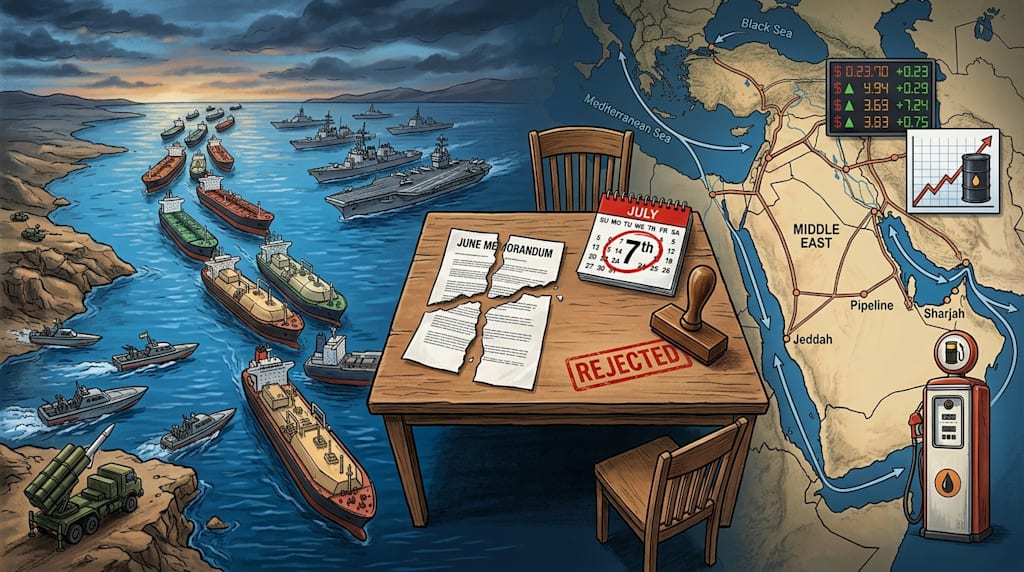
On September 25, 2026, Iranian Foreign Minister Abbas Araghchi presented a plan at the United Nations in New York. If the United States took certain steps, the Strait of Hormuz would reopen within seven days. The next day, Trump told cameras, “I rejected their proposal” and “The United States completely controls the Strait of Hormuz.” The plan lasted less than a day.
Why it was rejected matters more than what it proposed.
What the strait carries every day
The Strait of Hormuz is 39 kilometers wide at its narrowest point. About 20 million barrels of oil move through it daily, one-fifth of global seaborne oil trade. Nearly all of Qatar’s liquefied natural gas goes through it. About 80 percent of Japan’s oil tankers use it. More than 40 percent of China’s imported crude passes through it.
These numbers rarely make headlines. After U.S. and Israeli strikes on Iran in late February 2026, they became prices. By late September, Brent crude was above $106 a barrel, up more than 65 percent for the year. Lloyd’s war-risk premiums had jumped from 0.1 to 0.25 percent of a ship’s value to as high as 3 percent. Vitol’s CEO said the closure had cut about 12 million barrels per day of production.
Prices are the result. The cause sits in Tehran and Washington.
The June memorandum neither side implemented
When Araghchi announced the seven-day plan, he said one thing: “The actions required of the United States under the plan are not new conditions, but what the United States already committed to in the U.S.-Iran memorandum of understanding signed in June.”
The memorandum is formally called the “Islamabad Memorandum of Understanding.” CCTV News published its clauses: the United States and Iran immediately and permanently stop military operations on all fronts; Iran immediately reopens the Strait of Hormuz; the United States immediately lifts its maritime blockade; some financial restrictions on Iran are relaxed; Iran reaffirms it will not acquire or develop nuclear weapons; the two sides agree to on-site dilution of Iranian enriched uranium under IAEA supervision; and they commit to negotiations within 60 days to reach a final agreement.
After the signing, the United States was accused of not fully implementing its commitments. Iran closed the strait again. At the UN, Araghchi said that if the United States truly wanted to reopen the strait, it “only needs to accept this plan, and the strait can be reopened within seven days.” He added that Iran does not accept coercion, threats, or intimidation and will not hand over its sovereignty under pressure.
The wording matters: “not new conditions.” Iran tried to define the seven-day plan as the fulfillment of existing promises, not the start of a new negotiation. If that definition held, the United States would have no room to bargain.
The United States rejected the definition.
The southern route changes the math
Qin Tian, deputy director of the Institute of Middle East Studies at the China Institutes of Contemporary International Relations, points to a shift in relative power over the strait.
At the start of the conflict, the United States lacked an effective way to open the strait. By late September, that had changed. The U.S. maritime blockade kept hitting Iran’s oil exports and domestic economy. At the same time, the United States and Gulf countries opened a southern alternative shipping lane in waters near Oman. That lane weakened Iran’s previous exclusive control over the Strait of Hormuz.
The data show the shift. Saudi Aramco’s chairman said the East-West Pipeline had diverted about 7 million barrels per day. Iraq exported about 3.3 million barrels per day before the war, saw exports collapse in mid-March, and recovered to 2.3 million barrels per day in August. Hapag-Lloyd adjusted its network, using Jeddah Port in Saudi Arabia and Sharjah Port in the UAE to keep the Gulf market connected.
All these alternatives bypass waters controlled by the Iranian navy. Qin Tian notes that the routes remain within Iran’s reach, and their security is uncertain. But “within reach” and “can be cut off at any time” are different. The first is geography. The second requires military capability, political will, and economic endurance.
Iran now has to calculate the second.
Pezeshkian’s distrust and the negotiation trap
Iranian President Masoud Pezeshkian said in a September 26 interview: “Given that the United States launches attacks and imposes sanctions after every round of negotiations, Iran no longer trusts dialogue with the United States.”
He also said: “The issue of the Strait of Hormuz can only be resolved through negotiation, not through the use of force.” And: “When all channels are closed to Iran, closing the Strait of Hormuz is a natural reaction.”
Together, the three sentences form a trap. Iran does not trust dialogue, but only dialogue can solve the problem. Closing the strait is a natural reaction, but closing it forces dialogue to happen.
Qatar and Pakistan are mediating. Pezeshkian said the talks are based on the June memorandum, and “the United States must clarify its position on this.” Araghchi said Iran had received the initial U.S. reaction but no specific information from the mediators. Iran is waiting for a final position.
Waiting is Iran’s main move right now.
Trump’s claim of control and the November election
When Trump rejected the seven-day plan, his claim that “the United States completely controls the Strait of Hormuz” was not fully accurate in military terms. At its narrowest, the strait is 39 kilometers wide. Iran has anti-ship missiles, fast boats, and mining capabilities on the northern shore. But the political meaning is clearer than the military one: the United States believes it has the upper hand and is not in a hurry.
A U.S. official had already said the United States was not rushing because it was “in a favorable position.” Qin Tian argues that after rejecting the plan, Washington may raise its demands. The goal would be to increase Iran’s domestic economic pressure and force concessions on the nuclear question and strait navigation rules that go far beyond the June memorandum.
The Wall Street Journal, citing U.S. officials, reported that Trump told aides he might resume bombing Iran after the November congressional midterm elections. If true, the rejection of the seven-day plan is not an end to diplomacy. It is part of continued pressure.
Congress is divided. The Senate voted 50 to 49 to reject a resolution that would have required the president to end the war against Iran. The House passed a war powers resolution for the third time, seeking to limit military action without congressional approval. Fifty votes to 49 shows there is no consensus on Iran policy.
Qin Tian notes that the midterms will not directly affect the U.S.-Iran conflict, but they will have an indirect effect. If Republicans lose, Trump’s negotiating position may change. Trump has said he does not rule out an agreement after the election.
The election is in November. Oil tankers in the Strait of Hormuz will not wait until November to decide whether to sail.
Pipelines, ports, and detours
Chatham House says the crisis is accelerating a broader reorganization in the Middle East. Iraq, Syria, and Lebanon are planning new oil pipelines and transport corridors, trying to use their position between Europe and the Gulf. Saudi Arabia’s East-West Pipeline is expanding. Sharjah Port in the UAE and Jeddah Port in Saudi Arabia are serving as alternative routes. China and Russia are promoting Arctic sea routes and overland corridors. All respond to one question: if the Strait of Hormuz is no longer reliable, how will oil and gas move?
Whether these alternatives work does not depend on pipeline diameter or port throughput. Chatham House says it depends on whether the countries involved can carry out deeper governance reforms. A pipeline through Iraq and Syria to the Mediterranean carries political risks as high as the military risks in the strait. The Saudi East-West Pipeline can be rerouted, but its capacity has limits. Hapag-Lloyd’s route changes can keep goods moving, but the cost will show up in freight rates.
Energy traders are drawing new routes. How fast they draw them depends on how long the standoff lasts. How long the standoff lasts depends on how much pressure Tehran and Washington can each still bear.
How long Iran can hold out
The war has pushed Iran’s GDP down, shrunk oil and industrial activity, driven inflation up, and cut oil exports. Those are macro numbers. At the micro level, the Financial Times reported that Iran has pursued a “resistance economy” for decades, encouraging self-reliance and domestic production and building an independent national economy and defense industry. Trade with China also provides a buffer.
But the war tests several parts of Iran’s economy at once. Oil revenue, foreign exchange reserves, domestic production, and public purchasing power are not simple substitutes. Non-oil exports cannot fill the gap left by oil. Reserves can support imports only as long as they last. Domestic production can replace some imports, but replacement takes time and technology.
Part of Iran’s negotiating power comes from its own estimate of how much it can endure. Part of Washington’s power comes from its outside estimate of the same thing. The gap between the two estimates is the current stalemate.
After the seven-day plan
Araghchi said Iran will not concede on its conditions, and the reopening of the strait depends on whether those conditions are met. Trump said he rejected the proposal and that the United States completely controls the strait.
Qatar and Pakistan are still mediating. The “final position” the mediators are supposed to deliver has not appeared.
On the Gulf of Oman side, tankers are using the southern route. On the Persian Gulf side, Iranian fast boats are still patrolling. Brent crude remains above $106 a barrel. Lloyd’s war-risk premiums have not fallen.
The Strait of Hormuz is 39 kilometers wide at its narrowest. The two shores are much closer to each other than Tehran is to Washington.
About the Creator
Jin
Writer of reamstories
https://reamstories.com/jin
Enjoyed the story? Support the Creator.
Subscribe for free to receive all their stories in your feed. You could also become a paid subscriber, letting them know you appreciate their work.
Comments
There are no comments for this story
Be the first to respond and start the conversation.