
Iran Has Eight Days to Reach Trump Through Beijing
Why Araghchi’s Trip to China Matters Before the Xi-Trump Summit
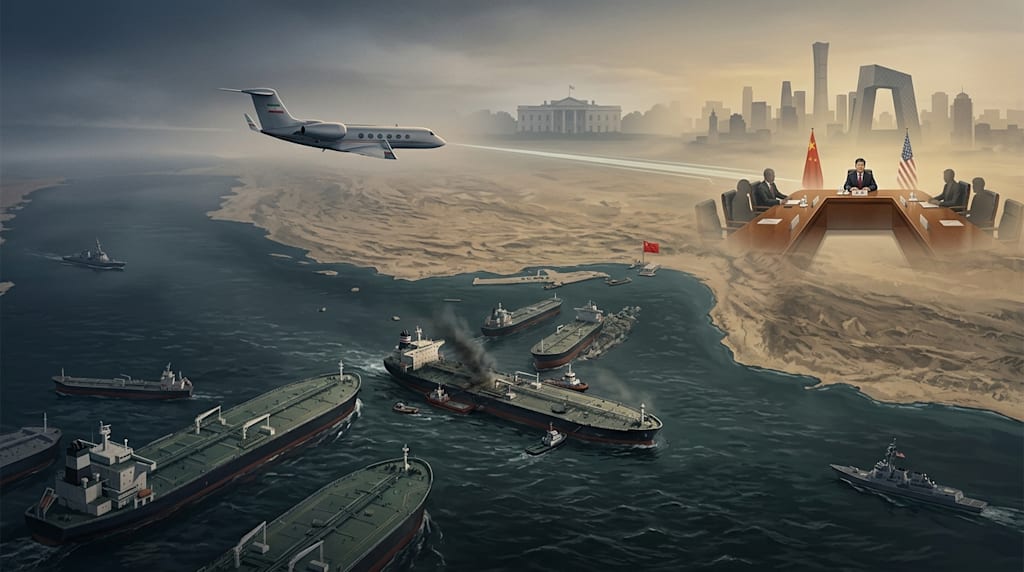
The Messenger and the Shock Absorber
At 4 p.m. on September 15, 2026, China’s Ministry of Foreign Affairs posted a single sentence on its website.
Iranian Foreign Minister Abbas Araghchi will visit China on September 16, where Chinese Communist Party Politburo member and Foreign Minister Wang Yi will hold talks with him.
The statement did not say that Araghchi was visiting “at the invitation of” the Chinese side.
In Chinese diplomatic language, that omission carries meaning. The wording suggests that Tehran initiated the trip and Beijing agreed to arrange it, rather than Beijing issuing the invitation and Tehran accepting it.
Araghchi’s plane left Tehran eight days before Xi Jinping was due to leave Beijing for Washington.
Trump had confirmed the visit on September 4. Xi and his wife, Peng Liyuan, are scheduled to visit the White House on September 24, where Trump will host them for a state dinner.
“We’re going to accomplish some very great things with China,” Trump told reporters in the Oval Office. “He’s a great gentleman.”
Araghchi has eight days to do something specific: make sure that any discussion of Iran during the Xi-Trump meeting does not proceed without Tehran knowing what is being discussed.
I. Six People, Six Ways to Say “You Can’t Control It”
Iran and the United States currently have no direct channel for negotiations.
That is not because they have never tried. In April, the two sides held face-to-face talks in Islamabad. The U.S. delegation was led by Vice President JD Vance and included Middle East envoy Steve Witkoff and Trump’s son-in-law Jared Kushner.
Before boarding his flight, Vance said he expected “positive” talks and warned Iran against “playing games.”
The talks lasted two days.
“We were not able to reach an agreement and are heading back to the United States,” Vance told reporters in Islamabad.
The structure of the delegation helps explain what happened.
Vance was formally in charge. But according to several participants quoted by The Guardian, Witkoff and Kushner exercised much of the influence. They reportedly did not bring a U.S. technical team and instead relied on Rafael Grossi as the technical expert.
A former official briefed on the talks told The Guardian: “Witkoff and Kushner were essentially Israel’s inside men.”
The remark reflects a broader dispute over how the negotiations were being conducted.
Jonathan Powell, Britain’s national security adviser, participated in the final U.S.-Iran talks in Geneva before the war began. The Guardian reported that Powell believed the talks were making progress and that Iran’s proposal on its nuclear program was “enough to form the basis of an agreement.”
Then, on February 28, Israel and the United States launched airstrikes on Iran.
Another figure was present at the nuclear talks in Oman: U.S. Central Command commander Brad Cooper.
Cooper is a four-star admiral responsible for U.S. forces across the Middle East.
Most of the delegation wore suits.
Cooper wore a Navy uniform.
The Associated Press described his presence as a departure from diplomatic convention. An unnamed Gulf diplomat told the media that the uniform “reminded people that the United States was strengthening its military presence in the region.”
A four-star commander sitting beside civilian negotiators changed the visual message of the talks. Iran was not dealing only with a diplomatic envoy. The military chain of command was physically present in the room.
That matters because the formal U.S. diplomat responsible for the Middle East is Secretary of State Marco Rubio.
Rubio has not been a central public figure in most U.S.-Iran negotiating reports. His recent regional activity has instead focused on the Gulf states.
In June, he traveled to the Middle East to persuade Gulf allies, after Iranian missile attacks, to accept a proposed agreement and help raise as much as $300 billion for Iran’s reconstruction.
The Gulf states were reportedly “deeply shocked and disappointed” by the proposal.
The financing would require their cooperation. Their diplomatic relationship with Washington also runs through Rubio’s State Department.
That gives the Gulf states a practical veto over any arrangement that depends on their money, territory, or political support.
The list therefore includes Vance, Witkoff, Kushner, Cooper, Rubio, and Israel.
Each can block an agreement.
None can make the agreement work alone.
II. From 125 to Single Digits
Iran has one instrument that does not require approval from any of them.
On September 14, Iran’s Revolutionary Guard Navy said that the supertanker Al Ghaya struck a mine and exploded south of the Strait of Hormuz.
The strait is under what Iranian officials call “smart control.”
The vessel-tracking figures cited here come from Kpler.
Before the war, roughly 125 large commercial vessels passed through the Strait of Hormuz each day.
On September 8, Kpler recorded six.
On September 9, seven.
On September 14, four.
Rystad Energy chief economist Claudio Galimberti gives another measure of the contraction. In the week before the conflict resumed on August 30, flows through the strait were around 8 million to 9 million barrels a day.
Recently, they had fallen below 2 million barrels a day.
Brent crude moved above $100 intraday on September 9 and closed at $101.21. WTI ended at $96.05, its highest level in three months. Brent was up roughly 65% for the year.
Rezaei, secretary of Iran’s Supreme National Security Council, summarized Tehran’s position in a statement repeatedly quoted by major news agencies:
“The situation surrounding oil and the Strait of Hormuz has changed. Iran will not negotiate until its conditions are met.”
Trump said on social media that Iran was “eager to reach a deal.”
Rezaei responded:
“Do not be misled by the contradictory signals coming from the U.S. president.”
The pressure created by the strait also feeds back into Iran.
The rial fell to more than 2.2 million per dollar in early September, compared with roughly 1 million a year earlier. The free-market rate crossed 2.2 million on September 2, while the official rate stood near 1.5 million.
Domestic inflation was 69.9%.
That creates an obvious contradiction for Tehran.
The Strait of Hormuz gives Iran leverage over the global oil market, but oil exports also provide Iran with one of its main sources of hard currency. A sustained disruption cuts both ways. Tankers cannot leave easily. Foreign currency does not come in as quickly.
The rial had already lost nearly 15% of its value after Trump announced new economic pressure measures in August.
Neither side can sustain the current position indefinitely.
Iran has more immediate economic exposure because the same mechanism that pressures the outside world also constrains its own access to foreign exchange.
III. Two Recordings, One Supreme Leader
The political divisions inside Tehran create another constraint.
Two leaked recordings surfaced in August.
The first featured Mohammad-Bagher Ghalibaf, described as a relative by marriage of Supreme Leader Mojtaba Khamenei and a figure associated with the hardline camp.
In the recording, Ghalibaf claimed that the supreme leader had “formally and publicly announced” that if President Masoud Pezeshkian raised the issue of resignation again, the resignation would be accepted.
Ghalibaf said Pezeshkian had “threatened to resign 27 or 28 times” and “now he doesn’t dare.”
He also claimed that Foreign Minister Araghchi had been “completely excluded from the U.S.-Iran negotiations” and that the order came from the supreme leader.
The supreme leader’s public-relations office denied the claim concerning the president’s resignation, although it did not directly name Ghalibaf.
A second recording emerged soon afterward.
Ali Saeedi, a conservative veteran with close ties to the supreme leader’s office, claimed that Khamenei had told one of Saeedi’s brothers:
“I have never opposed negotiations, and I do not oppose them now. I authorized the negotiations. I am dissatisfied with the hardline positions of certain people.”
Saeedi also said that Khamenei supported parliamentary speaker Mohammad Bagher Ghalibaf, saying:
“he is like Haj Qassem Soleimani.”
The two recordings present sharply different accounts of the supreme leader’s position.
Middle East Eye reported in August that principlists feared an agreement would marginalize them politically and were “doing everything they can to obstruct negotiations.”
The same report said they wanted to “turn Pezeshkian and Ghalibaf into political outcasts, ultimately pushing the supreme leader into opposition to them.”
Araghchi is operating inside that dispute.
One faction says he has effectively been excluded.
Another says the supreme leader authorized negotiations.
The public cannot independently resolve the contradiction because Mojtaba Khamenei has not appeared publicly for more than three months, according to the account cited here. Communications have instead come through written statements.
That leaves Araghchi with a difficult question: how much authority does he actually carry into negotiations?
He is flying to Beijing without a fully transparent answer.
IV. The Guarantor
China’s last direct intervention between Iran and the United States came in April.
The Guardian reported that, as late as the evening of April 7, Tehran was still unwilling to accept a ceasefire.
Iran’s stated concern was trust. Officials feared the Trump administration would use negotiations to buy time while the United States and Israel regrouped for another attack.
China then became involved.
According to a Pakistani official familiar with the discussions, China “directly encouraged Iran to accept the ceasefire” and gave Tehran a specific assurance: Iranian leaders traveling to the talks would not be assassinated.
The official described China’s role this way:
“We were the mediators, not the guarantors. China played the major role. They became the guarantor of the ceasefire and promised that the United States would honor the agreement.”
Trump was later asked about China’s participation.
He said:
“Iranian leaders, when they’re at the talks and when they’re talking to the media, their statements are totally different. They’re much more reasonable.”
Trump said he believed Chinese involvement helped persuade Iran to attend.
A Pakistani official gave The Guardian a more direct summary:
“Pakistan had to bring China into it to convince Iran to agree to the ceasefire.”
Calling China a guarantor matters because that is a different function from mediation.
A mediator gets opposing parties into the same room.
A guarantor gives one side a reason to believe that entering the room carries an acceptable level of risk.
That distinction was particularly important in April. Iran wanted assurance that its representatives would not be killed on the way to negotiations by Israel or the United States.
The account cited here says China provided that assurance.
V. The Table in Beijing
Araghchi visited Beijing in May.
He also met Wang Yi in New Delhi the previous week on the sidelines of the BRICS summit.
Eight days after his arrival in Beijing, Xi Jinping is scheduled to sit down with Trump at a White House state dinner.
Xi will also bring a large group of senior corporate executives. Reuters described the delegation as unusually large, with the symbolism of the visit potentially exceeding its immediate commercial results.
For Araghchi, the immediate objective is narrower.
If Trump raises Iran during the Xi-Trump meeting, Beijing needs to hear Tehran’s position directly rather than receive only an American description of the problem.
Iran’s concern is not limited to what happens on the battlefield.
Military losses can be measured.
The harder problem is what happens when major powers negotiate over regional stability without the affected country controlling the conversation.
Tehran wants to remain a negotiating party rather than become an issue to be settled by others.
China currently occupies an unusual position. It maintains communication with Washington while retaining a level of trust in Tehran that other intermediaries may not have.
Pakistan has acted as a mediator.
China has taken on the additional role of guarantor.
That distinction became important in April because Iran needed confidence that negotiations themselves would not create another security risk.
The April arrangement produced two months of ceasefire.
The ceasefire collapsed in June.
The conflict resumed in late August.
Now traffic through the Strait of Hormuz is down to single digits in Kpler’s daily observations. The rial is near 2.2 million per dollar. Brent is above $100.
Araghchi’s plane is landing in Beijing while tankers remain backed up in the Gulf.
Every additional day of disruption raises the cost.
For Tehran, the Beijing meeting is therefore not simply another diplomatic visit. It is a way to place its position inside the channel connecting Beijing and Washington before Xi and Trump sit down on September 24.
Eight days remain.
About the Creator
Jin
Writer of reamstories
https://reamstories.com/jin
Enjoyed the story? Support the Creator.
Subscribe for free to receive all their stories in your feed. You could also become a paid subscriber, letting them know you appreciate their work.
Comments
There are no comments for this story
Be the first to respond and start the conversation.