
Governor Seyi Makinde Is About to Declare for President — And It Could Reshape Nigeria’s 2027 Race Completely
On Thursday, May 14, Oyo State Governor Seyi Makinde is expected to do something that Nigerian politics has been buzzing about for months: formally declare his intention to run for president in the 2027 general elections. The venue is the historic Mapo Hall in Ibadan — a landmark of southwestern Nigerian civic life — and the event is expected to draw thousands of supporters, political allies, and curious observers from across the country.
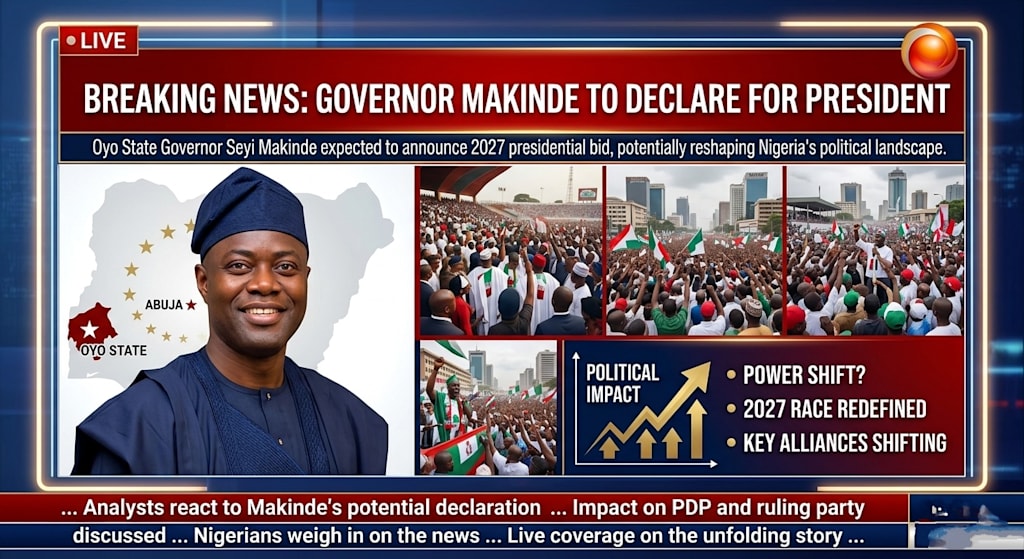
On Thursday, May 14, all eyes in Nigerian politics are expected to turn toward Mapo Hall — the iconic colonial-era civic building in Ibadan where Oyo State Governor Seyi Makinde is widely expected to formally declare his intention to contest the 2027 presidential election.
If he does, the announcement will mark far more than the launch of another presidential ambition. It could become the moment Nigeria’s opposition politics officially enters a new and unpredictable phase.
Why Makinde Matters Nationally
At 55, Seyi Makinde has spent the last several years quietly building a reputation very different from the style traditionally associated with Nigerian power politics.
Unlike many national figures known primarily for fiery rhetoric or political patronage networks, Makinde has cultivated an image centered on technocratic governance and administrative competence. Since first winning the Oyo governorship under the Peoples Democratic Party in 2019 and securing re-election in 2023, he has focused heavily on infrastructure projects, education reform, agribusiness expansion, healthcare investment, and state-level economic management.
Even critics often acknowledge his disciplined managerial style.
That matters because Nigeria’s political atmosphere has changed dramatically since the 2023 elections. Economic hardship, inflation, fuel subsidy removal, naira instability, and rising insecurity have created widespread frustration among younger voters and urban professionals who increasingly prioritize competence over traditional political slogans.
The PDP’s Identity Crisis
The timing of Makinde’s anticipated declaration is especially significant because the Peoples Democratic Party remains deeply fragmented after its bruising defeat in 2023.
That election shattered assumptions about Nigeria’s long-standing two-party dominance. Bola Tinubu and the ruling All Progressives Congress secured victory, but the opposition vote splintered dramatically between former Vice President Atiku Abubakar and Peter Obi.
For the first time in decades, the PDP was no longer the unquestioned primary alternative to the APC.
Internal divisions worsened afterward. Regional tensions, leadership disputes, and questions over zoning weakened party cohesion. Some PDP figures blamed Atiku’s candidacy for alienating southern voters. Others argued the party lacked a coherent post-election strategy.
Makinde has increasingly positioned himself as a potential solution to that crisis.
His appeal lies partly in geography and generational change. As a relatively younger southern governor with strong technocratic branding, he offers a contrast both to older establishment politicians and to the populist outsider energy associated with Peter Obi.
The Emerging Coalition Politics
Reports surrounding Thursday’s rally suggest the event may involve more than a simple presidential declaration.
Sources indicate that Makinde could also unveil a political alliance between the PDP and the Allied Peoples Movement — a move interpreted by many analysts as the early architecture of a broader opposition coalition.
The APC itself emerged from a coalition merger before winning power nationally in 2015. Many opposition strategists now believe defeating the ruling party in 2027 may require another large-scale political alliance capable of combining regional influence, youth enthusiasm, and elite political machinery.
But coalition politics in Nigeria is notoriously difficult.
Personal ambition often collides with regional expectations, ethnic balancing, zoning calculations, and internal rivalries. Every major figure wants influence. Every faction wants relevance. Every region wants representation.
Makinde’s challenge will not simply be announcing a candidacy.
It will be convincing competing opposition forces that he can unify them.
The Atiku Question
One of the biggest unanswered questions remains the future of Atiku Abubakar.
Atiku has contested for president multiple times and still commands substantial political influence, especially in northern Nigeria. Yet growing numbers within the opposition believe the country may be entering a post-Atiku political era.
This week, former Kano governor Rabiu Kwankwaso reportedly advised Atiku to “wait and see” before making decisions about 2027 — a statement widely interpreted as a warning that the opposition landscape is shifting rapidly.
If Makinde formally enters the race, pressure will intensify on senior PDP figures to clarify their positions.
Will the party embrace generational transition?
Or will old rivalries once again fracture the opposition before the campaign even fully begins?
The Peter Obi Factor Still Exists
At the same time, no serious analysis of 2027 can ignore Peter Obi.
Although his political future remains somewhat fluid after the 2023 elections, Obi still commands extraordinary grassroots enthusiasm, particularly among younger Nigerians, urban professionals, and first-time voters disillusioned with traditional party structures.
Recent reports suggesting that politicians are already changing party affiliations because of Obi’s possible involvement demonstrate how influential his political brand remains.
Even without holding office, Obi continues shaping the national conversation.
That creates a difficult strategic question for every opposition figure entering the 2027 race:
Can anyone realistically defeat the APC without some form of understanding between Makinde, Obi, Atiku-aligned structures, and other regional power brokers?
Why Mapo Hall Matters Symbolically
The choice of Mapo Hall itself carries symbolism.
Mapo Hall has long represented political activism, Yoruba civic identity, and southwestern political consciousness. Launching a presidential bid there connects Makinde’s ambition to a deeper tradition of regional political influence in Nigerian history.
And if the expected declaration happens Thursday, it may be remembered as the unofficial opening moment of Nigeria’s most consequential political season since the return to democratic rule in 1999.
Because 2027 is already shaping up to be more than a normal election.
It is becoming a contest over generational change, opposition survival, economic frustration, and the future direction of Nigerian democracy itself.
About the Creator
Enjoyed the story? Support the Creator.
Subscribe for free to receive all their stories in your feed.
Comments
There are no comments for this story
Be the first to respond and start the conversation.