
Government Bans Mondays After Public Outrage
Experts say productivity is up 400% and confusion is up “significantly more than that”

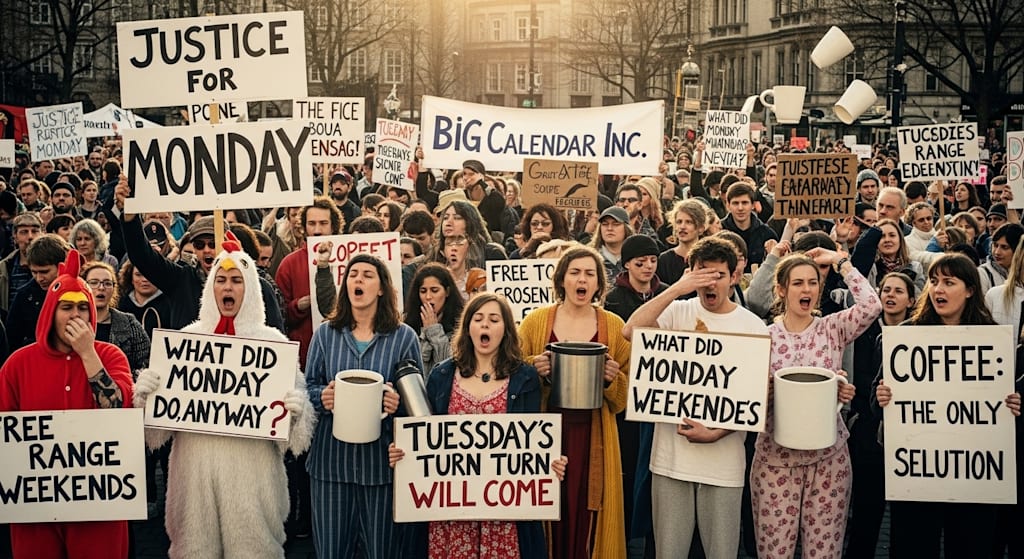
In a groundbreaking move that absolutely no one was prepared for but everyone somehow expected, the National Council for Temporal Wellbeing has officially announced the banning of Mondays.
Yes. Mondays.
Effective immediately, Monday has been declared “non-participatory in civic life” and will no longer exist in official calendars, digital systems, or emotional recognition frameworks.
Citizens were reportedly informed via emergency notification systems, though most people initially assumed it was just another software update they ignored out of habit.
The announcement read:
“After extensive research, public feedback analysis, and several emotionally distressing Zoom meetings, we have determined that Monday is no longer compatible with modern human wellbeing.”
When asked for clarification, officials confirmed that Monday will not be replaced. It will simply be “skipped.”
Tuesday will now directly follow Sunday, which experts describe as “a bold but mathematically questionable improvement to societal structure.”
Reactions have been mixed.
Some citizens expressed relief.
“I feel lighter already,” said one office worker while accidentally refreshing their calendar five times to confirm reality had not broken. “I think I’ve been emotionally allergic to Mondays my whole life.”
Others were more confused.
“If Monday doesn’t exist,” asked a concerned citizen, “what happens to all the meetings we were avoiding on Monday?”
Officials clarified that those meetings will now be “distributed evenly across the remaining emotional time units.”
No one fully understands what that means.
Meanwhile, economists are struggling to assess the impact.
Early reports suggest productivity has increased by 400%, primarily because no one is sure what day it is anymore, so everyone is just working constantly out of fear of missing something important.
“This is the most efficient chaos we’ve ever seen,” said one analyst. “We’re not sure if we’ve improved the economy or accidentally deleted time management.”
Not all reactions have been positive.
The “Monday Preservation League,” a small but emotionally passionate group, held protests outside government buildings holding signs that read:
* “What did Monday ever do to you?”
* “Justice for Monday”
* “Tuesdays are not emotionally stable enough to replace it”
One protester stated, “If we can just delete days we don’t like, what’s next? Wednesday? Emotional responsibility?”
In response, officials assured the public that Wednesday is “currently under review but emotionally stable for now.”
Meanwhile, scientists have been brought in to analyze the situation.
A leading temporal physicist explained, “Technically, Monday was never a physical object. It was a social agreement. So in theory, yes, it can be removed. But so can most things if you are confident enough.”
When asked whether time itself could be edited further, the scientist paused for a very long time and then said, “Let’s not explore that publicly.”
The most unexpected outcome of the ban has been psychological.
Many citizens report experiencing “phantom Mondays,” where they wake up feeling stressed, tired, and emotionally behind on tasks that do not exist.
Therapists have coined a new term for this condition: Post-Monday Stress Residue Disorder (PMSRD).
Symptoms include:
* Feeling exhausted without reason
* Believing emails are overdue even when none exist
* Sighing deeply while doing absolutely nothing
* Strong emotional distrust of Tuesdays
One therapist explained, “We removed Monday, but unfortunately the memory of Monday remains.”
In corporate environments, confusion has reached unprecedented levels.
Several companies accidentally scheduled “Monday meetings” on Tuesday, only to realize mid-discussion that no one was sure what they were discussing or why.
One CEO reportedly said, “We’re more productive, but also spiritually lost.”
Tech companies are now rushing to update calendars globally.
However, early beta versions have introduced a new issue: some systems are replacing Monday with “Optional Day,” which employees have already begun treating as “emotionally negotiable time.”
Social media has responded in its usual measured and rational way.
Trending posts include:
* “Monday was holding us back spiritually”
* “I always knew Monday was the villain”
* “What if we ban burnout next??”
* “Tuesday is suspicious now”
In an unexpected twist, Monday itself has not commented on the situation.
However, users have reported strange glitches where calendar apps briefly display the message:
“Monday remembers you.”
Authorities have dismissed this as a “non-critical emotional artifact.”
At press time, the government is reportedly considering additional reforms, including:
* Removing alarm clocks that sound “judgmental”
* Reclassifying emails marked “urgent” as “emotional suggestions”
* And evaluating whether “Friday afternoons” should be extended into a permanent state of mild hope
As for Monday, its fate remains sealed.
Or unsealed.
Or possibly just… postponed indefinitely.
One official summarized the situation best:
“We didn’t delete Monday. We simply made it everyone else’s problem at a different time.”
And somewhere, in a system no one fully understands, a calendar quietly updates itself—hesitates for a second—then skips forward without explanation.
About the Creator
Enjoyed the story? Support the Creator.
Subscribe for free to receive all their stories in your feed.
Comments
There are no comments for this story
Be the first to respond and start the conversation.