
Germany Sodium-ion Battery Market Set to Double by 2033 as Energy Storage Innovation Accelerates
Germany’s push toward renewable energy, battery independence, and sustainable industrial growth is creating strong opportunities for sodium-ion battery technology through 2033.

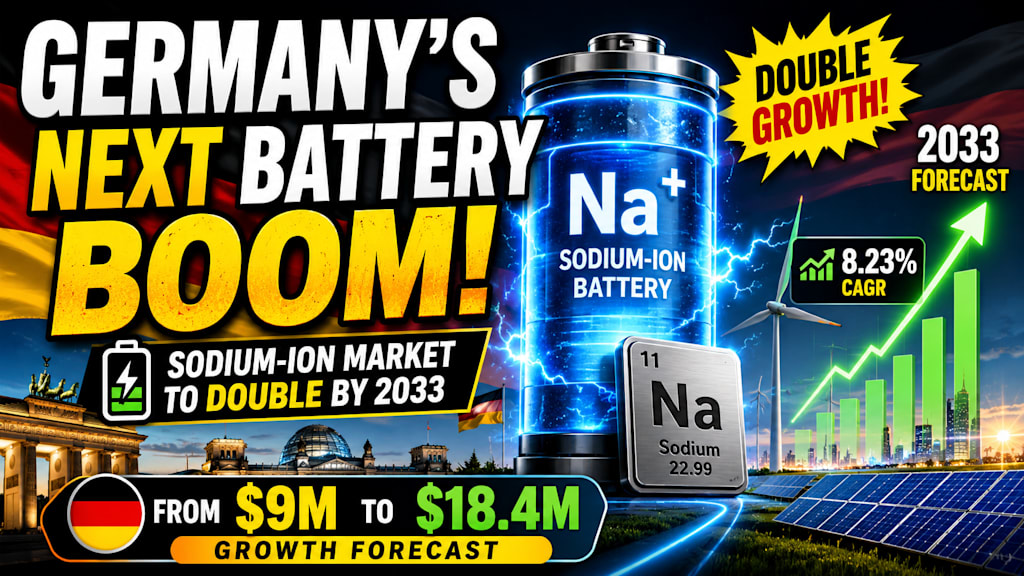
Germany Sodium-ion Battery Market Size & Forecast 2025–2033
Germany's energy transition is entering a new phase, and advanced battery technologies are becoming central to the country's long-term sustainability goals. While lithium-ion batteries continue to dominate global markets, sodium-ion batteries are emerging as a promising alternative that could reshape energy storage economics and supply chain security.
According to Renub Research, the Germany Sodium-ion Battery Market is projected to grow from US$ 9.03 million in 2024 to US$ 18.41 million by 2033, expanding at a CAGR of 8.23% during 2025–2033.
The growth is being driven by Germany’s commitment to renewable energy integration, increasing demand for cost-effective energy storage systems, concerns regarding lithium supply chains, and growing investments in sustainable battery technologies.
As Europe seeks greater energy independence and environmentally responsible industrial development, sodium-ion batteries are gaining recognition as one of the most promising next-generation storage solutions.
Understanding Sodium-ion Battery Technology
A sodium-ion battery is a rechargeable battery that utilizes sodium ions instead of lithium ions for storing and transferring energy.
The battery consists of:
A positive electrode (cathode)
A negative electrode (anode)
A sodium-rich electrolyte
The major advantage of sodium-ion technology lies in the abundance of sodium. Unlike lithium, which is geographically concentrated and subject to supply-chain volatility, sodium is widely available and inexpensive.
This abundance provides manufacturers with an opportunity to reduce production costs while minimizing dependence on critical raw materials.
As governments and industries seek alternatives to expensive and strategically sensitive minerals, sodium-ion batteries are becoming increasingly attractive for large-scale deployment.
Germany’s Renewable Energy Revolution Creating New Opportunities
Germany's famous Energiewende, or energy transition strategy, has significantly increased the country's reliance on renewable energy sources such as wind and solar power.
However, renewable electricity generation is inherently intermittent.
Solar panels generate electricity only during daylight hours, while wind turbines depend on weather conditions. This creates a growing need for reliable and affordable energy storage systems that can balance electricity supply and demand.
Sodium-ion batteries are emerging as a strong solution for grid-scale storage because they offer:
Lower material costs
Improved safety characteristics
Reduced dependence on scarce minerals
Better tolerance to temperature fluctuations
As Germany continues expanding renewable energy capacity, large-scale storage projects are becoming essential.
In July 2025, Germany announced tenders supporting hundreds of megawatts of renewable energy projects integrated with energy storage systems. Such initiatives are expected to create substantial demand for advanced battery technologies, including sodium-ion solutions.
Strategic Need for Raw Material Independence
One of the strongest drivers behind Germany's sodium-ion battery market is the country's desire to reduce dependence on imported critical minerals.
Currently, lithium, cobalt, and nickel are essential components in conventional battery manufacturing. However, many of these materials originate from politically sensitive regions, creating supply risks and price volatility.
Germany and the European Union are increasingly prioritizing supply-chain resilience.
Sodium-ion batteries provide an attractive alternative because sodium is abundant and widely distributed globally. This helps reduce geopolitical risks while strengthening domestic manufacturing capabilities.
In February 2025, the German Federal Ministry of Education and Research (BMBF) supported the SIB:DE FORSCHUNG initiative, bringing together 21 industrial and academic partners to accelerate sodium-ion battery development and commercialization.
Such collaborative efforts demonstrate Germany's determination to become a leader in next-generation battery technologies.
Sustainability Goals Favor Sodium-ion Adoption
Environmental sustainability remains a cornerstone of German industrial policy.
Traditional lithium extraction has often been criticized for its environmental impact, including water consumption and ecosystem disruption.
Sodium-ion batteries offer several sustainability advantages:
Reduced reliance on rare minerals
Lower environmental footprint
Improved recyclability
Alignment with circular economy principles
As industries face increasing pressure to meet carbon reduction targets, sodium-ion technology presents an environmentally responsible alternative.
Germany’s automotive, manufacturing, and energy sectors are actively exploring cleaner technologies that support long-term sustainability goals.
The growing emphasis on environmentally friendly innovation is expected to further accelerate sodium-ion battery adoption across multiple industries.
Research and Development Driving Market Expansion
Germany has long been recognized as a global innovation hub, particularly in engineering and advanced manufacturing.
Research institutions, universities, and technology companies are investing heavily in sodium-ion battery development.
A notable example is the Four-Volt Sodium-Ion Battery (4NiB) project launched in January 2024.
Led by researchers from the Helmholtz Institute Ulm in collaboration with the Center for Solar Energy and Hydrogen Research Baden-Württemberg and other partners, the project aims to develop affordable and environmentally sustainable sodium-ion batteries using organic waste-derived materials.
The initiative received funding of approximately €1.35 million from the Federal Ministry of Education and Research.
Projects like these are helping Germany build the technological foundation required for future commercial deployment.
Key Challenge: Lower Energy Density
Despite its advantages, sodium-ion battery technology faces several obstacles.
The most significant challenge is lower energy density compared with lithium-ion batteries.
Energy density determines how much energy can be stored within a specific battery size and weight.
This limitation affects applications where long driving ranges and compact battery packs are essential, particularly premium electric vehicles.
Germany's automotive industry is globally known for producing high-performance vehicles. Manufacturers may be reluctant to replace lithium-ion technology until sodium-ion batteries achieve further performance improvements.
Although sodium-ion batteries perform well in stationary storage and urban transportation applications, technological advancements are still required before they can compete directly in long-range electric vehicle segments.
Commercial Ecosystem Still Developing
Another challenge involves the relatively immature commercial ecosystem surrounding sodium-ion batteries.
Lithium-ion technology benefits from decades of development, extensive manufacturing infrastructure, and established supply chains.
In contrast, sodium-ion battery production remains in its early stages.
Many projects are still operating at pilot scale, while large-scale manufacturing facilities remain limited.
Without substantial investment in production capacity, commercialization may progress more slowly than anticipated.
Public-private partnerships and government support will play a crucial role in accelerating industrial readiness and reducing production costs.
Sodium-Sulphur Batteries Strengthening Grid Applications
Germany has already gained experience with sodium-based battery technologies through sodium-sulphur (NaS) batteries.
These batteries are widely recognized for:
High energy density
Long operational life
Suitability for large-scale storage
Utilities use sodium-sulphur batteries to manage fluctuations in renewable electricity generation and improve grid reliability.
However, high operating temperatures and safety considerations remain important challenges.
Continuous advancements in thermal management technologies could expand the role of sodium-sulphur batteries within Germany's renewable energy ecosystem.
Sodium-Air Batteries Represent Future Potential
While sodium-ion batteries are moving closer to commercialization, sodium-air batteries remain largely in the research phase.
German universities and research institutions are actively exploring this technology because of its exceptionally high theoretical energy density.
Potential advantages include:
Lightweight designs
Lower material costs
Improved sustainability
Research centers in cities such as Berlin and Munich continue developing prototype systems.
Although commercial adoption may still be years away, sodium-air batteries represent a potentially transformative long-term opportunity for Germany's advanced battery industry.
Transportation Sector Emerging as a Key Opportunity
Sodium-ion batteries are increasingly attracting attention in Germany's transportation sector.
Applications currently being explored include:
Electric buses
E-bikes
Urban logistics vehicles
Delivery fleets
Urban mobility solutions often prioritize affordability, safety, and reliability over maximum driving range.
This creates favorable conditions for sodium-ion technology.
As German cities continue pursuing sustainability initiatives and low-emission transportation systems, sodium-ion batteries may become an important component of future urban mobility infrastructure.
Automotive Industry Exploring Cost-Effective EV Solutions
Germany is home to some of the world's largest automobile manufacturers.
As electric vehicle adoption accelerates, automakers are seeking ways to reduce battery costs without compromising performance.
Sodium-ion batteries offer several benefits:
Lower material expenses
Improved safety
Reduced environmental impact
Greater supply-chain security
Although premium vehicle segments may continue relying on lithium-ion batteries, sodium-ion technology could prove highly attractive for affordable EV models and city vehicles.
Collaborative pilot programs between battery developers and automotive manufacturers are expected to increase in the coming years.
Industrial Sector Expected to Drive Strong Demand
Germany's industrial economy depends heavily on reliable energy infrastructure.
Manufacturing facilities increasingly require energy storage systems that can:
Reduce electricity costs
Manage peak demand
Support renewable energy integration
Provide backup power during outages
Sodium-ion batteries are well-positioned to serve these needs.
Their safety characteristics, affordability, and sustainability advantages make them appealing for factories, warehouses, and industrial campuses.
Small and medium-sized enterprises are also beginning to recognize the potential benefits of adopting sodium-based storage technologies.
As industrial electrification continues, this segment may become one of the largest sources of future demand.
Regional Outlook: Bavaria Leading Innovation
Bavaria
Bavaria remains one of Germany's most important centers for battery innovation.
The region combines:
World-class automotive manufacturers
Leading universities
Advanced research institutions
Strong industrial infrastructure
These strengths are fostering partnerships between startups, automakers, and academic organizations focused on sodium-ion battery development.
Berlin
Berlin serves as Germany's political and startup capital.
Government-supported innovation programs and venture-funded technology companies are actively exploring sodium-ion applications.
The city's commitment to sustainability and smart-city initiatives creates a favorable environment for emerging energy storage technologies.
Hamburg
Hamburg's strategic importance as a logistics and renewable energy hub creates significant opportunities for sodium-ion batteries.
Applications include:
Port operations
Warehousing
Fleet electrification
Offshore wind energy storage
As Hamburg continues pursuing decarbonization goals, sodium-ion technologies may play an increasingly important role in regional energy infrastructure.
Competitive Landscape
The Germany Sodium-ion Battery Market features a mix of established battery companies, innovative startups, and emerging technology developers.
Key market participants include:
Altris AB
Faradion Limited
AMTE Power plc
Natron Energy Inc.
Aquion Energy
NGK Insulators Ltd.
HiNa Battery Technology Co. Ltd.
Tiamat Energy
NEI Corporation
10 Recent Industry Developments Shaping the Sodium-ion Battery Market
Altris AB expanded development of high-performance Prussian White cathode materials for sodium-ion batteries.
Faradion Limited continued commercial partnerships aimed at scaling sodium-ion battery manufacturing globally.
Natron Energy accelerated production plans for sodium-ion batteries targeting industrial and data-center applications.
Tiamat Energy advanced fast-charging sodium-ion battery prototypes for transportation applications.
Germany's SIB:DE FORSCHUNG initiative united 21 research and industry partners to strengthen sodium-ion innovation.
The 4NiB Project advanced sustainable sodium-ion battery development using organic waste-derived materials.
European policymakers increased support for battery technologies that reduce dependence on critical minerals.
Multiple German renewable energy projects began integrating advanced energy storage solutions into new installations.
Research institutions across Berlin and Munich expanded sodium-air battery development programs.
Automotive manufacturers increased evaluation of sodium-ion batteries for affordable electric mobility solutions.
Final Thoughts
Germany's sodium-ion battery market is entering a period of significant growth and technological advancement. Rising renewable energy deployment, increasing concerns about lithium supply chains, sustainability objectives, and industrial demand for cost-effective energy storage are all contributing to market expansion.
With the market expected to grow from US$ 9.03 million in 2024 to US$ 18.41 million by 2033, sodium-ion batteries are poised to become an important complement to lithium-ion technologies rather than a direct replacement.
While challenges related to energy density and commercialization remain, Germany's strong research ecosystem, government support, and industrial expertise position the country as one of Europe's most promising centers for sodium-ion battery innovation. As the energy transition accelerates, sodium-ion technology could become a critical pillar of Germany's future clean-energy landscape.
About the Creator
Enjoyed the story? Support the Creator.
Subscribe for free to receive all their stories in your feed.
Comments
There are no comments for this story
Be the first to respond and start the conversation.