
From Sunflower Seeds to Lithium Ore
The U.S. Just Blacklisted 43 Chinese Companies in One Sweep. It's Not About Forced Labor — It's About Who Controls the Supply Chain.
Washington, D.C., August 3, 2026 – 00:00 EST.
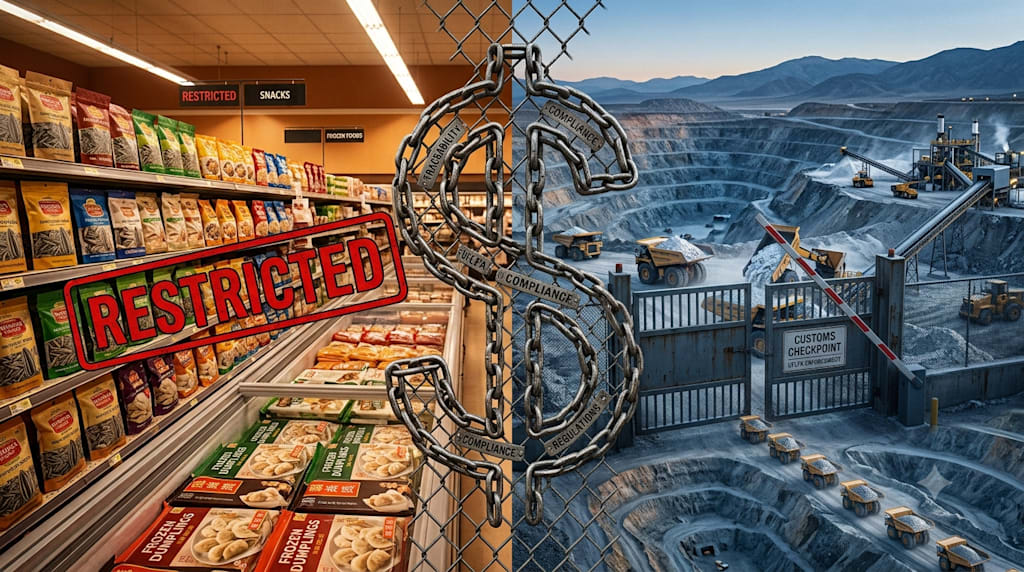
The U.S. Department of Homeland Security's updated import restriction list took effect at midnight. ChaCha Food's sunflower seeds, Synear's frozen tangyuan, Septwolves' jackets, and SDIC Xinjiang's lithium concentrate – products from these 43 Chinese companies – were now barred at the U.S. customs gate. (Note: one em dash kept for clarity.)
This was the largest single expansion since the Uyghur Forced Labor Prevention Act (UFLPA) came into force. The number of Chinese entities on the list jumped from 144 to 187 – a 30% increase. It was also the first time the Trump administration had touched this list since taking office.
Just 24 hours before the announcement, a high-level U.S.-China economic and trade video call had concluded. The readout contained one word: constructive.
The blacklist contained no such word.
I. The UFLPA Logic: The Law Doesn't Ban, But Compliance Costs Can Kill a Deal
The difference between the UFLPA and the chip ban lies in the reversal of the burden of proof.
The chip ban says, "You cannot sell." The UFLPA says, "You can sell, but you must prove that what you sell has no connection to Xinjiang." U.S. Customs requires importers to submit full-chain traceability documents – from planting or mining to factory gate – including origin certificates for each batch of raw materials, employment records for every production step, and bank statements for every wage payment.
For a bag of sunflower seeds, tracing every single seed back to its specific field costs more than the seeds themselves.
So this is not "full decoupling." The U.S. has not cut off the global circulation of sunflower seeds or tangyuan. Instead, it has set an entry bar so high that most suppliers cannot clear it. The gate is not locked, but the threshold is prohibitive for all but a few.
The 43 newly added companies span five industries – food, textiles, pharmaceuticals, non-ferrous metals, and lithium battery materials. Though the sectors are diverse, they share a single thread: all have links to Xinjiang in raw material procurement, production processing, or labor flow.
Shandong Weiqiao, the world's largest cotton textile firm, sources its cotton from Xinjiang. SDIC Xinjiang Lithium is an upstream node in the global new-energy supply chain, with its lithium concentrate mined in Xinjiang. ChaCha Food's sunflower seed procurement network covers Xinjiang's growing regions.
The U.S. is not targeting "Made in China" – it is targeting the "Xinjiang label." Its method is not an embargo, but a compliance regime that strangles supply chains.
II. Three Layers of Intent
(i) On the Campaign Trail: A Bag of Seeds Tells a Better Story Than a Chip
2026 is a midterm election year.
The chip ban is a complex narrative – you have to explain "advanced nodes," "lithography machines," "strategic competition." But a bag of seeds, a down jacket, a box of cold medicine – every American voter has touched these in a supermarket. Using "forced labor" to block them has low narrative cost and high transmission efficiency.
On August 3 itself, Congressman John Moolenaar, chair of the House Select Committee on the Chinese Communist Party, posted a tweet with a photo of Chinese food products on a supermarket shelf. The caption read: "Is there slave labor in your shopping cart?"
That tweet reached more people than any white paper on semiconductor supply chains.
(ii) Supply Chain Rules: America Is Writing a New Playbook
The UFLPA's ambition lies not at U.S. Customs, but inside the compliance departments of global purchasers.
When lithium ore (a core new-energy material) and active pharmaceutical ingredients (a public health necessity) are put on the blacklist, the U.S. sends a signal to multinationals in the EU, Japan, South Korea, and Southeast Asia: if you use Xinjiang-sourced materials, your products won't enter Western mainstream markets.
BMW, Apple, Pfizer – their compliance teams now face a choice: keep their China market profits, or secure their U.S. and European market access.
This is not a trade war. It is a battle over who sets supply chain standards. The U.S. is writing a handbook with a new clause: "free of Xinjiang components." Every company that wants to enter its market must buy according to that handbook.
(iii) At the Negotiating Table: The Blacklist Is a Stack of Chips
The U.S.-China call 24 hours before the list took effect was no coincidence.
"Adding pressure on the eve of talks" is a standard U.S. tactic. Expanding sanctions from semiconductors to food and pharmaceuticals raises the stakes for Beijing – food security and drug supply are directly tied to social stability. Washington is building a chip heavy enough to bring Beijing to the table.
III. The Shockwaves: Not Just Exports Blocked, but a Trust Discount
At the micro level: Whether Synear's tangyuan actually sell in the U.S. doesn't matter.
Synear's direct exports to the U.S. account for a tiny fraction of its total revenue. The damage lies elsewhere: Walmart, Costco, Sam's Club – these global retailers' compliance teams are now doing one thing: preemptive delisting. To avoid a future shipment being seized by U.S. Customs, they simply stop sourcing the entire product category from China. It's not just Synear being blocked – the entire category's channel has narrowed.
At the meso level: Lithium salt prices jumped 12% within 48 hours of the list's publication.
This is no coincidence. SDIC Xinjiang Lithium is one of China's major lithium concentrate suppliers. Its products blocked at the U.S. gate create a gap in the global lithium supply chain. Australian mines can fill that gap, but their expansion cycle is 18 months. In the short term, the gap is bridged by price. The ultimate payers for that 12% are European EV makers and American battery plants – and then it trickles down to global consumers' car-purchase costs.
At the macro level: The UFLPA has shifted from a "presidential executive order" to a "congressional statute."
This distinction matters. An executive order can be overturned by the next president; a congressional statute requires both chambers to vote. The UFLPA has been law for five years, and this expansion signals that its enforcement mechanism is becoming institutionalized. The window for repairing U.S.-China economic ties is narrowing – not because the White House has a new occupant, but because this legal framework now has its own inertia and momentum.
IV. What Can China Do?
On the legal front: Is a WTO complaint useful?
The WTO Appellate Body is paralyzed, so a lawsuit may not yield a ruling. But the point of litigation is not victory – it is delay and documentation. China can join with countries that rely on Chinese APIs – India, Brazil, South Africa – to file a case under existing dispute settlement mechanisms, arguing that the U.S. violates non-discrimination principles. Even without a final ruling, every hearing is an evidence stage on the international stage of public opinion.
On the supply chain front: Traceability is the hard skill.
In the short term, listed companies need to do one thing: isolate non-Xinjiang raw material supply chains and build digital traceability files. This is costly and time-consuming, but without it, compliance is impossible. In the long term, the pace of export market diversification must accelerate. RCEP members, Central Asia, the Middle East – these markets have enough incremental space to absorb the current share of U.S.-bound exports.
On the narrative front: Show, don't rebut.
"Forced labor" is a lie of the century – Beijing has said this many times. But a more effective approach is to invite foreign media and diplomats to walk through Xinjiang factory floors, look at attendance sheets, pay stubs, and assembly lines. Show, instead of rebut – because rebuttal is a declaration, while showing is evidence.
V. Closing
On August 3, a new batch of Harmonized System codes was locked into U.S. Customs' system.
ChaCha's production lines did not stop. Synear's packaging lines ran as usual. The haul trucks at Xinjiang's lithium mines kept dumping ore at the crushers around the clock.
These assembly lines will not halt because of a list from across the ocean. But every company's compliance department now has one more position. Every export contract now has one more page of traceability documentation. Every shipment's customs declaration now has one more blank line waiting for a customs stamp.
This is not the end of a battle. It is the routinization of a new set of rules.
It is not called "decoupling." It is called "conditional access." And that condition is getting more expensive by the day.
About the Creator
Jin
Writer of reamstories
https://reamstories.com/jin
Enjoyed the story? Support the Creator.
Subscribe for free to receive all their stories in your feed. You could also become a paid subscriber, letting them know you appreciate their work.
Comments
There are no comments for this story
Be the first to respond and start the conversation.