
France's Campus Powder Keg: 1,000 Schools, 2,397 Arrests, and a Budget That Ran Out
The street fights look like a fuel revolt. The paper trail runs through debt interest, a broken admissions platform, and a generation priced out of its own future.
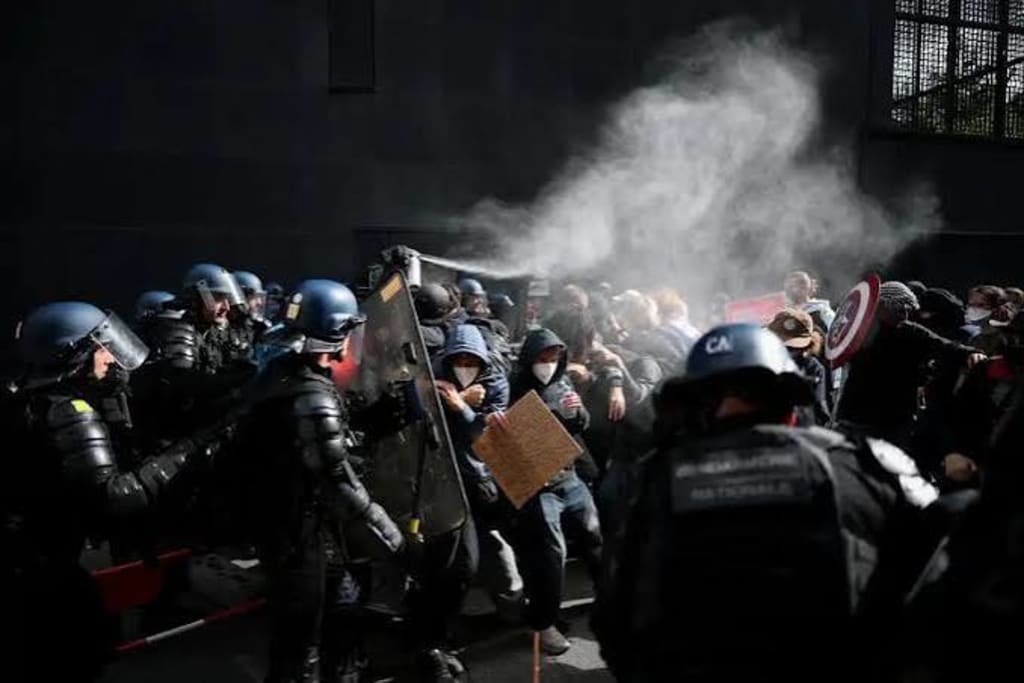
In October, French streets became the place where political pressure gets measured. On October 17, protests over the cost of living and fuel prices broke out in Paris and other cities. The Interior Ministry counted about 550,000 protesters nationwide, including 110,000 in Paris. The CGT counted 800,000. By the end of the day, 2,397 people had been arrested. 997 police officers and gendarmes were injured, seven seriously. On October 18, Macron gave a televised address. He condemned the violence and said no reason could justify it. He also said he understood young people's anxiety, promised talks with students, teachers, and unions, and said he would visit Gulf countries on October 19 to secure energy supplies.
That scene reads like a sudden riot set off by fuel prices. A second timeline matters more. On October 2, more than 400 schools across France closed and moved online as high school protests intensified. By October 1, more than 1,020 schools had joined the protests, over a quarter of all secondary schools in France. On September 28, the number was 180. The unrest lasted nearly two weeks. Thousands were detained. Protesters set several schools on fire. The timing collided with the 2027 presidential campaign and negotiations over a new budget.
The useful question: why did campuses become the powder keg, and why did an education protest merge so fast with fuel prices, youth unemployment, and election politics?
The answer sits in a chain of numbers and actions. The state has no money. Universities have no seats. Young people see no future. Political actors turned the anger into a bargaining chip at the worst possible moment.
Debt interest beat the education budget
"The state has no money" is correct and useless. The better question is where the money went.
France's public debt reached about 116.2% of GDP in 2025. Debt interest payments alone came to about 66 billion euros. That exceeded the Education Ministry's budget of 64.3 billion euros for the first time in history. The gap is expected to widen in 2026. The 2026 budget plan would cut 1.5 billion euros from higher education and research. 67 universities are running deficit budgets. More than 30,000 bachelor's and master's places face cuts. Nearly 80% of universities were already in deficit in 2025.
French higher education is shrinking while it tries to reform. The number of university-age students is still rising slowly. University places, teachers, and buildings are not. The old promise that every student who passes the BAC gets a university place no longer matches the material base.
When resources stop growing, reform becomes a fight over who absorbs the anxiety. Once that anxiety is distributed, it looks for an exit.
Parcoursup made scarcity look like fairness
The admissions fight centers on Parcoursup. The platform replaced a lottery. The lottery had an obvious flaw. Getting into university depended on luck, not grades. After the 2018 reform, universities stopped drawing lots and started reviewing files by hand.
France has no simple national score to compare applicants. The high school system gives teachers wide control. The state writes the syllabus. Teachers decide how to teach it, what to teach first, which textbook to use, or whether to write their own. Teaching pace varies. In-school exams are written and graded by the subject teacher. A university that looks only at grades cannot tell whether an 80 from a famous school beats a 90 from an ordinary one. A university that adjusts for school ranking gets accused of backroom dealing.
Reform went in circles. In 2019, the government tried national exams in the first and second years of high school. The pandemic disrupted the plan in 2020. The exams were scrapped in 2021. In 2023, the government tried a single national exam in the final year and moved the big test to March, while still expecting students to attend class afterward. Teachers revolted. The final semester lost its teaching order. That exam was dropped too. Admissions returned to school grades, teacher comments, cover letters, and extracurricular records.
The system turns two years of high school into a slow-motion gaokao. Every exam and every comment in the second and third years can enter the file. Students face part of the gaokao every week. Parents fight teachers over one point. Some bring lawyers to inspect exam scripts and sue schools over unfair grading. Teachers burn out. Students drown in anxiety. Admissions staff wade through piles of files. Better-off students can polish extracurricular records, cover letters, and school pedigree. Students from suburbs and low-income families face a screening system they cannot see or control.
A 2025 survey found that only 34% of candidates considered Parcoursup fair. 83% called the process anxiety-inducing. A parliamentary report published in 2025 said the current system helps maintain social and cultural inequality. After the main admissions phase ended in July 2026, about 100,000 students still had no offer.
University admission has turned from a right into a long bidding contest that rewards luck, background, information, and psychological endurance. Anger then becomes a challenge to the system's legitimacy.
The educational promise ends in a thin bank balance
If the protest were only about Parcoursup, it might not have turned violent. Student anger spreads because it lands on a fragile base.
In 2025, unemployment among French 15-to-29-year-olds jumped 2.8 percentage points to 21.5%. Nearly a quarter of young people had less than 100 euros a month after rent. More than three-quarters had to monitor every euro. Nearly a third said their income could not cover their costs.
Parcoursup sells a path from education to stability. The path now ends in a weaker credential, a fragmented job market, and relentless living costs. When students say "they took our future," they are describing a balance sheet. They see a passage that gets narrower and more expensive at every step. They do not see a line from effort to exam to admission to job.
That explains why the protest moved from high schools to unions, parents' groups, and wider public audiences. Parents know the anxiety. Teachers know the system failure. Unions know the purchasing power squeeze. The sense that young people have been robbed of a future crossed generational lines.
Election timing turned anger into fuel
The protests hit at the end of Macron's second term, as the 2027 presidential campaign heats up and budget talks continue. Polls put far-right candidate Le Pen ahead in the first round. Far-left candidate Mélenchon has about 40% support among voters aged 18 to 24. He mobilizes well in immigrant-heavy suburbs such as Seine-Saint-Denis.
Student anger became a resource that several camps wanted. Mélenchon and La France Insoumise stood with students and condemned police tactics. Le Pen called for more police power to restore order. An internal report for the Paris police prefecture alleged that far-left union activists and political groups had incited students. In that polarized setting, street clashes paid better than peaceful campus blockades. Violence brought media attention and political leverage.
France has a deep protest repertoire. Student movements in 1990 and 1998 used blockades and demonstrations to force education funding concessions. The fiscal room has shrunk. The government cannot solve the problem by writing a check. The old script lost its soft exit. Violence moved from the edges toward the front.
Macron's October 18 speech captured the trap. He condemned violence and demanded legal consequences. He also said he understood young people's anxiety and promised talks with students and teachers. He asked the government to improve information gathering and forecasting. If the budget structure stays the same, university places keep shrinking, and admissions stay opaque, the street will read "understanding" as a gesture.
Scarcity politics does not leave on its own
The thousand-school protest became a riot through a chain. Debt interest squeezes education. The system distributes scarce seats while shrinking. Parcoursup produces opacity and class anxiety without a comparable national score. Youth unemployment and living costs strip the educational promise of credibility. The 2027 election and budget talks turn street anger into political currency. These pieces lock together. A technical fix cannot open the lock.
Violence cannot be rationalized. Arson, attacks on police, and damage to shops have no excuse. But condemning the flames without examining the gunpowder guarantees another fire on another campus, another street, another budget deadline.
The fight is about who carries the scarcity. As long as debt interest eats the education budget, university places get cut, admissions standards swing between transparency and opacity, and young people cannot see a stable life after school, the street will speak earlier and louder than the ballot box.
France needs a serious argument about spending priorities, educational fairness, and the future of young people. Without that argument, the thousand-school protest will become a footnote to a recurring politics of scarcity.
About the Creator
Jin
Writer of reamstories
https://reamstories.com/jin
Enjoyed the story? Support the Creator.
Subscribe for free to receive all their stories in your feed. You could also become a paid subscriber, letting them know you appreciate their work.
Comments
There are no comments for this story
Be the first to respond and start the conversation.