
France Social Media Ban: Why the Under-15 Restrictions Were Blocked and What Happens Next
Best choice because the article focuses on government legislation, constitutional rights, regulation, freedom of expression, and President Macron’s policy.
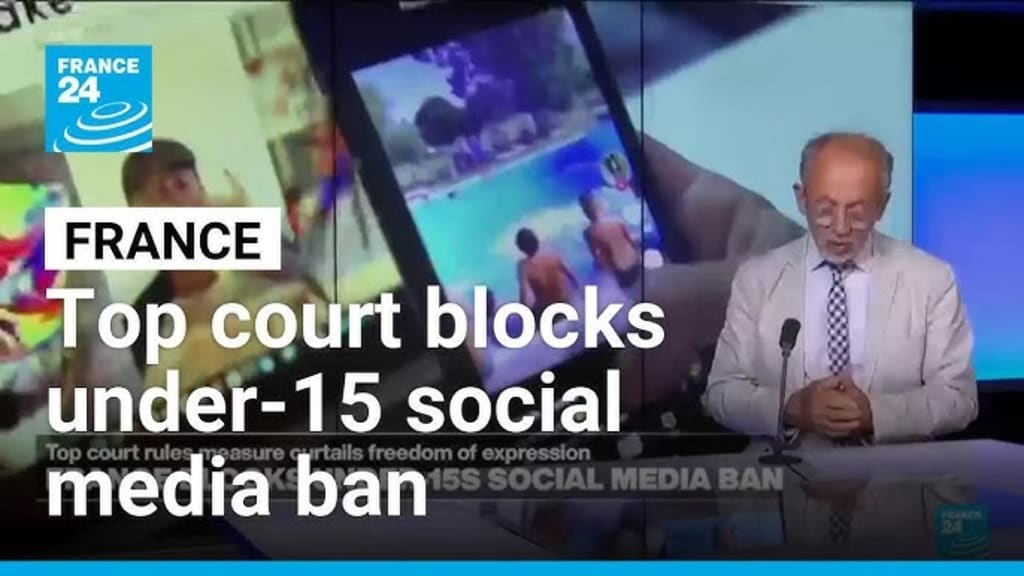
France has become a major battleground in the global debate over how governments should regulate social media access for children. In July 2026, French lawmakers approved legislation that would have prevented children under 15 from accessing social media platforms. The proposal was designed to address concerns about online bullying, harmful content, addictive platform features, privacy, and the wider effects of social media on young people.
However, the planned French social media ban has now encountered a major legal setback. On August 14, 2026, France's Constitutional Council blocked the legislation, ruling that parts of the measure violated fundamental freedoms, including freedom of expression and privacy.
The decision does not necessarily end France's effort to restrict children's social media use. President Emmanuel Macron has instructed the government to revise the legislation, creating the possibility of a new proposal with stronger legal safeguards.
Why France Wanted a Social Media Ban
The proposed ban was driven by growing concern about the effects of social media on children and teenagers. French officials have argued that young people can be exposed to cyberbullying, harmful material, excessive screen use, and online pressures that can affect their development.
Macron has repeatedly called for stronger protection of children from social media. Earlier in 2026, he urged young people to spend less time on their phones and more time reading and developing skills outside digital platforms.
French lawmakers approved the under-15 restriction in July, making France the first European country to formally adopt legislation modeled on Australia's stronger restrictions for young users.
The proposed system would have required social media companies to prevent children below the age threshold from creating or maintaining accounts.
How the Proposed Ban Would Have Worked
The legislation was designed around age verification. Social media platforms would have been required to use systems capable of determining whether a user was at least 15 years old.
Existing accounts belonging to children under 15 would have been subject to closure after the law took effect. The original plan envisioned the restrictions beginning from September 1, with existing accounts potentially being shut down within four months.
The French privacy regulator would have played an important role in approving age-verification technology. The objective was to prevent children from simply entering a false birth date when registering for an account.
However, age verification creates another difficult problem: privacy.
The Privacy Challenge
To determine someone's age, online platforms may need users to provide additional information. That could include official identification, biometric information, or other methods of verifying identity.
This creates concerns about how personal information would be collected, stored, processed, and protected.
France's Constitutional Council specifically criticized the legislation because it did not sufficiently define the conditions and limits under which age verification information would be provided. The Council concluded that the measure created disproportionate restrictions on freedom of expression and did not provide adequate safeguards for private life.
The ruling highlights one of the central problems facing governments around the world: protecting children online without creating excessive surveillance of the entire population.
Free Speech Versus Child Protection
The French debate reflects a much larger conflict between two important principles.
On one side, governments and child-safety advocates argue that children need stronger protection from online harms. Social media platforms can expose young users to harassment, dangerous challenges, inappropriate content, and algorithmically promoted material.
On the other side, critics argue that blanket age restrictions can interfere with freedom of expression and legitimate access to information.
Teenagers also use social media for education, communication, entertainment, creativity, and maintaining relationships. A complete restriction could therefore affect legitimate activities as well as harmful ones.
The Constitutional Council's decision shows that lawmakers cannot simply focus on the intended benefits of a policy. They must also demonstrate that restrictions are legally precise and proportionate.
Macron Wants a Revised Law
Although the court blocked the legislation in its current form, the French government has not abandoned the objective.
Macron has ordered Prime Minister Sébastien Lecornu to revise the proposal so that it addresses the Constitutional Council's concerns. The French presidency has indicated that Macron remains determined to introduce stronger protections for children before the 2027 presidential election.
A revised law could attempt to improve age-verification rules, strengthen privacy protections, clarify which platforms are covered, and provide more precise legal safeguards.
The challenge will be creating a system that is effective enough to protect minors while still respecting constitutional rights.
France Is Part of a Global Trend
France is not alone in considering restrictions on children's social media use. Australia introduced the world's first nationwide social media ban for children under 16 in December 2025.
Other countries, including Denmark, Spain, Greece, Malaysia, Turkey, and the United Arab Emirates, have also introduced or considered restrictions aimed at younger users. The European Union is separately examining stronger protections against harmful social media features and addictive digital design.
Australia's experience has also demonstrated how difficult enforcement can be. Recent Australian data indicated that more than eight in ten teenagers were still using social media three months after the restrictions came into effect, raising questions about how effectively age-based bans can be enforced online.
What Social Media Companies Face
Technology companies are likely to remain central to the debate. Platforms such as TikTok, Instagram, Snapchat, YouTube, Facebook, and other major services would potentially have to develop or adopt reliable age-verification systems.
Companies have generally argued that they already have measures designed to protect younger users, while also facing increasing pressure from governments and child-safety organizations.
A French law could therefore create significant technical and financial obligations for technology companies operating in the country.
What Happens Next?
The immediate next step is for the French government to rewrite the legislation. The revised proposal will need to address the constitutional concerns that caused the original bill to fail.
The government could focus on narrower restrictions, stronger privacy protections, clearer rules for age verification, or a combination of these approaches.
The outcome will be closely watched across Europe because France's approach could influence other countries considering similar measures.
Conclusion
France's social media ban debate represents a much larger global question: how can societies protect children online without unnecessarily restricting freedom, privacy, and access to information?
The Constitutional Council's August 2026 decision has stopped the current under-15 ban, but it has not ended France's effort to regulate social media for children. Macron's government now faces the difficult task of creating legislation that can survive constitutional scrutiny while achieving its child-protection objectives.
The future of France's social media policy will depend on finding a careful balance between safety and individual rights. Whatever solution emerges could become an important model—or warning—for other countries considering similar restrictions.
About the Creator
Enjoyed the story? Support the Creator.
Subscribe for free to receive all their stories in your feed.
Comments
There are no comments for this story
Be the first to respond and start the conversation.