
Europe’s Commercial Drone Boom: How Smart Skies Are Creating a Multi-Billion Dollar Market by 2034
From agriculture and logistics to law enforcement and construction, Europe’s drone revolution is accelerating faster than ever.

Europe is entering a new era of commercial aviation—but this time, no pilots are sitting inside the aircraft.
Commercial drones, once considered niche gadgets or experimental tools, are now becoming a core part of Europe’s digital economy. Businesses across the continent are using drones for mapping land, monitoring crops, inspecting bridges, surveying construction sites, delivering goods, and even assisting emergency services.
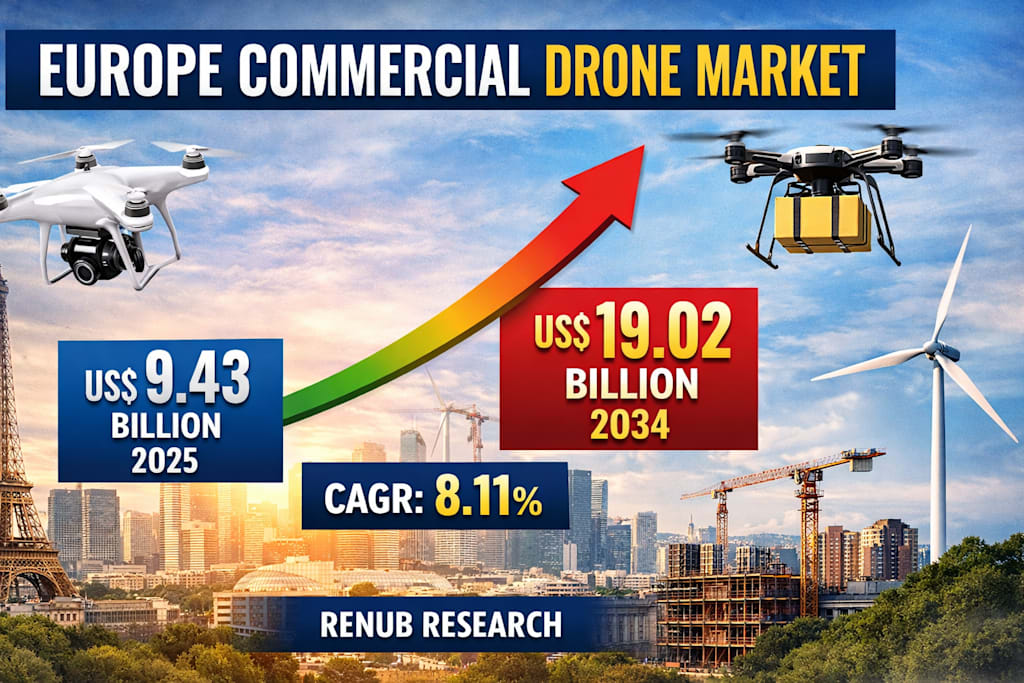
According to Renub Research, the Europe Commercial Drone Market is expected to grow from US$ 9.43 billion in 2025 to US$ 19.02 billion by 2034, expanding at a CAGR of 8.11% between 2026 and 2034. This growth highlights how rapidly drones are shifting from novelty devices to essential business assets.
So why is Europe investing so heavily in drone technology—and what does the future look like?
What Is a Commercial Drone?
A commercial drone is an unmanned aerial vehicle (UAV) designed for business and industrial use rather than recreation. These drones are often equipped with:
High-resolution cameras
Thermal imaging systems
LiDAR sensors
GPS navigation
AI-powered flight controls
Automated data collection tools
Unlike consumer drones used for hobby photography, commercial drones are built for precision, safety, and efficiency.
Across Europe, these drones are replacing slow, expensive, and risky manual tasks. Whether it’s inspecting a wind turbine in Norway, surveying vineyards in Italy, or monitoring highways in France, drones are proving they can do more—with less cost and greater accuracy.
Why Europe’s Drone Market Is Growing Fast
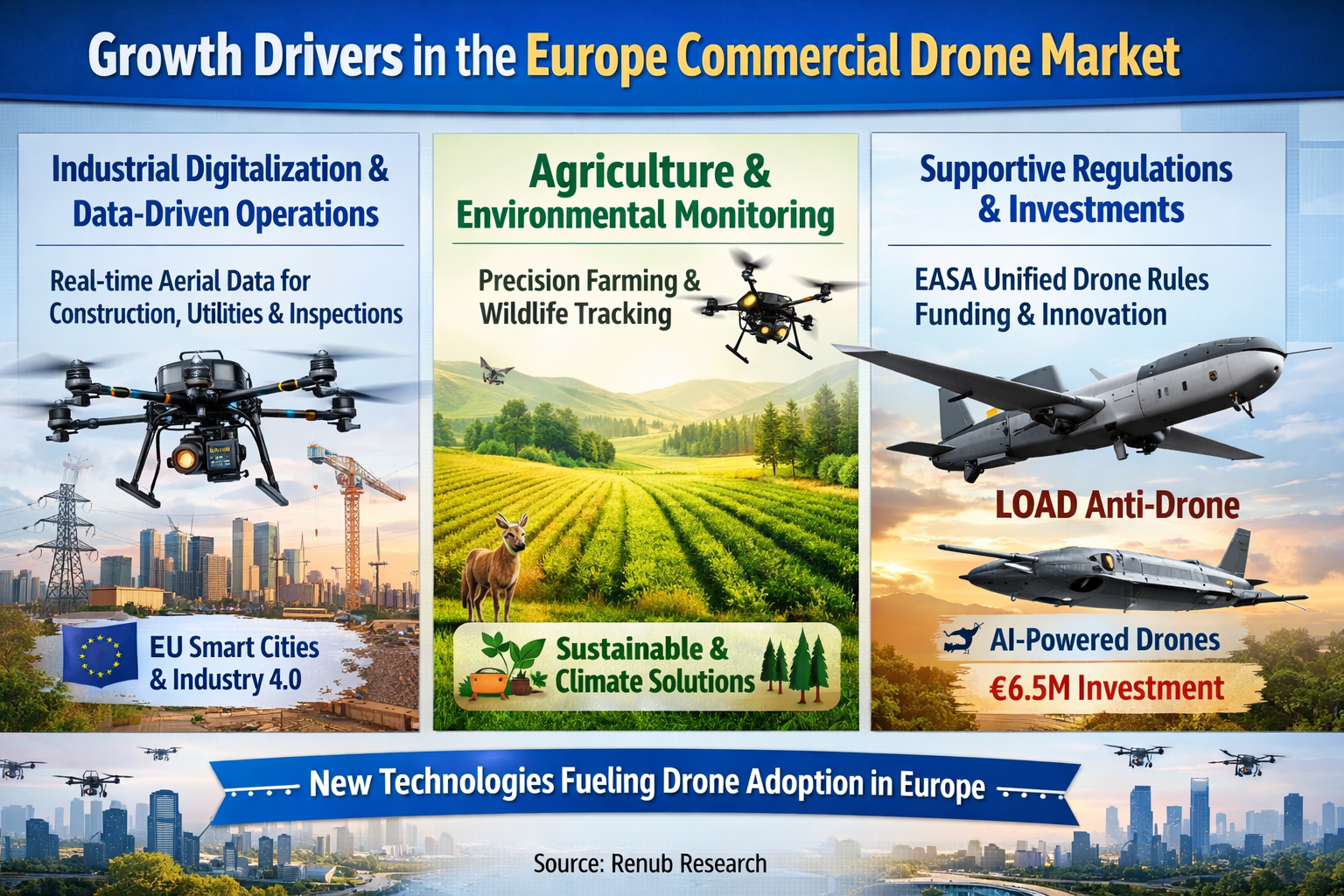
1. Businesses Need Faster, Smarter Data
Modern companies depend on real-time data. Drones can gather aerial intelligence in minutes—something that might take crews days to complete manually.
Construction firms use drones to map project progress. Energy companies inspect pipelines and solar farms. Rail networks monitor tracks and infrastructure.
This ability to collect valuable data quickly is a major reason businesses are adopting drones across Europe.
2. Agriculture Is Going High-Tech
Europe’s farming sector is changing rapidly, and drones are leading that transformation.
Farmers now use drones to:
Detect crop disease early
Monitor soil moisture
Optimize irrigation
Reduce fertilizer waste
Improve yields through precision spraying
With rising food demand and climate challenges, agriculture needs smarter tools—and drones are becoming one of the most valuable.
Countries like Italy, France, and Spain are especially active in agricultural drone adoption.
3. Strong Government Support
Europe has made significant progress in drone regulation. The European Union Aviation Safety Agency (EASA) has worked toward unified rules that help businesses operate drones across borders more easily.
This is crucial because clear regulations give investors and companies confidence.
Many governments are also funding:
Drone pilot training
Urban air mobility projects
Research labs
Testing corridors
AI navigation systems
That public-private cooperation is accelerating innovation across the region.
Top Industries Using Commercial Drones in Europe
Construction & Real Estate
Builders use drones for:
Land surveying
Progress tracking
Roof inspections
3D mapping
Safety monitoring
This reduces delays, lowers costs, and improves planning.
Energy & Utilities
Wind farms, solar plants, power lines, and pipelines are expensive to inspect manually.
Drones can perform these tasks faster and without risking worker safety.
Logistics & Delivery
Drone delivery is still developing, but Europe is making progress—especially in remote or rural regions.
Medical supplies, urgent parcels, and small goods may soon be delivered routinely by air.
Security & Emergency Services
Police and rescue teams increasingly rely on drones for:
Crowd monitoring
Missing person searches
Disaster response
Traffic surveillance
Night operations with thermal cameras
This provides real-time visibility in dangerous or urgent situations.
Why Lightweight Drones Are Winning
One of the fastest-growing segments in Europe is drones weighing under 2 kilograms.
These smaller drones are popular because they are:
Easier to transport
Simpler to license
More affordable
Ideal for urban environments
Great for photography and inspections
Small businesses, surveyors, consultants, and media creators are especially drawn to lightweight models.
France Leads the European Market
France is currently one of Europe’s strongest commercial drone markets.
Why?
Strong aerospace industry
Government support for innovation
High adoption in agriculture and construction
Investment in drone delivery and smart cities
France’s combination of engineering talent and policy support gives it a major competitive advantage.
Italy’s Unique Drone Opportunity
Italy has embraced drones in sectors that are both modern and historic.
Italian companies use drones for:
Vineyard and crop management
Bridge and road inspections
Environmental monitoring
Mapping ancient ruins and heritage sites
This blend of agriculture, tourism, and preservation makes Italy one of Europe’s most interesting drone markets.
The UK’s Fast-Moving Drone Ecosystem
The United Kingdom remains a leading innovation hub for drones.
With strong startup ecosystems, research grants, and testing programs, the UK is advancing:
Autonomous navigation
Infrastructure monitoring
Commercial mapping software
Urban air mobility
British businesses are adopting drones as efficiency and sustainability become priorities.
Challenges That Still Need Solving
Despite huge growth potential, Europe’s drone market still faces obstacles.
1. Regulatory Complexity
Even with EU progress, some countries interpret drone laws differently. This can create confusion for businesses operating internationally.
2. Battery Limitations
Many drones still face short flight times, especially when carrying heavy equipment.
3. Privacy Concerns
Public acceptance matters. Surveillance drones can raise concerns about data collection, safety, and noise.
To succeed long-term, companies must balance innovation with trust.
The Rise of Semi-Autonomous Drones
Fully autonomous drones may be the future—but semi-autonomous drones are dominating today.
These systems combine human oversight with smart automation such as:
Pre-programmed flight paths
Obstacle avoidance
Auto-return functions
Route optimization
This lowers pilot workload while maintaining safety, making them ideal for business use.
What Happens Next?
By 2034, drones may become as common in business operations as delivery vans or laptops.
We can expect growth in:
AI-powered drone fleets
Smart city monitoring
Last-mile delivery
Climate and forest tracking
Automated industrial inspections
Emergency medical transport
Europe’s focus on sustainability, innovation, and digital infrastructure makes it one of the world’s most promising drone markets.
Why This Market Matters
Commercial drones are not just about flying cameras.
They represent:
Lower business costs
Better safety
Faster decisions
Cleaner operations
Higher productivity
New job creation in tech and data services
As industries modernize, drones are becoming mission-critical tools.
Final Thoughts
Europe’s skies are changing—and this transformation is only beginning.
With the market projected to nearly double from US$ 9.43 billion in 2025 to US$ 19.02 billion by 2034, commercial drones are no longer futuristic experiments. They are real-world business solutions solving today’s biggest challenges.
About the Creator
Enjoyed the story? Support the Creator.
Subscribe for free to receive all their stories in your feed.
Comments
There are no comments for this story
Be the first to respond and start the conversation.