
Europe Is Burning (and It's Not About Ukraine)
Four countries, four different fights, one shared fuel: the euro's original sin.
The tents outside Poland's Constitutional Tribunal have been up for three weeks. October rain has made the sleeping bags heavy, but no one is pulling out. Every morning a middle-aged man in an army-green jacket hands a thermos to the people on shift. A faded sticker on the thermos reads: "2015, we won." He does not explain what it means. Across the way, the curtains in the presidential palace stay drawn.
At the same time, in a high school in the northern suburbs of Paris, rainwater is dripping through a crack in the ceiling into a plastic bucket. The bucket was brought over from the chemistry lab; its label has not been fully peeled off. A printed sheet taped to the staff-room wall says: four teaching posts unfilled this year; repair request submitted eleven months ago. Someone has added a line in ballpoint: "How many shells would that buy?"
These are not the same storm. But the wind comes from the same direction.
Four Fights, Each on Its Own Terms
The tents in Poland are not about Ukraine.
Supporters of Law and Justice (PiS) pitched camp outside the Constitutional Tribunal because they believe Tusk's government is using its parliamentary majority to rewrite the rules on judicial appointments. Tusk pushed the parliament to appoint judges including Maciej Berek. Berek is Tusk's longtime associate, a detail PiS has repeatedly amplified. President Nawrocki refuses to swear Berek in; the president of the Constitutional Tribunal refuses to let him take up the post. Kaczyński stood in front of the tents and told the crowd: "They are stealing the courts." Someone in the crowd held up a sign reading "Hands off the judges." The letters were handwritten; the marker had run in the rain.
Organizers say tens of thousands took part. Warsaw police have not released an exact figure, but several streets in the city center were indeed blocked. This is not "millions pouring into the streets." That description belongs to another story, a simpler and more satisfying one. The Polish conflict is this: in a semi-presidential system, the prime minister and the president belong to rival camps, and both are using their veto powers to drive the other into a corner. Judicial appointments are the latest knot in that tug-of-war. Aid to Ukraine is contested in Polish politics, but it is not why the tents are outside the Constitutional Tribunal. The tents are there because who sits on the bench will determine who decides for years to come.
In France, the rain leaked into classrooms, and then into the budget debate.
High-school students were the first to take to the streets, with demands so concrete they were almost embarrassing: broken toilets no one fixes, three substitute teachers in a single week, an economics course for the final year simply cancelled. Unions then joined and tore the opening called "education funding" into a larger one called "purchasing power." The Interior Ministry counted 500,000 to 550,000 people on the streets over several weeks. The curfews are local: specific neighborhoods in Paris, minors in Lille and Lyon, central Nice. They are not a "national curfew." A taxi driver who lives in Paris's 18th arrondissement said his son's middle school had "free activity" in the playground all afternoon last Wednesday because teachers were absent. He said this while filling his car with diesel; he glanced at the price display and turned away.
Le Pen found the opening. At a rally she said: "Six billion euros a year apportioned to Ukraine, and teachers' salaries cannot rise." The precision of that sentence does not survive scrutiny. French aid to Ukraine runs through direct bilateral and multilateral assessed contributions, and the six billion is an annual estimate of the assessed portion. But it does not need to survive scrutiny. It needs a target. Mélenchon's target is Macron himself. His La France Insoumise mobilizes on campuses and in unions, with slogans sliding from "raise wages" to "Macron out" to "the Sixth Republic." Both wings are harvesting the same anger; they are simply driving their combines in different directions.
The streets in Germany belong to the people opposing AfD.
To describe Germany's protests as "AfD mobilizing" is a complete inversion. After AfD won roughly 44 percent in the Saxony-Anhalt state election, what followed was the largest anti-far-right mobilization in decades. 25,000 in Hamburg, 12,000 in Munich, and according to organizers 150,000 nationwide. Signs read "Ban AfD now." The handwriting was scrawled; the cardboard had gone soft at the edges in the rain. A mother with two children told local radio she had come because she did not want "what happened in 1933 to be rewritten in a different grammar." She did not use a phrase like "it is worth reflecting on." She simply stood in the rain and pulled her children's hoods down.
The five hundred soldiers in Milan are not martial law.
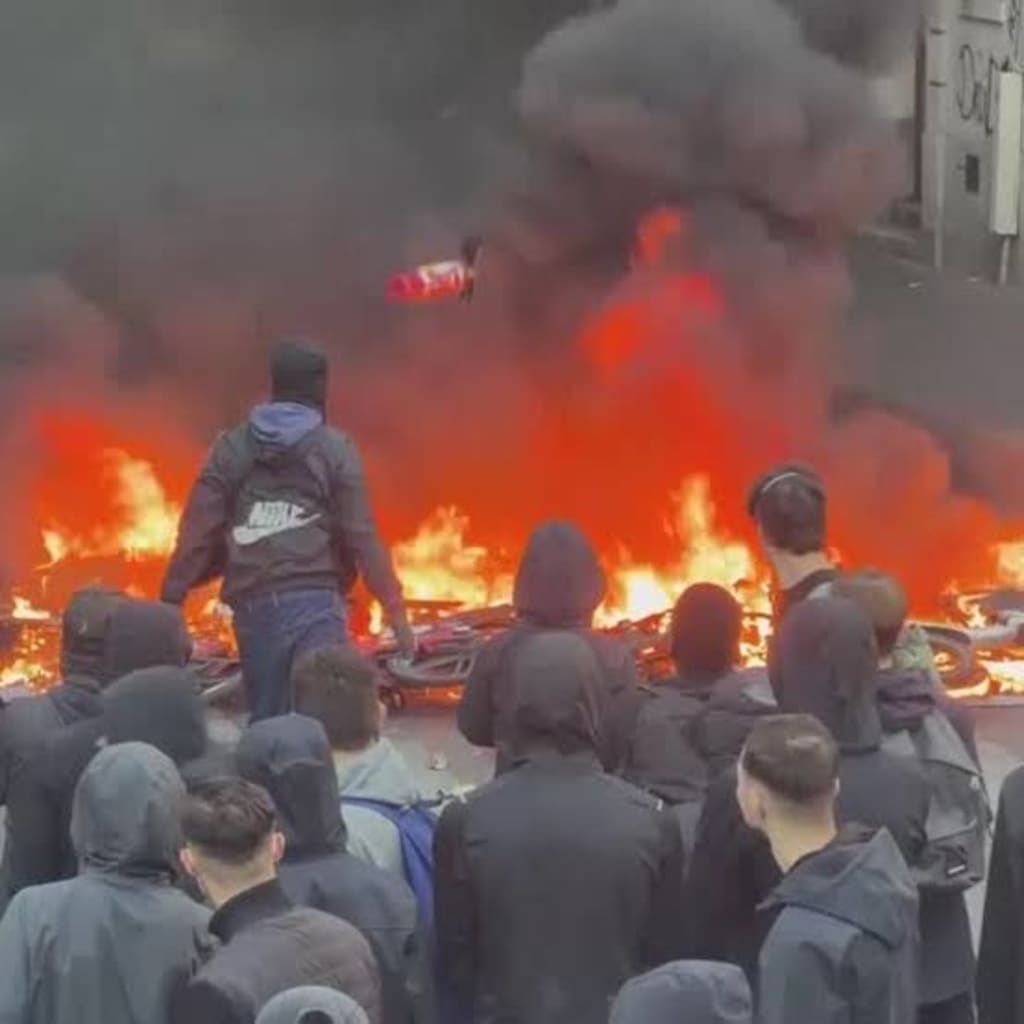
Masked crowds smashed shop windows, looted supermarkets, and set bins on fire. At least 14 security personnel were injured and more than 270 people detained. The Meloni government sent 500 soldiers to Milan to assist the police, with the mission running to the end of the year. This is reinforcement within the existing "Safe Streets" framework, not military rule. Italian inflation was 4.2 percent in September, above the euro-area average of 3.8 percent. But another figure is more striking: between 2000 and 2025, the cost of food, energy, and transport in Italy rose by 68 percent, while average full-time wages fell by nearly 5 percent. A man who runs a bar near Milan Central Station said several regulars had started ordering the cheapest coffee, something they never used to do. He said this while wiping a cup, and he kept wiping it for a long time.
One Furnace, Different Pots
The four fights have separate fuses, but they burn the same fuel.
Euro-area inflation rebounded to 3.8 percent in September, with energy prices up 18.8 percent year on year, up from 14.3 percent in August. For low-income households this is not a number in a statistical release. It is putting a pack of meat back on the shelf, stopping the pump early, turning the heating down two degrees at the end of the month. Rising fuel costs have mobilized truck drivers and farmers, who have merged with already angry students into a protest coalition that crosses occupational lines. The coalition has no common program but a shared physical sense that life is getting thinner.
The decay of public services is a quieter crack. In Madrid, an 87-year-old man died in hospital after being evicted, and that set off the tent camp in Puerta del Sol. Spain's minimum monthly wage is 1,221 euros; the average monthly rent for an 80-square-meter apartment is about 1,130 euros. A dual-income household renting a three-bedroom apartment in central Lisbon has 253 euros left at the end of the month after paying rent. Teachers in Madrid have begun an indefinite strike demanding better pay and working conditions. These numbers need no ideological translation. They are a mobilization order in themselves.
Political polarization does not create anger. It gives anger directions. The far right systematically links street disorder to immigration, trying to re-narrate a crisis about purchasing power and public services as a crisis about identity and security. French authorities and police have stated clearly that there is no evidence linking the violence to immigrants, but that narrative travels through the information space far faster than budget data. The left responds with "wealth distribution" and "public investment," and harvests the same anger. The traditional center is caught between two narratives: it cannot deny the need for austerity, and it cannot persuade voters to bear the cost of austerity. Le Pen accuses the Macron government of "weakness"; Mélenchon accuses it of "repression." The double bind is structural.
Spreadsheets in Brussels, Classrooms in Paris
All the pressures above, inside any sovereign state, would be ordinary challenges that could be buffered through the exchange rate, the interest rate, and fiscal transfers. Euro-area member states have lost two of the first three. The third is precisely what is missing.
The design of the euro contains a core tension that its founders clearly recognized but could not resolve politically: a monetary union without a fiscal union. Member states gave up the right to issue their own currency; monetary policy was centralized at the European Central Bank; fiscal sovereignty remained national. Governments can no longer dilute debt through currency depreciation. They can no longer order the central bank to print money to finance them. They must compete for capital in the markets like foreign borrowers. In good times this is tolerable. In a crisis, the entire weight of adjustment falls on one path: fiscal austerity.
France is the clearest case. Since July 2024, France has been under the EU's excessive deficit procedure. Its public deficit was 5.8 percent of GDP in 2024 and 5.1 percent in 2025; public debt reached 115.6 percent of GDP at the end of 2025 and is projected to rise to 120.2 percent in 2027. Under the EU fiscal rules, the direction of adjustment is locked in as spending cuts, with the goal of bringing the deficit below 3 percent by 2029. For a country where government spending is nearly 57 percent of GDP, spending cuts mean touching concrete jobs and concrete classrooms: teachers, nurses, users of local public services, public-sector employees. In a spreadsheet in Brussels, austerity is a target number. On the ceiling of that high-school classroom in the northern Paris suburbs, it is a crack that has gone eleven months without repair.
The euro area lacks a symmetrical adjustment mechanism. When a high-debt country like France is forced into austerity, surplus countries do not have a corresponding obligation to expand and absorb the demand gap. Germany's export-oriented model and fiscal restraint are institutionalized in a rule system that favors surplus countries. Adjustment pressure falls one way, on deficit countries. The domestic political systems of deficit countries, left or right, eventually hit the same impossible triangle: satisfy EU fiscal rules, maintain public services, avoid street explosions. Pick two.
The LSE Review of Books' summary of the history of the euro crisis points to the same logic: every short-term intervention that saved the euro weakened its institutional foundations over the long run. The ECB's "whatever it takes" pledge during the sovereign debt crisis effectively made it a lender of last resort, and in doing so removed the market discipline that might have constrained fiscal policy. That gave member states political room to postpone structural adjustment. When adjustment can no longer be postponed, it returns in its most intense and most political form: tents, barricades, curfews, far-right votes.
Coda: The Bucket Is Still Catching Water
The tents in Warsaw were half dismantled by the end of the third week. Winter was coming, not an agreement. Kaczyński told those remaining: "We will be back." He did not say when. The plastic bucket in that high-school classroom in the northern Paris suburbs is still catching water. The printed sheet on the staff-room wall has been half-covered by a new one: next week's substitute timetable. The bar owner in Milan raised the price of the cheapest coffee by another fifty cents. He said one of his regulars had stopped coming; the man had moved to the suburbs last month.
These details do not add up to a conclusion. They point to one thing: the fire on the streets is a signal. The source is a budget rule written in Brussels that no one on those streets voted for.
The European Union's idealism is not the problem. What is missing is a symmetrical system of fiscal and adjustment mechanisms. After centralizing monetary sovereignty, the project has still not politically completed that system. When the storm comes, member states are pushed back into their national arenas, using strikes, tents, curfews, and ballots to digest a structural imbalance that is essentially European.
The bucket in that Paris classroom is full. A student walks past, picks it up, and empties it into the sink. His movements are practiced; clearly it is not the first time. Then he goes back to his seat and opens his textbook. The teacher has not arrived.
About the Creator
Jin
Writer of reamstories
https://reamstories.com/jin
Enjoyed the story? Support the Creator.
Subscribe for free to receive all their stories in your feed. You could also become a paid subscriber, letting them know you appreciate their work.
Comments
There are no comments for this story
Be the first to respond and start the conversation.