
Automotive Actuators Market Accelerates as Electric and Smart Vehicles Redefine Mobility
Rising electric vehicle adoption, advanced driver assistance systems, and growing demand for comfort features are fueling strong growth in the global automotive actuators industry.

Automotive Actuators Market Overview
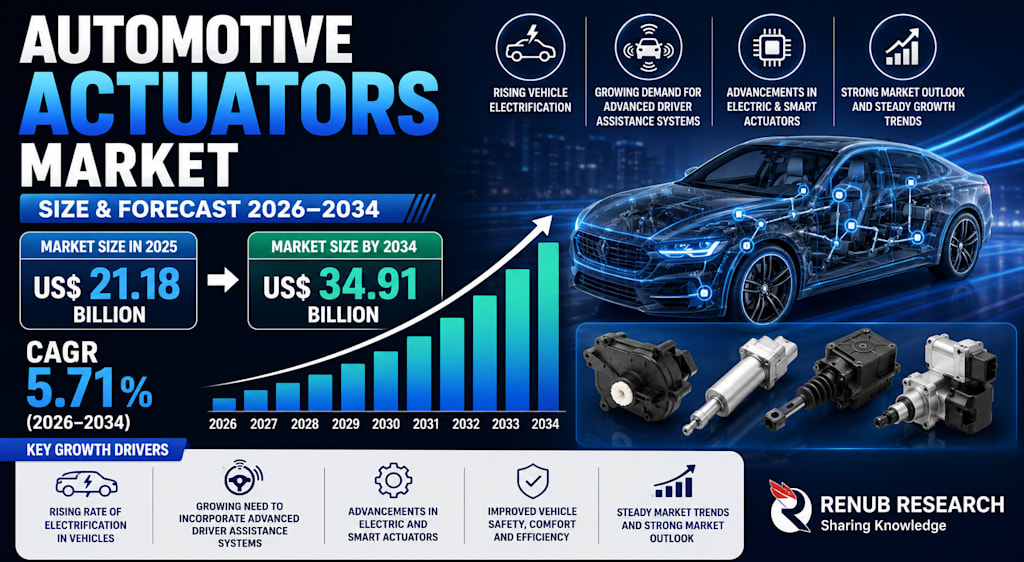
The global automotive industry is undergoing one of the most significant technological transformations in its history, and automotive actuators are emerging as critical components behind this evolution. As vehicles become increasingly electrified, connected, and software-driven, the demand for precise motion-control systems is rising rapidly across passenger cars, commercial vehicles, and electric mobility platforms. According to Renub Research, the global Automotive Actuators Market is expected to grow from US$ 21.18 Billion in 2025 to US$ 34.91 Billion by 2034, expanding at a Compound Annual Growth Rate (CAGR) of 5.71% during 2026–2034.
This projected growth reflects the growing importance of automation and intelligent vehicle systems in modern transportation. Automotive actuators are mechanical or electromechanical devices that convert electrical, hydraulic, or pneumatic energy into controlled motion. They are responsible for operating a wide range of vehicle functions including braking systems, throttle control, seat adjustment, fuel injection, HVAC systems, mirror positioning, transmission systems, power windows, and advanced driver assistance technologies.
As the automotive industry shifts toward electric mobility and intelligent driving systems, actuators are becoming increasingly sophisticated. Modern vehicles rely heavily on electronic controls, requiring actuators that can deliver high precision, fast response times, reliability, and energy efficiency. This growing dependence on automated systems is positioning automotive actuators as one of the most important enabling technologies in the future mobility ecosystem.
Electric Vehicle Growth Is Transforming the Industry
One of the strongest drivers of the automotive actuators market is the rapid global adoption of electric vehicles (EVs). Electric and hybrid vehicles contain significantly more electronic systems than traditional internal combustion engine vehicles, increasing the demand for electric actuators across multiple vehicle functions.
Vehicle electrification requires advanced actuator technologies to support battery systems, drive-by-wire systems, regenerative braking, thermal management, charging systems, and intelligent safety functions. As automakers continue transitioning toward cleaner mobility solutions, the number of actuators integrated into vehicles is steadily increasing.
The report highlights the impressive pace of global EV adoption. More than 17 million electric cars were sold globally in 2024, accounting for approximately 20% of all new vehicle sales worldwide. China alone represented nearly 11 million electric vehicle sales, maintaining its leadership position in the global EV market. Countries such as Norway, Sweden, Denmark, Finland, and the Netherlands also recorded exceptionally high electric vehicle market shares.
This transition toward electrified mobility is expected to remain one of the largest long-term growth opportunities for automotive actuator manufacturers. Electric vehicles require highly responsive and energy-efficient actuator systems capable of supporting increasingly complex vehicle architectures.
Advanced Driver Assistance Systems Fuel Demand
Another major growth catalyst for the automotive actuators market is the rising integration of Advanced Driver Assistance Systems (ADAS). These technologies are rapidly becoming standard features in modern vehicles as governments tighten safety regulations and consumers prioritize safer driving experiences.
ADAS features such as adaptive cruise control, lane-keeping assistance, automatic emergency braking, parking assistance, and collision avoidance systems rely heavily on actuators for real-time steering, braking, and throttle control. These systems require extremely precise and responsive motion control technologies to ensure driver safety and vehicle performance.
As semi-autonomous and autonomous driving technologies continue evolving, the importance of actuators within intelligent vehicle systems will only increase further. Automotive manufacturers are investing heavily in next-generation electronic architectures that depend on highly integrated actuator networks.
The report references Volkswagen’s unveiling of its first in-house developed ADAS platform at Auto Shanghai 2025. This reflects the growing competition among automakers to strengthen software-defined vehicle capabilities and deliver safer, more intelligent driving experiences.
Consumers Continue Demanding Comfort and Convenience
Consumer expectations around comfort and convenience are also contributing significantly to actuator demand. Features once considered luxury options are increasingly becoming standard even in mid-range and entry-level vehicles.
Powered seats, electric tailgates, automatic doors, climate control systems, mirror positioning systems, sunroofs, and power windows all rely on actuators to function efficiently. As consumers seek more personalized and comfortable driving experiences, automakers are integrating more actuator-driven features into vehicle interiors.
The growing popularity of premium and mid-sized vehicles in both developed and emerging markets is accelerating this trend further. Buyers increasingly expect advanced comfort technologies regardless of vehicle price category, pushing manufacturers to incorporate more compact, efficient, and reliable actuators into their designs.
One example highlighted in the report is Johnson Electric’s launch of its EV Locking Actuator in April 2025. Designed specifically for electric vehicle charging applications, the actuator provides strong locking force and operates effectively under extreme environmental conditions.
Technical Complexity and Development Costs Remain Challenges
Despite strong market momentum, the automotive actuators industry faces several major challenges. One of the most significant is the high cost associated with research, development, and integration of advanced actuator systems. Modern actuators must meet extremely demanding automotive standards related to durability, precision, reliability, and safety.
Developing actuators capable of operating effectively in harsh environmental conditions while maintaining long-term performance requires substantial engineering investment. This can create barriers for smaller suppliers attempting to compete with established global manufacturers.
Additionally, the increasing complexity of software-defined vehicles means actuators must now integrate seamlessly with advanced electronic control units, sensors, and vehicle communication systems. The transition toward intelligent mobility is therefore increasing both technological requirements and development costs across the industry.
Supply Chain Volatility Continues to Impact Production
The automotive actuators market also remains vulnerable to global supply chain disruptions and raw material price volatility. Semiconductor shortages, rare earth material dependencies, transportation disruptions, and geopolitical tensions have all impacted automotive manufacturing in recent years.
Actuator systems rely heavily on electronic components, precision metals, semiconductors, and specialized materials. Any disruption within global supply chains can delay production schedules and increase manufacturing costs for both suppliers and automakers.
As vehicle architectures become more electronic and software-intensive, ensuring stable supply chains has become a critical priority for automotive OEMs and component manufacturers worldwide. Companies are increasingly focusing on supply chain resilience, local sourcing strategies, and production diversification to minimize future disruptions.
Hydraulic Actuators Maintain Importance in Heavy-Duty Applications
Although electric actuators are gaining popularity, hydraulic actuators continue to play an important role in automotive systems requiring high force and durability. Hydraulic actuators use pressurized fluids to generate strong and reliable motion, making them particularly suitable for braking systems, clutch systems, and suspension applications.
Heavy-duty vehicles and performance-oriented applications continue to depend on hydraulic actuator technologies because of their load-handling capabilities and operational reliability under demanding conditions. Even as electric actuator technologies improve, hydraulic systems remain essential for specific safety-critical automotive functions.
Passenger Cars Lead Overall Market Demand
Passenger vehicles remain the largest application segment within the automotive actuators market. Modern passenger cars incorporate numerous actuator systems across safety, comfort, convenience, and performance applications.
The shift toward intelligent vehicle architectures is further increasing actuator complexity and volume within passenger vehicles. Advanced electronic systems such as drive-by-wire steering, adaptive suspension, intelligent braking, and semi-autonomous driving functions require highly responsive actuators capable of interacting seamlessly with software platforms and vehicle sensors.
Automakers are increasingly integrating actuators into connected vehicle networks to improve diagnostics, predictive maintenance, and system performance monitoring. As software-defined vehicles become more common, actuator demand within passenger cars is expected to rise steadily worldwide.
Seat Adjustment and Brake Actuators Show Strong Potential
Among specific application categories, seat adjustment actuators represent one of the fastest-growing segments. Consumers increasingly prioritize ergonomic interiors, customization, and long-distance driving comfort, especially in mid-range and premium vehicles. Electric seat adjustment systems allow users to personalize driving positions more easily, improving comfort and convenience.
Brake actuators are another critical growth area due to rising global vehicle safety standards. Advanced braking systems such as ABS, electronic stability control, brake-by-wire systems, and automatic emergency braking all depend heavily on high-performance actuators.
The transition toward hybrid and electric vehicles is further increasing demand for electromechanical brake actuators capable of delivering rapid response times and high efficiency. Safety-focused regulations across major automotive markets are expected to continue driving investment in advanced braking technologies.
Regional Markets Reflect Different Growth Dynamics
The United States automotive actuators market continues to grow steadily due to strong vehicle production levels, rising electrification, and high investment in advanced automotive technologies. American OEMs and suppliers are increasingly focused on software-defined vehicles and precision electromechanical systems.
The report references Nexteer Automotive’s introduction of its Direct Drive Hand Wheel Actuator for steer-by-wire applications in October 2025. This innovation supports next-generation autonomous and driver-assistance systems across traditional, hybrid, and electric vehicles.
In the United Kingdom, environmental regulations and growing electric vehicle adoption are driving demand for electronic actuator systems. The UK automotive industry is increasingly emphasizing efficiency, safety, and sustainability in vehicle design.
India’s automotive actuators market is experiencing strong growth due to expanding vehicle production, rising disposable incomes, and increasing government support for electric mobility. Passenger cars and two-wheelers are creating particularly strong demand opportunities.
Saudi Arabia is also emerging as an important market due to rising vehicle sales, increasing consumer demand for comfort features, and growing interest in electric and hybrid vehicles. Investments in automotive infrastructure and manufacturing are expected to support long-term industry growth.
Major Companies Continue Driving Innovation
The automotive actuators market includes major global suppliers such as Robert Bosch GmbH, Nidec Corporation, Denso Corporation, Johnson Electric, Mitsubishi Electric Corporation, CTS Corporation, Hitachi Ltd, Aptiv PLC, and BorgWarner Inc.
Competition within the industry is increasingly focused on miniaturization, energy efficiency, intelligent integration, and software compatibility. Companies investing in advanced electromechanical systems, smart actuators, and next-generation autonomous vehicle technologies are expected to maintain strong competitive positions.
Final Thoughts
The automotive actuators market is becoming increasingly central to the future of mobility. As vehicles evolve toward electrification, automation, and intelligent software-driven architectures, actuators are playing a critical role in enabling safety, efficiency, comfort, and advanced driving functions.
With the market projected to grow from US$ 21.18 Billion in 2025 to US$ 34.91 Billion by 2034, long-term demand for advanced actuator technologies appears highly promising.
About the Creator
Enjoyed the story? Support the Creator.
Subscribe for free to receive all their stories in your feed.
Comments
There are no comments for this story
Be the first to respond and start the conversation.