
Australia Just Slammed the Door on “Visa Hopping.” Here’s Who Gets to Stay.
International students can no longer bring family. Backpackers now face a lottery. And the path to permanent residency just got narrower.
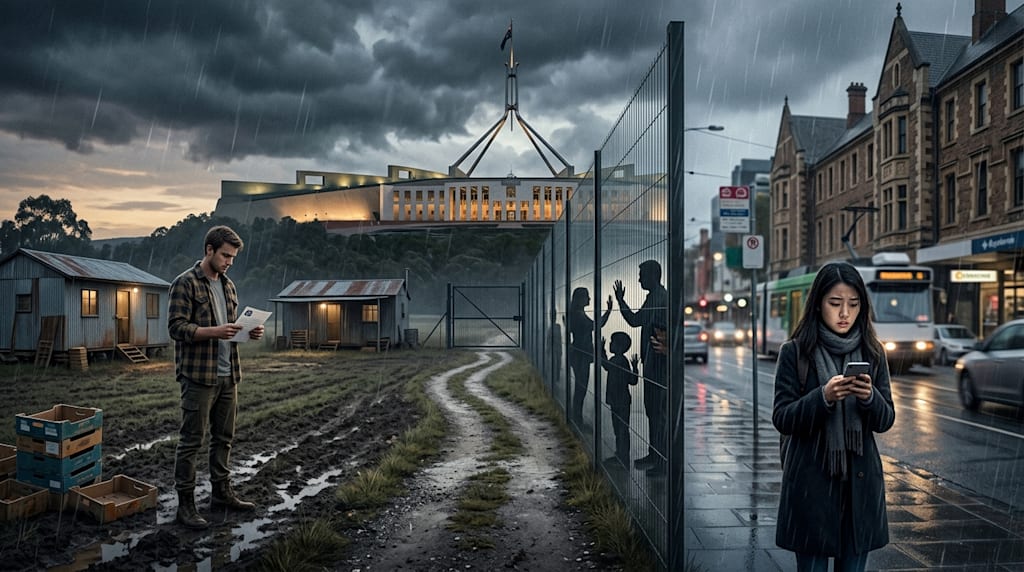
Australia Tightens Migration: Who Comes, Who Stays, Who Leaves
Outside a college in Melbourne's CBD, a group of students stands in a loose semicircle, phones angled against the wind. One of them, a 23-year-old from Chengdu, refreshes her email. Nothing. She refreshes again. The rain has stopped, but the pavement still shines. A tram rattles past. She does not look up.
On 17 September 2026, Australia's Minister for Home Affairs, Tony Burke, stood in Parliament and delivered a speech titled "Managing the Migration Programme: Who Comes, Who Stays, Who Leaves." The title was the policy, compressed into one sentence.
The government wants net overseas migration down to 225,000 by 2028. In the year to March 2026, Australia's population grew 1.4 per cent to 27.9 million. Net overseas migration was 292,100. That number sits inside a country where rents have climbed faster than wages and hospitals and roads are stretched. Immigration has become a live political wound.
Burke did not announce that Australia was closing its doors. He said migration is an "advantage." Then he said it must be "highly controlled." The two sentences belong together. The first is the country's economic need. The second is its political mood.
Students: no automatic family ticket
The first change lands on international students. Under the new rules, foreign students will no longer automatically have the right to bring family members to Australia. There are exemptions: students already in Australia, applicants from the Pacific and Southeast Asia, and doctoral students. Burke said PhD students are at a different stage of life from undergraduates. The line is narrow, but it is a line.
The second change is aimed at what the government calls "visa hopping." A student finishes one course, then enrols in another. The second course is often lower-level. Sometimes it comes from an institution that is not entirely regular. The purpose is time.
Under the new rules, a student who wants to stay must move up, not sideways. A bachelor's graduate can apply for a master's. A master's graduate cannot enrol in a diploma just to keep the visa alive. The government is saying: study is study. It is not a waiting room.
For universities, the policy is a test. Australia's international education sector is a major export. It fills lecture halls, employs tutors, rents apartments, sells coffee. It also feeds a pipeline of low-quality colleges that exist mainly to issue confirmation letters. The government is trying to separate the two. Whether it can do so without shrinking the whole sector is another question.
Backpackers: the ballot replaces the automatic extension
The working holiday visa is also changing. The visa allows people aged 18 to 30 to work in Australia for 12 months. It is used by backpackers and is a critical source of labour for farms, hostels, and remote towns. At present, holders can extend to a second year by doing three months of specified work in regional Australia. A third year requires another six months.
From now on, the second-year extension will be decided by a ballot. The cap is 45,000 places, down from 57,000 who qualified last year. The third-year ballot is capped at 5,000, down from 31,000. British backpackers are exempt because of the Australia–UK free trade agreement. In July, the government also paused working holiday visa applications from 24 countries. The UK was not on that list.
The ballot turns a working holiday into a lottery. For a strawberry farm in Queensland or a mango packhouse in the Northern Territory, the change may not show up immediately. It will show up when the fruit ripens and the cabins are empty.
The numbers behind the politics
Australia's population is growing. The Australian Bureau of Statistics reported that in the 12 months to March 2026, the country added 292,100 net overseas migrants. Population growth reached 1.4 per cent. Living costs have risen, housing affordability has worsened, and public services are under pressure. Immigration is no longer a background policy issue. It is a contest.
The right-wing populist party One Nation has risen in the polls. This week it released its own migration policy. It proposes cutting 750,000 temporary migration visas over three years. It wants a net overseas migration cap of 130,000. In May, the party won its first federal House of Representatives seat. Burke criticised the proposal, saying it could "devastate parts of the Australian economy." That sentence is a warning inside his own party.
In July, the government already began prioritising family visa applications lodged inside Australia over those lodged overseas. Skilled migrants already in Australia and applying for permanent residency were also given priority over offshore applicants. The message was clear: if you are already here, working, paying rent, building a life, the system will look at you first.
The argument against the tightening
Not everyone welcomes the direction. Violet Roumeliotis, from Settlement Services International, said the migration debate is increasingly driven by "short-term political considerations rather than what is best for the country." She pointed to the changes to family visas for international students. "This will make it harder for Australia to compete with other countries and attract future talent," she said.
Her argument is simple. Countries compete for students, researchers, and skilled workers. Canada, the UK, New Zealand, and Germany all want them. A student who cannot bring a spouse may choose another country. A PhD candidate who can bring a partner may still come. A master's student who cannot may not.
The government's counter-argument is also simple. Public support for migration depends on control. If Australians believe the system is chaotic, they will vote for parties that promise to cut it. By tightening the rules now, the government hopes to protect the broader migration programme later.
The path narrows
The speech's title was the policy. Who comes. Who stays. Who leaves. Australia still wants migrants. It wants them skilled and already inside the country. It wants fewer people arriving with families on student visas. It wants backpackers to earn their second year through a ballot, not through automatic extension. It wants the path from temporary to permanent to be narrower and clearer.
For the student from Chengdu, the rules mean a choice. She can apply for a master's. She can go home. She can wait for an email that may not arrive. Her phone lights up. It is a message from her mother. She reads it, types a reply, and puts the phone in her pocket.
The ballot opens next month. The first emails will go out at 9 a.m. Some will land while the recipient is on a tram. Some will land while the recipient is in a picker's cabin, looking at a field that needs hands. Some will not land at all.
About the Creator
Jin
Writer of reamstories
https://reamstories.com/jin
Enjoyed the story? Support the Creator.
Subscribe for free to receive all their stories in your feed. You could also become a paid subscriber, letting them know you appreciate their work.
Comments
There are no comments for this story
Be the first to respond and start the conversation.