
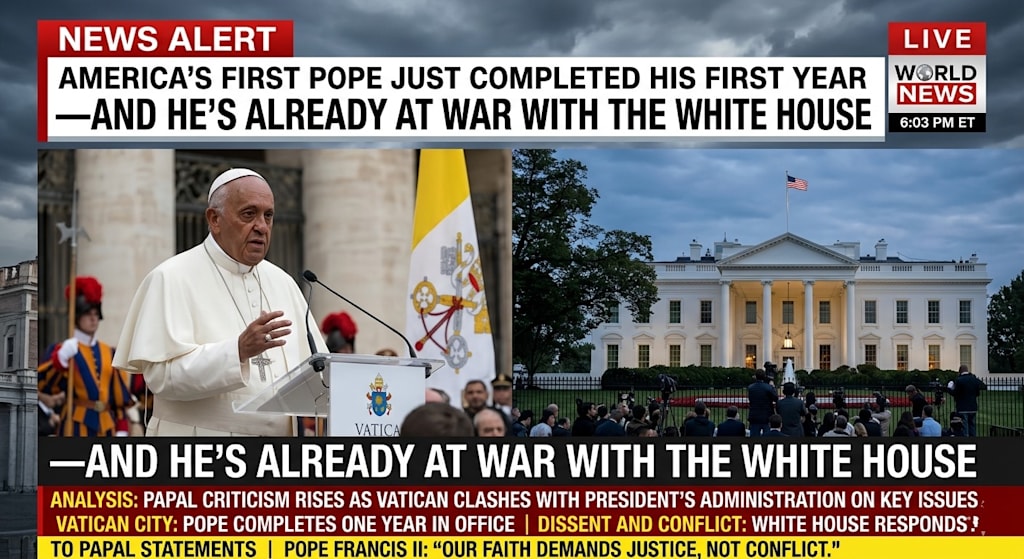
America’s First Pope Just Completed His First Year — and He’s Already at War With the White House
Pope Leo XIV came in promising unity. Then Donald Trump started picking fights. Here’s how the most unlikely papacy in history is unfolding — and why it matters far beyond the Vatican.
For the first time in history, an American sits on the throne of Saint Peter.
When white smoke rose above the Vatican and the world heard the name of the new pope, many Americans celebrated with pride. A pope from the United States felt impossible for decades. Critics once believed America was too politically powerful, too culturally dominant, and too entangled with global influence for a U.S. citizen to ever become leader of the Catholic Church.
Exactly one year ago today, white smoke rose from the chimney of the Sistine Chapel at 6:07 p.m. Rome time.
A few minutes later, the bells of St. Peter’s Basilica began to ring. The crowd in the square roared. And Cardinal Robert F. Prevost of Chicago — a man few outside the Vatican had ever heard of — walked onto the famous balcony and became Pope Leo XIV: the first American pope in the 2,000-year history of the Catholic Church.
It was one of the most jaw-dropping moments in modern religious history. And the first year has been every bit as extraordinary as that stunning beginning.
The Man Behind the Mitre
Leo XIV — the former Robert Prevost — is shaped by his Augustinian spirituality, a tradition that emphasises community, humility, and harmony over confrontation. Where his predecessor, Pope Francis, was often deliberately provocative, Leo has sought a calmer, more pastoral style.
In his first year, he completed an apostolic journey to Africa, closed the 2025 Jubilee Year, and has made unity the cornerstone of his papacy. He has moved slowly and consulted broadly — a style that has avoided alienating either the progressive or traditionalist wings of the 1.3-billion-strong Catholic Church.
“Together we must try to be a missionary church, a church that builds bridges and always dialogues, always open to receiving everyone,” he told the crowd at St. Peter’s Square on the day of his election.
Then Came Trump
If Leo’s plan was to stay focused on the pastoral and spiritual, Donald Trump had other ideas.
Trump’s repeated and increasingly sharp criticisms of the pope — centred primarily on Leo’s outspoken opposition to the Iran war — triggered something remarkable: a pope fighting back. Italian newspapers screamed headlines using words like “outrage,” “shock attack,” and “Trump’s schism.” The back-and-forth became one of the most unusual diplomatic dramas of the era.
This week, in what amounts to a formal attempt at a reset, U.S. Secretary of State Marco Rubio flew to the Vatican for a private meeting with Leo in his library. Both sides afterwards stressed their “strong bilateral ties.” The optics were clear: someone in Washington decided the feud needed to end.
Whether it will is another matter. Leo has shown he is not afraid to push back — and Trump has rarely walked away from a fight voluntarily.
What His Second Year Holds
Leo has a packed calendar ahead. A visit to Spain in June. A planned trip to France, where rising conversion rates are linked to more conservative forms of worship — a delicate challenge for a pope trying to bridge internal church divisions. Later in the year, bishops from around the world will gather in Rome to discuss synodality, one of the most contested concepts in modern Catholicism.
On the geopolitical front, Leo has positioned the Church’s global mission around three words: seek peace, build peace, foster peace. In a world currently fighting wars on multiple fronts, that message may be more necessary — and more difficult — than at any point in recent memory.
America’s first pope is one year in. He has already shown more resilience than most expected.
The second year is just beginning.
About the Creator
Enjoyed the story? Support the Creator.
Subscribe for free to receive all their stories in your feed.
Comments
There are no comments for this story
Be the first to respond and start the conversation.