
America Is Stripping Citizenship From Its Own Citizens — And the Numbers Are About to Explode
The Trump administration just launched the most aggressive denaturalization campaign in U.S. history. If you or someone you love became an American citizen through naturalization, here is everything you need to know — right now.
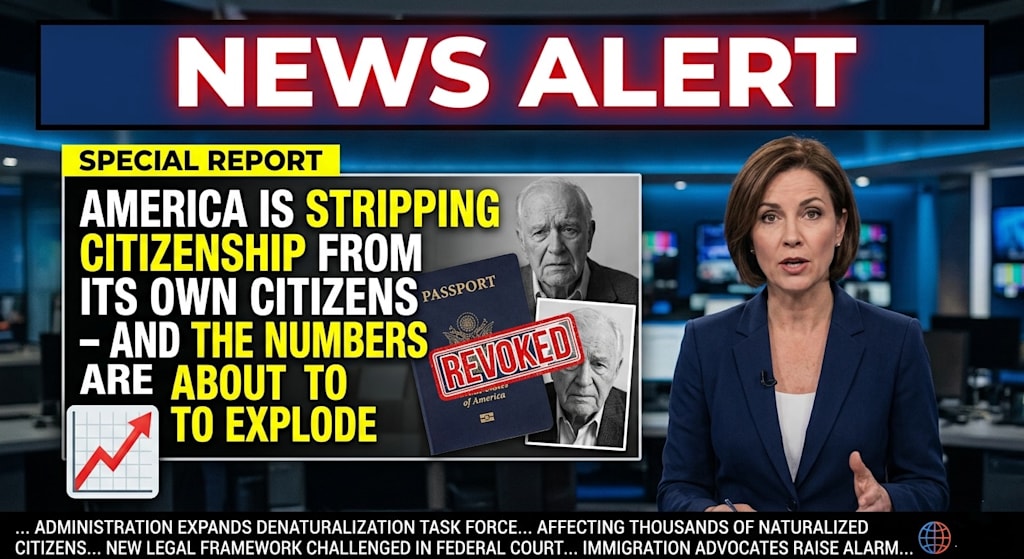
There is a legal process in the United States called denaturalization.
Most Americans have never heard of it. Until very recently, most immigration lawyers rarely had to use it. Between 1990 and 2017 — a span of 27 years — the U.S. government filed just over 300 denaturalization cases in total. That works out to roughly 11 cases per year.
This week, the Trump administration filed 12 new cases in a single day.
And according to internal government discussions reported by NPR, the White House plans to denaturalize 100 to 200 people every single month for the rest of 2026.
Let that number sink in.
What Denaturalization Actually Means
Denaturalization is the legal process by which the U.S. government revokes citizenship from someone who became an American through the naturalization process — meaning they were born elsewhere and applied for citizenship.
It is important to understand what it does not apply to: if you were born in the United States, your citizenship cannot be denaturalized. This process applies only to the roughly 24 million naturalized American citizens — people who passed citizenship tests, swore oaths, and received their naturalization certificates after going through years of legal immigration processes.
When denaturalization succeeds, the consequences are severe. The individual loses all the rights and privileges of U.S. citizenship. They revert to their previous immigration status — typically permanent resident — and become immediately deportable if they have any criminal record or other disqualifying factors. In the words of the USCIS Policy Manual, once citizenship is revoked, it is treated as if it never existed — a legal rewind.
Who Is Being Targeted Right Now
The Justice Department announced this week that it is seeking to revoke citizenship from 12 specific individuals — immigrants from Bolivia, China, Colombia, Gambia, India, Iraq, Kenya, Morocco, Nigeria, Somalia, and Uzbekistan.
The cases involve a range of alleged offences. Among those targeted are a Colombian-born Catholic priest convicted of sexually assaulting a minor, a man born in Morocco with alleged ties to al-Qaeda, and a former American diplomat named Manuel Rocha who admitted to spying for Cuba for decades. Acting Attorney General Todd Blanche was direct about the administration’s position: “There are a lot of individuals who are citizens who shouldn’t be.”
He added: “We should disincentivise people from committing fraud when they’re going to become a citizen of this great country.”
When asked whether the roughly 24 million naturalized citizens in America should be worried, Blanche said only “a very small percentage” should be concerned — and that those who legally obtained their citizenship had “nothing to worry about.”
Why Legal Experts Are Not So Reassured
Here is where the story gets complicated — and alarming for civil rights advocates.
The Supreme Court has spent nearly a century establishing that denaturalization is a narrow, fraud-based remedy. It is not, under existing law, a general tool for immigration enforcement or political punishment. The Court has consistently held that citizenship may only be stripped when it was unlawfully obtained in the first place — and only with rigorous proof.
But the Trump administration’s stated ambitions go further than what the courts have historically permitted. Immigration scholars have warned that proposals to denaturalize people based on ideological grounds or loosely defined “incompatibility” with American values have no basis in existing law.
More practically, immigration attorneys interviewed by NPR described hitting a target of 100 to 200 cases per month as a “Herculean undertaking” that risks cutting corners and sweeping in borderline cases — people whose paperwork had minor errors decades ago, or who failed to disclose minor criminal matters they didn’t realise were relevant.
What You Should Do If You Are a Naturalized Citizen
If you or someone you love went through the naturalization process at any point, legal experts are advising the following steps now, before any contact from authorities:
First, have an immigration attorney review your full immigration history — your N-400 application, green card filings, any visa or asylum records, criminal history, and travel history. Second, consider filing a Freedom of Information Act (FOIA) request to see what records the government holds on you. Third, early legal preparation significantly reduces risk — do not wait to act.
The administration has been clear: this campaign is not stopping. The question is how far the courts will allow it to go.
About the Creator
Enjoyed the story? Support the Creator.
Subscribe for free to receive all their stories in your feed.
Comments
There are no comments for this story
Be the first to respond and start the conversation.