
AI Is Changing Banking: How Intelligent Agents Are Transforming Financial Services
From fraud detection and customer service to lending and compliance, artificial intelligence is moving beyond simple chatbots and becoming part of the core banking system.
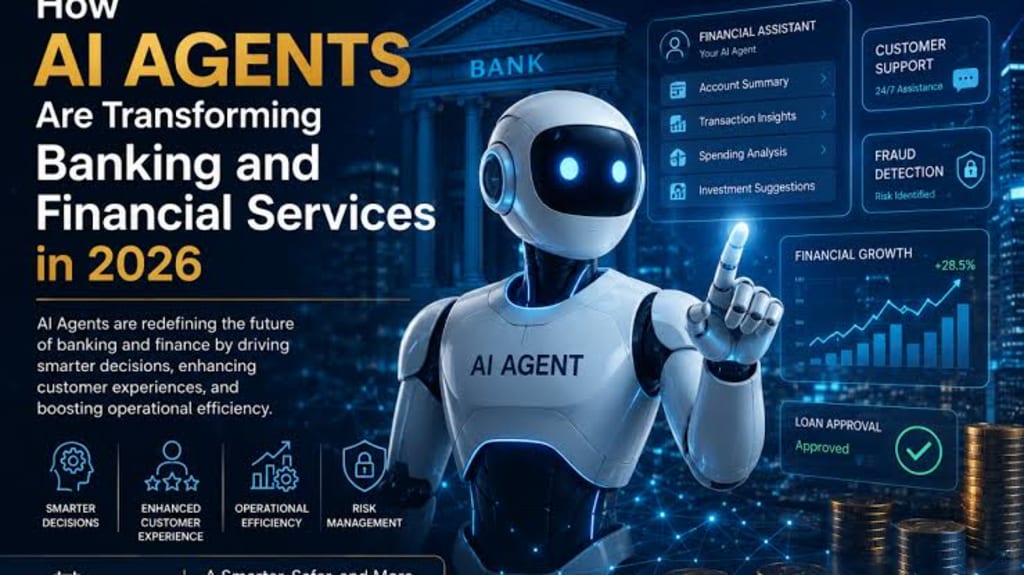
Artificial intelligence is rapidly changing the way banks operate. In 2026, the financial sector is moving beyond basic automation and experimenting with increasingly capable AI agents that can analyze information, coordinate workflows and complete multiple tasks with limited human intervention.
The European Central Bank has described AI as a potentially transformative general-purpose technology capable of reshaping production processes, business models and economic structures.
For banks, the transformation could be particularly significant because financial institutions manage enormous amounts of data every day. AI can process that information at a speed that would be impossible for human employees working alone.
From Chatbots to AI Agents
Traditional banking chatbots generally answer simple questions such as account balances, payment information or branch opening hours.
The newer generation of agentic AI is designed to do much more. AI agents can potentially plan a series of actions, interact with banking systems and help complete complicated workflows.
Boston Consulting Group says agentic AI is poised to transform retail banking, affecting both customer journeys and the internal workflows supporting them.
This means the future banking assistant may not simply tell customers what to do. It could potentially help complete tasks, identify problems and coordinate solutions while operating within rules established by the bank.
AI Is Becoming a Fraud-Fighting Tool
One of the most valuable applications of AI in banking is fraud detection.
Financial institutions process millions of transactions, making it difficult for traditional systems to identify every suspicious activity. AI can examine transaction patterns and behavioral signals in real time and flag unusual activity for investigation.
Banks are increasingly applying AI to fraud detection, anti-money-laundering systems and Know Your Customer processes. Industry analysis for 2026 highlights the movement toward adaptive, real-time intelligence in these areas.
Recent deployments are also showing how this technology is moving from experimentation toward practical use. Lloyds Banking Group, for example, has been expanding agentic AI within fraud-prevention operations and real-time scam detection.
Faster and More Personalized Customer Service
Customer service is another major area of change.
Instead of waiting for a human representative, customers could increasingly interact with AI systems that understand their requests and access relevant information.
AI can help banks answer routine questions, summarize customer histories and assist employees in resolving complex cases. Deloitte notes that banks are exploring AI-assisted customer service as a way to reduce friction in contact centers while improving the customer experience.
The biggest advantage may be availability. AI systems can operate around the clock, allowing customers to receive assistance outside traditional banking hours.
However, human employees will remain important for sensitive situations, disputes and decisions requiring judgment or empathy.
Lending Could Become More Data-Driven
AI is also changing the way financial institutions evaluate credit.
Banks have traditionally relied on credit histories, income information and other financial indicators when assessing borrowers. AI can analyze larger datasets and identify patterns that traditional models may overlook.
This could make some lending decisions faster, but it also introduces serious concerns.
If an AI system uses biased or incomplete data, it could produce unfair outcomes. That is why financial institutions need strong governance, testing and human oversight before allowing AI to influence high-impact decisions.
The Cybersecurity Challenge
AI creates opportunities for banks, but it also introduces new risks.
Financial institutions are attractive targets for cybercriminals, and AI can potentially make scams more sophisticated. Criminals can use advanced technology to generate convincing messages, automate attacks and analyze publicly available information about potential victims.
At the same time, banks themselves are becoming increasingly dependent on AI infrastructure and external technology providers.
Moody's has warned that rapid AI adoption could increase financial-sector dependence on a small number of major technology providers, creating concerns about outages, cybersecurity, privacy and operational resilience.
This creates an important question: What happens if a critical AI system suddenly becomes unavailable?
Banks cannot afford to discover the answer during a major financial disruption.
Regulation Will Become More Important
As AI systems gain greater responsibility, regulators are paying closer attention.
The Bank of England has highlighted how agentic AI could reshape cyber risk, financial markets and payments, while emphasizing the need for financial institutions and regulators to strengthen resilience and cooperation.
The challenge is finding the right balance.
Too little regulation could allow unsafe or poorly controlled AI systems to affect customers and financial markets. Too much bureaucracy, however, could slow innovation and make it harder for banks to compete.
The likely future will involve stronger requirements for transparency, auditability, security, data protection and human oversight.
What Happens to Banking Jobs?
The rise of AI naturally raises questions about employment.
Some repetitive tasks may increasingly be handled by software. Customer-service inquiries, document processing, compliance checks and certain administrative activities are among the areas where automation can reduce manual work.
But AI does not necessarily mean that banks will eliminate every human role.
Instead, employees may increasingly work alongside AI systems. Staff could spend less time processing routine information and more time handling complicated cases, building relationships with customers and making decisions requiring human judgment.
The transition will nevertheless require significant retraining. Workers who understand both financial services and AI technology could become increasingly valuable.
A New Banking Model
The banking industry is entering a period in which AI may become part of everyday operations rather than an experimental technology.
Lloyds Banking Group describes 2026 as a turning point for agentic AI, with financial institutions moving toward broader enterprise deployment.
The transformation will not happen overnight. Banks still operate large legacy systems, face strict regulations and handle extremely sensitive customer information.
But the direction is becoming clear.
The bank of the future may have fewer purely manual processes and more intelligent digital systems working continuously behind the scenes.
Conclusion
Artificial intelligence is changing banking from the inside out.
It is improving fraud detection, accelerating customer service, supporting compliance and creating new possibilities for lending and financial management. At the same time, it introduces new risks involving cybersecurity, privacy, bias, technology dependence and employment.
The winners in this transformation will not necessarily be the banks that use the most AI. They will be the institutions that learn how to combine AI's speed and analytical power with human judgment, strong security and responsible governance.
Banking has always evolved with technology. From ATMs and online banking to smartphones and digital payments, each generation has changed how people interact with money.
AI could be the next major transformation—and in 2026, that transformation is already underway.
SEO Keywords: AI in banking 2026, artificial intelligence banking, AI agents in finance, banking technology, AI fraud detection, digital banking, financial technology, AI customer service, future of banking, agentic AI.
About the Creator
Enjoyed the story? Support the Creator.
Subscribe for free to receive all their stories in your feed.
Comments
There are no comments for this story
Be the first to respond and start the conversation.