
76% of Experts Say a Global War Could Start Within Seven Years. The Map Already Shows Where.
The UN’s 2026 risk report says the danger is no longer distant. The conflicts are already here.
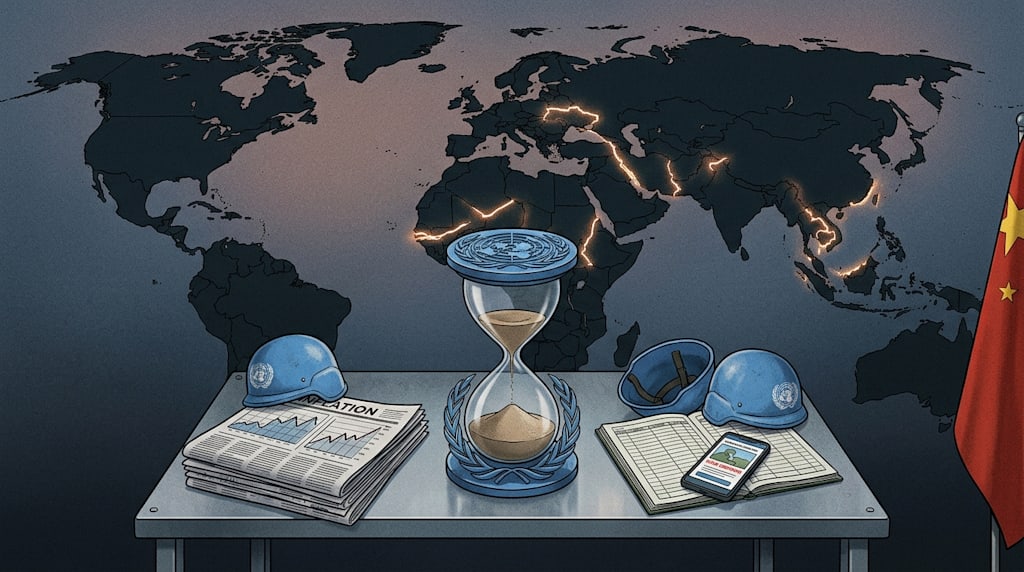
On September 15, 2026, the United Nations released its third Global Risks Report. Fewer than thirty journalists came to the press room in Geneva. That number told its own story. Talk about global war had moved from “if” to “when.”
The report’s main finding: 76 percent of surveyed experts believe a large-scale war will happen within seven years. Thirty-six percent say it could happen within one. Among twenty-eight global risks, large-scale war jumped sixteen places in urgency compared with 2024. That was the biggest jump of any risk. It pushed environmental threats and disinformation out of the top spot.
António Guterres did not name names in his preface. He did not have to. “Political risks have moved to center stage,” he wrote. “Compared with two years ago, a large-scale war is seen as more likely and more imminent. At the same time, confidence in the institutions meant to address these threats has weakened.”
I
Open the conflict map of 2026, and you see something different from the Cold War. There are no clear blocs. There are many fires.
Russia and Ukraine saw a brief ceasefire window in May. At the U.S. proposal, both sides agreed to a three-day ceasefire during Victory Day and exchanged prisoners. Russia refused to extend it. Russian presidential aide Yuri Ushakov then said trilateral talks on Ukraine had been suspended. No agreement was reached on the next round. After the short ceasefire, both sides said they were willing to resume talks. The core disputes remained. Zhang Hong, a researcher at the Chinese Academy of Social Sciences, put it this way: “Both sides will face difficult negotiations.” The subtext: no one is ready to end it.
The Middle East was worse. At the end of February 2026, the United States and Israel launched military strikes on targets inside Iran. By March 30, the war had entered its thirty-first day. Iran said the strikes damaged 131 historical sites. An orphanage was hit. Two people died. Five were wounded. Israel’s parliament approved the largest budget in its history. The defense ministry budget alone was more than 142 billion new shekels, about $45.3 billion. Israeli Defense Minister Israel Katz said publicly that the army was ready to restart operations against Iran and was “waiting for the green light from the United States.” The plans included strikes on Iran’s top leadership successors and key energy and power facilities. Katz said the result would “send Iran back to the dark Stone Age.”
In South Asia, India and Pakistan kept raising the temperature in Kashmir. In July 2026, the two sides exchanged heavy fire for about two hours along the Rajouri axis of the Line of Control. It was the largest incident since the May 2025 ceasefire. Earlier, in April 2025, India launched Operation Sindoor after the Pahalgam bombing. Indian forces struck targets inside Pakistan. Pakistan called it “a blatant act of war.” The U.S. Council on Foreign Relations listed “renewed armed conflict between India and Pakistan triggered by intensified terrorist activity” as a key concern for 2026.
Southeast Asia did not escape. Between January and February 2026, Thai and Cambodian border areas saw repeated exchanges of fire. Thailand accused Cambodia of firing grenades that wounded Thai soldiers. Cambodia denied the claim and protested. In September, Cambodia’s information minister issued a statement on the border dispute. He accused Thai forces of “invading Cambodian territory and trying to change the facts on the ground by installing barbed wire and container barriers.”
The Horn of Africa was just as bad. Sudan’s civil war had lasted nearly three years. Control of the country was split. The army held the capital, Khartoum, and the east. The Rapid Support Forces dominated much of western Darfur. The International Crisis Group warned that Sudan faced “the risk of long-term partition and steadily widening spillover effects.” The war forced as many as four million people to flee. Several regions fell into prolonged famine. The UN Office for the Coordination of Humanitarian Affairs said at least 33.7 million people in Sudan needed humanitarian assistance. Fourteen million were displaced.
These conflicts shared one feature: no clear beginning and no clear end. Fight, stop, fight again. Each ceasefire stored up more hatred for the next exchange.
II
Wars do not come from nowhere. Beneath the conflict map, the global economy is cracking.
The UN’s World Economic Situation and Prospects 2026 mid-year update lowered its forecast for global GDP growth in 2026 from 2.7 percent in January to 2.5 percent. That is well below the pre-pandemic level. Shantanu Mukherjee, director of the UN’s Economic Analysis Division, described the impact of Middle East hostilities on energy markets as “a broad supply shock whose scope, scale, and duration are uncertain.” The forecast for global inflation was raised by 0.8 percentage points to 3.9 percent. Developing countries were hit harder. Their growth rate was expected to be a full 1.3 percentage points lower than before the pandemic.
The link between economic pressure and poverty is starkest in the most fragile regions.
Myanmar is the clearest case. A 2024 UN Development Programme report showed that Myanmar’s poverty rate rose from 24.8 percent in 2017 to 49.7 percent in 2023. That is nearly double. The middle class shrank by 50 percent in three years. Seventy-six percent of the population lived below or dangerously close to the poverty line. UNDP estimated that responding to this poverty wave through cash transfers and other means would cost $4 billion a year. UNDP Administrator Achim Steiner warned: “Without urgent intervention to provide cash assistance, food security, and basic services, vulnerability will continue to expand, and its effects will cross generations.”
Extreme poverty feeds criminal economies. A 2026 UN Office on Drugs and Crime threat assessment on transnational organized crime in Southeast Asia said the region’s criminal networks had undergone a “fundamental restructuring.” Once scattered groups were becoming technology-driven transnational operations spanning multiple illegal markets. In 2025 alone, losses from fraud in East Asia, Southeast Asia, and Oceania were estimated at $88.3 billion to $114.1 billion. Scam compounds in Southeast Asia involved people from at least 80 countries and regions. Recruitment networks reached across Asia, the Middle East, and Africa. They were beginning to expand into Europe and North America.
The “resurgence” of scam compounds in Myawaddy shows how resilient this model is. In 2025, joint Chinese and Myanmar operations destroyed more than 630 scam buildings there. In September 2026, Myanmar media reported that online fraud activity in the Myawaddy area was expanding again. New compounds were under construction. Some were already finished. Fraud groups were openly recruiting through social media. As several Southeast Asian countries cracked down, criminal gangs began spilling out of the region. Scam activity increased in Sri Lanka. Indonesia uncovered multiple new bases. The Chinese embassy in Indonesia confirmed that “more and more people who once engaged in telecom fraud in Cambodia and other countries are moving to Indonesia.”
Mexico offers another reference point. According to 2024 data from Mexico’s National Institute of Statistics and Geography, the multidimensional poverty rate was 29.6 percent, about 38.5 million people. That was down 6.7 percentage points from 36.3 percent in 2022. Poverty is not irreversible. But income inequality remains deep. The top 10 percent of households concentrate 30.3 percent of total income. Poverty rates in southern states such as Chiapas are far above the national average. The easing of poverty has not eliminated the social base of criminal economies.
III
As these risks pile up, the global governance system has less capacity to respond.
UN peacekeeping is in a bind. In September 2026, Guterres told the Security Council debate on peacekeeping that “comprehensive peace agreements are rarer than at any time in decades, harder to reach and more fragile.” Peacekeepers were being attacked. Civilians were being targeted. International law was being violated with “a growing sense of impunity.” At the same time, peacekeeping budgets were cut sharply. Troop and police numbers fell. The UN General Assembly approved a total peacekeeping budget for 2025 and 2026 of $5.38 billion. That was the lowest in nearly a decade. The number of military personnel in global peacekeeping missions fell to its lowest level in twenty-five years.
The deeper problem sits in the Security Council. At the UN peacekeeping review, Guterres said: “Mistrust among major powers makes it harder for the UN Security Council to act in a united and clear manner.” Since 2014, the Council has not authorized any new, fully UN-led peacekeeping operation. The world faces more severe challenges than ever.
Peacekeeping is one example of shrinking global governance. The Munich Security Conference’s 2026 annual report said plainly that the U.S. government had become “the most conspicuous destroyer” of the post-war international order. It said its “bulldozer politics” were steadily weakening international law and multilateral institutions. The report listed the Trump administration’s “systematic destruction” of multilateralism. One phrase circulating is “the world minus one.” The United States still has the strongest economy and military. It is also actively distancing itself from, opposing, and undermining existing international institutions.
Global military spending is rising fast. Data from the Stockholm International Peace Research Institute showed that global military expenditure rose 2.9 percent in 2025 to $2.89 trillion. The U.S. Congress approved more than $1 trillion in military spending for 2026. If budget proposals pass, that could rise to $1.5 trillion by 2027. Ukraine’s defense spending was 31.1 percent of its GDP, the highest in the world.
Military budgets are growing. Peacekeeping budgets are shrinking. States are choosing self-help over multilateral mechanisms. Trust in those mechanisms keeps falling.
IV
The UN report shows a rise in war risk. The shape of current conflicts shows something else: a change in kind.
This new mode of war has a consequence that gets overlooked. It accumulates hatred more easily than full-scale war. Full-scale war has a clear beginning and end. It has a judgment of victory and defeat. It has post-war reconstruction. Fragmented, prolonged conflict has no clear endpoint. Each round of fighting deepens trauma, hardens hostility, and creates motives for revenge. Sudan is an extreme case. The International Crisis Group noted that external supporters led both the army and the Rapid Support Forces to “reject mediators and believe they can win through force and attrition.” The external supporters themselves “have fallen into an escalation cycle.”
In this mode, the lines of blocs become blurred. But fragmentation does not mean great-power competition has left the stage. Behind almost every regional conflict, you can see the shadow of great-power rivalry. The method has shifted from Cold War bloc confrontation to a mix of proxies, sanctions, technology blockades, and information warfare. In Sudan’s civil war, Gulf states backed opposing sides. In the Middle East, the United States entered the war directly while other major powers used diplomatic and economic channels. Blocs still exist. They are just harder to see and quicker to shift.
V
Where does China stand?
In hard power, China has an industrial base, military capacity, and governance mobilization capacity that the Qing dynasty could not match. Global military spending is soaring. China’s defense modernization continues. Diplomatically, frameworks such as the Global Security Initiative and the Global Development Initiative have received some international response. Pakistani Prime Minister Shehbaz Sharif thanked China at the 81st UN General Assembly for its four major global initiatives. He said they “provide solid pillars for building a community with a shared future for mankind.”
But “not the Qing dynasty” does not mean “immune to risk.”
China’s security threats go beyond traditional military confrontation. The harm done to Chinese citizens by scam compounds in Southeast Asia is a persistent non-traditional security challenge. Its roots are not in the strength or weakness of military power. They are in cross-border governance vacuums and the organizational capacity of criminal supply chains. In 2026, joint Chinese and Myanmar operations destroyed large numbers of scam buildings in Myawaddy. The speed of their “resurgence” shows that law enforcement crackdowns alone cannot uproot the problem. As criminal gangs spill into Indonesia, Sri Lanka, and elsewhere, China needs a broader international cooperation network, not stronger unilateral action.
The effects of global supply chain fragmentation on China’s economy also matter. The UN lowered its 2026 global growth forecast to 2.5 percent. Developing countries were hit harder. As one of the world’s largest trading nations, China cannot remain untouched by a global downturn.
The neighborhood is messy. The Taiwan Strait crisis has been listed as a first-tier risk by the U.S. Council on Foreign Relations for nine straight years. The South China Sea dispute, the Korean Peninsula, and structural problems in China-Japan relations all create persistent strategic pressure.
VI
The UN report matters for what it records. It captures a shift in how global elites see the world. That shift matters more than any single prediction.
When 76 percent of risk experts believe a large-scale war is possible within seven years, that number changes how decision-makers calculate. It can lead to more arms spending, tougher foreign postures, and less willingness to cooperate. In that way, the prediction can help make itself come true.
The shift is not irreversible. The report also notes that respondents believe “joint action among governments is by far the most effective means of prevention.” No single country, company, or institution can address these risks alone.
Guterres put it at the end of the report: “The choice is in our hands.”
That line is not decoration. In a fragmented world, the scarcest resource may not be oil or chips. It may be the political will among states to keep cooperating at a minimum level. When that will disappears, war stops being a distant hypothesis. It becomes a self-fulfilling prophecy.
After the press conference in Geneva, journalists packed up their equipment and left. No one asked, “Seven years from when?” Everyone already knew. The countdown had started long before.
About the Creator
Jin
Writer of reamstories
https://reamstories.com/jin
Enjoyed the story? Support the Creator.
Subscribe for free to receive all their stories in your feed. You could also become a paid subscriber, letting them know you appreciate their work.
Comments
There are no comments for this story
Be the first to respond and start the conversation.