
100 Civilians Dead at a Market. The Army Says It Was Targeting Bandits. The Families in Zamfara State Say Otherwise.
This story is not from a war zone in the traditional sense. There are no armies facing each other across front lines, no declared battles, no official enemy state. But the people buried in Zamfara State in northwestern Nigeria this week are just as dead as any soldier killed in any formal conflict, and the families mourning them deserve the same attention.
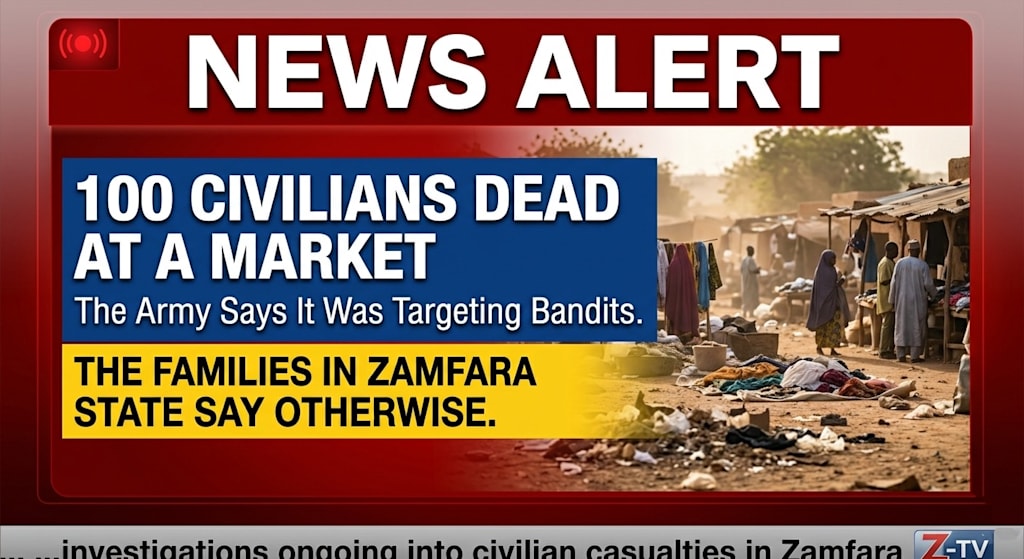
This story is unfolding far from the front pages of most international newspapers. There are no massive troop formations, no televised battlefield maps, and no formal declarations of war. Yet the people buried this week in Zamfara State are victims of a conflict just as real — and for the communities living through it, just as devastating.
On May 10, a Nigerian military airstrike hit the weekly Tumfa market in Zurmi district, a rural area in northwestern Nigeria long terrorized by heavily armed bandit groups. According to Amnesty International, at least 100 civilians were killed, including women and children. Witnesses described fighter jets circling the market before returning hours later to launch the strike. Survivors spoke of bodies torn apart and entire families wiped out.
The Nigerian military tells a very different story.
Military officials insist the operation targeted a “confirmed high-level gathering” of militant leaders and say there is “no credible, substantiated evidence” of civilian casualties. According to Defence Headquarters spokesperson Major-General Michael Onoja, the strike was lawful, intelligence-driven, and conducted under international humanitarian law.
Between those two versions lies the central crisis of Nigeria’s counterinsurgency campaign: accountability.
A Country Fighting Multiple Wars at Once
To understand why these strikes keep happening, you have to understand the complexity of northern Nigeria’s security crisis.
For years, the northwest has been plagued by armed criminal groups commonly referred to as “bandits.” These groups raid villages, burn homes, abduct schoolchildren, extort farmers, and control rural territories where state authority has nearly collapsed. In the northeast, Nigeria continues fighting a 17-year insurgency involving Boko Haram and its splinter factions, including ISWAP.
The military increasingly relies on airpower to fight enemies that move quickly across remote terrain.
In theory, airstrikes allow Nigeria to target militant camps without risking large numbers of ground troops. In practice, the intelligence environment is chaotic. Armed groups blend into civilian populations, operate inside markets and villages, and often receive support — voluntary or coerced — from local communities.
Analysts say this creates a deadly pattern: military pilots strike based on incomplete intelligence while lacking sufficient coordination with forces on the ground.
The result is that ordinary civilians increasingly find themselves trapped between violent armed groups and military operations supposedly designed to protect them.
A Pattern Too Consistent to Ignore
What happened in Tumfa is not an isolated tragedy.
In December 2023, a Nigerian military airstrike struck a Muslim religious gathering in Kaduna State, killing at least 85 civilians, many of them women and children. In January 2025, another strike in Zamfara reportedly killed 16 vigilantes defending their communities from bandits. In January 2026, yet another operation killed at least 20 vigilantes in the same region.
Then came the Jilli market strike in April 2026, where more than 100 civilians were reportedly killed during another anti-insurgency air operation. Survivors and rights groups described scenes almost identical to those emerging now from Tumfa: crowded markets hit in broad daylight, civilians mistaken for militants, mass burials afterward.
According to security analysts and rights organizations, Nigerian military air operations have killed hundreds of civilians since 2017.
That consistency is what alarms human rights observers most.
At some point, repeated “mistakes” begin to look less like isolated failures and more like systemic problems involving intelligence gathering, targeting procedures, operational oversight, and military accountability.
The Trust Gap Is Growing
Perhaps the most dangerous consequence of these incidents is not only the immediate loss of life, but the collapse of public trust.
Communities already traumatized by bandit violence increasingly fear both the armed groups attacking them and the military aircraft flying overhead. Villagers who once welcomed military intervention now often flee at the sound of approaching jets.
That fear creates a vicious cycle.
When civilians stop trusting the military, intelligence-sharing deteriorates. Communities become less willing to cooperate with security forces. Armed groups exploit resentment and grief to recruit new fighters or intimidate locals into silence.
In counterinsurgency warfare, legitimacy matters almost as much as firepower.
Every mistaken strike risks strengthening the very instability the government is trying to destroy.
Accountability Without Transparency
After previous deadly strikes, Nigerian authorities promised investigations.
Following the Kaduna bombing in 2023, the military announced court martials and internal reviews. Yet few findings have been made public, and almost no senior officials have faced visible consequences. Rights organizations argue that this lack of transparency fuels impunity and allows operational failures to continue unchecked.
Amnesty International described the latest strike as unlawful and accused the military of showing “disregard for civilian life.” The group warned that civilians in northern Nigeria increasingly face danger from both armed groups and state security operations.
The military rejects those accusations and insists it is acting responsibly in an extraordinarily difficult security environment.
But for grieving families in Zurmi and Shinkafi, those official denials offer little comfort.
They are not debating intelligence assessments or rules of engagement.
They are burying children, parents, traders, and neighbors.
And in many parts of northern Nigeria, that has become a horrifyingly familiar ritual.
About the Creator
Enjoyed the story? Support the Creator.
Subscribe for free to receive all their stories in your feed.
Comments
There are no comments for this story
Be the first to respond and start the conversation.