
What Is Cryptocurrency? A Beginner's Guide to Digital Money in 2026
Demystifying Blockchain, Bitcoin, and the Future of Money, One Concept at a Time.


Think of it this way: If you could send money to a friend living abroad and have it reach him in minutes, with only a few cents' worth of fees, without dealing with long lines at the bank, and with no paperwork... That’s the reason so many people are asking themselves the question, what is cryptocurrency? If you still don’t understand words like Bitcoin, blockchain, or wallet, then this book will take you from the very beginning up to an understanding in plain words about cryptocurrencies, in a step-by-step fashion.
What everyone calls cryptocurrency, in layman’s terms, is money that exists only as an entry on a decentralized, shared, electronic ledger known as the Blockchain. Unlike the currency in your bank account (Dollars), cryptocurrency does not exist in a single bank or government; nor does it maintain the master ledger; rather, it is maintained and verified by a network of computers around the globe using cryptography (the use of mathematics to secure information).
A great way to remember what cryptocurrency is: digital currency+technology to secure verification + there is no one authority to control it.
How Cryptocurrency Actually Works
The blockchain acts as a digital ledger to track transactions made with it. Transactions are bundled into sets and referred to as blocks. As each new block is linked to the previous block in the chain, it becomes increasingly difficult for someone to go back and change the information since they would have to change all subsequent blocks across multiple copies of the ledger at the same time. This structure allows for confirmed transactions where it is both transparent and difficult to alter the transaction history.
With decentralization, the control that has traditionally been held by a central banking system has now been spread out over tens of thousands of independent computers (known as nodes) located throughout the world. Rather than being solely controlled by one centralized company or government, the validity of transactions is based upon the consensus of thousands of independent parties. Thus, no one party or government can change the ledger or freeze the network as a whole, however, exchanges and wallets are still susceptible to regulation.
Due to its use of cryptography and encryption, it is safe and secure. You will have two keys for each account: a public (your account number, which anyone can see) and a private (your PIN or password, which should never be shared). The private key is what gives you access to your account and allows you to perform transactions. Therefore, if you lose or forget your private key, then you have lost access to that cryptocurrency account.
Cryptocurrency vs. Bank Money vs. Cash
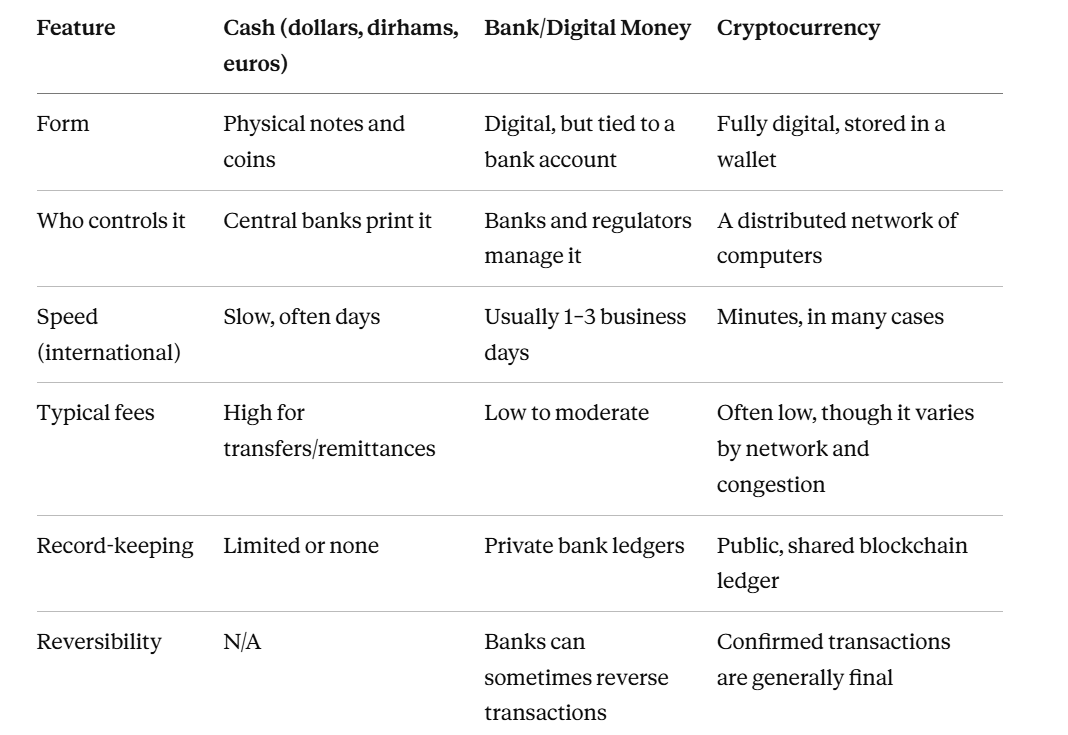
The trade-off worth remembering: cryptocurrency gives you more direct control over your money and faster global movement, but it also shifts more responsibility for security onto you, since there is no customer service line to call if you lose your private key or send funds to the wrong address.
The Building Blocks: Coins, Tokens, and Stablecoins
Cryptocurrency types may seem confusing at first glance, but understanding the categories below will help simplify your navigation through the rest of the cryptocurrency world.
Coins utilize their own independent blockchain and serve primarily as a form of currency or as an alternative way to store value. An example is Bitcoin (the very first cryptocurrency) which was launched in 2009. Litecoin is also an example.
Using someone else's blockchain to create tokens (i.e., tokens that are built on someone else's blockchain) has become very popular over the past 3 years. The majority of these tokens exist on the Ethereum blockchain, but other blockchains (i.e., blockchains that are different from Ethereum) have begun allowing users to create their own versions of tokens. Although these tokens can represent almost anything, some examples include: providing access to an application (i.e., giving someone access to your application), providing voting rights for a project, or providing a share of ownership (i.e., providing someone with a percentage of ownership) in an entity.
Stablecoins are cryptocurrencies that are intended to hold a relatively constant value, typically by having a reserve asset (usually, the US dollar) backing each stablecoin one-to-one. Since the value of a stablecoin doesn't change much unlike other types of crypto (i.e., bitcoin), stablecoins are often used as a form of currency for everyday purchases, saving assets, and moving value between exchanges (i.e., moving money to one exchange to another) without the risk of large fluctuations in value. By 2026, multiple countries including the US, the European Union, the UK, and various Asian nations are expected to have enacted laws making it mandatory for any entity issuing stablecoins to maintain a full reserve of all issued stablecoins and undergo periodic supervision of this process adding to the legitimacy of stablecoins as a mainstream financial instrument.
Sometimes User Access Tokens Allow You to Purchase a Product or Service Through A Blockchain Ecosystem; However, Other User Access Tokens Can Help You Access The Network and Access Certain Features of The Decentralized Application.
Currently, Three Companies Control Most of the Market by Size and Adoption; They Include; Bitcoin(BTC), Which is Currently The Largest and Most Established Cryptocurrency in Existence Today, Ethereum(ETH), Which is Best Known for Powering Smart Contracts and Decentralized Applications, and What Can Be Considered an Alternate Market Tier of Large Alternative Network Providers (e.g., Solana (fast/cheap), XRP (cross-border), BNB (Binance) = The Three Companies Listed Above are the Three Largest Providers by Size and Adoption Within That Tier. Project Ranks (size, adoption, etc) Are Always Changing, Therefore Any List of Projects Should Be Thought of As An Somewhat Inconstant Way to Rank Companies.
What People Actually Use Cryptocurrency For
Payments and money transfers through banks can take days to process and cost a lot of money, whereas crypto can often transfer money within minutes for much lower fees. These are among the reasons why many freelancers or immigrants who want to send money home have chosen to use crypto.
When two parties enter into an agreement that is created in code and executed automatically when the contract's conditions are met, these contracts referred to as 'smart contracts' do not require any lawyers or banks or third parties to process the transaction between the two participants which then allows for a higher valuation for the next stage: Decentralized Finance (DeFi).
DeFi allows participants to lend money to one another through smart contracts and be paid interest on the loan. Therefore, individuals or borrowers do not need to go through a bank to get loans or pay interest to landlords, and this can create some risks as we will also discuss later; however, it also provides many advantages over traditional banking.
NFTs are unique tokens that provide verified evidence of ownership of a digital or digitally linked asset, such as digital art, music, in-game collectibles, etc.
Individuals living in underbanked areas may have access to basic financial services usually provided by a bank account as long as they have a smartphone and internet access. Crypto provides individuals in this situation with the ability to deposit, save, pay, and receive a variety of other financial services previously provided by banks.
A Quick Real-World Example
Imagine a freelance designer who provides services to clients around the world. If he works through a bank, it's likely to take between 3 - 5 days for the client's payment to arrive. Meanwhile, the designer will pay much more to have that money converted into the right currency, as well as having to pay fees on top of that for moving money internationally. If he uses a stablecoin instead, the payment can be moved into his digital wallet within minutes and it will cost him less in fees. Most new participants in cryptocurrency culture enter it because of this type of example, rather than as a speculative investment.
Is Cryptocurrency Safe?
How you use crypto pretty much determines its level of safety.
The safer side of crypto generally comes from using regulated platforms and signing up for their services for a long time; protecting your private keys and recovery phrases (preferably by storing them offline); double-checking wallet addresses before sending funds; and gaining a good understanding of a project before you invest in it.
The riskier side of crypto usually comes from making an investment solely because of hype (i.e., not researching), leaving large amounts of money on exchanges instead of in a wallet that you control; clicking on unsolicited links from messages offering guaranteed returns; or completely skipping the basic steps necessary to establish and manage your own security (i.e., two-factor authentication).
The fact that regulation is starting to favor greater accountability for crypto exchanges and stable coin issuers should help improve the overall level of safety for crypto users. There are, however, no guarantees of safety associated with investments in cryptos; however, there will be greater external oversight over the more reputable platforms through government regulation than what currently exists through private self-regulating organizations.
Advantages and Disadvantages at a Glance
Benefits: Quicker transactions, mainly those conducted across international borders, could have reduced costs compared with existing wire transfer systems, be accessible to all individuals around the globe who have access to an internet-enabled device regardless of bank affiliation and lastly, transactions will be publicly available through a transparent and publicly shared database.
Disadvantages: Price fluctuations can occur very rapidly; Many new users will confront a large amount of information to learn about wallets, keys and security before feeling capable of properly securing their personal cash; Reports of scam attempts via stolen passwords or phishing (fraudulent emails) are frequently encountered; A dollar amount that is sent improperly through a cryptocurrency cannot typically be reversed.
Getting Started, Without the Overwhelm
When beginning your venture into cryptocurrency, this is a logical step-by-step process you can use: Open an account with a reputable regulated exchange; use only an amount of money you are comfortable losing (since cryptocurrency is extremely volatile); Transfer the funds you plan to hold long term into a private key controlled wallet rather than leaving them on an exchange; and treat "guaranteed returns" offers as red flags as opposed to being opportunities. None of this information is to be construed as financial advice; therefore, you should do your own due diligence on the exchange you choose before investing real money.
The Bigger Picture for 2026
Currently, cryptocurrencies are evolving from speculative markets with little usage in finance to becoming viable components of a regulated, mainstream financial system. In recent months, stablecoin regulations in the United States, the European Union, Great Britain, and various jurisdictions across Asia have mandated full reserves and regulated issuance of stablecoin currencies. As banks and payment processors are adding rails for settling cryptocurrencies, leading regulators in the United States are also shifting from enforcement actions to rulemaking as a foundation for regulating crypto. While none of these changes mitigate volatility or eliminate risk, they indicate that cryptocurrencies are increasingly integrated into regulated financial markets rather than being entirely outside of those markets.
Conclusion
Digital currency is a form of electronic money that is protected with cryptographic techniques and is governed by a network of computers instead of a centralized authority like a bank or government. Cryptocurrencies are changing how people transfer funds internationally, allowing people to access banking services without having a bank account, and providing proof of ownership of digital assets. As with any form of finance, individuals who take the time to learn about how this technology works and proceed with caution will benefit from it, while those who act on hype will be penalized by their premature entry into this space. One can start small, keep security as a priority, and learn one concept at a time to move from beginner to a confident user.
About the Creator
Henry cross
Henry is a crypto, blockchain, and finance analyst known for turning complex market trends into clear, actionable insights.
Enjoyed the story? Support the Creator.
Subscribe for free to receive all their stories in your feed.
Comments
There are no comments for this story
Be the first to respond and start the conversation.