
Top Real-World Asset Tokenization Investment Opportunities to Watch in 2026
Real-World Asset Tokenization Investment Opportunities

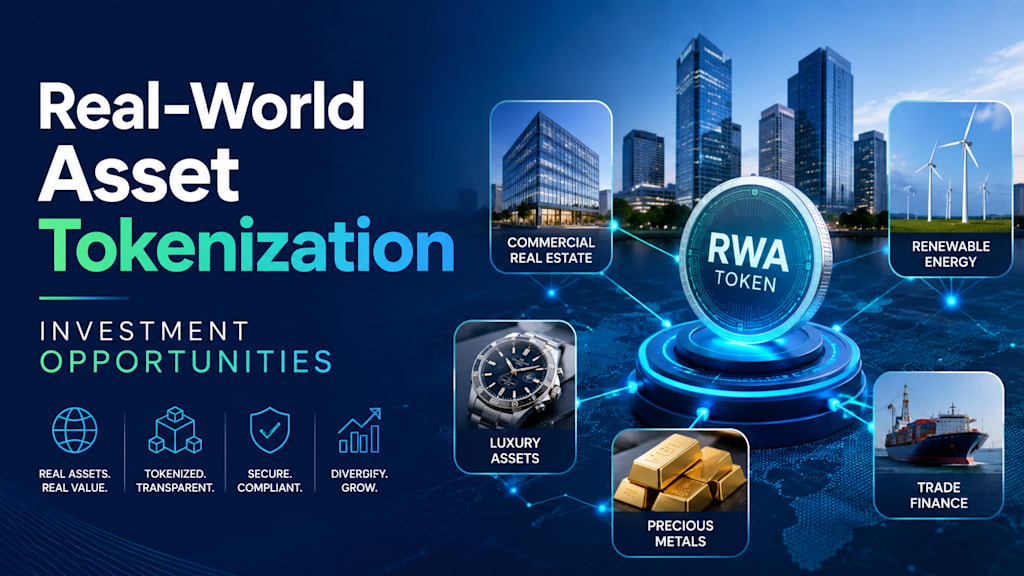
Real-world asset (RWA) tokenization is increasingly reshaping how value-bearing assets are issued, traded, and managed across digital financial ecosystems. By converting tangible and traditionally illiquid assets into blockchain-based tokens, this approach introduces fractional ownership, improved liquidity mechanisms, and more transparent settlement structures. As the infrastructure matures, 2026 is expected to mark a deeper integration of tokenized assets into institutional portfolios and retail investment platforms.
This analysis explores the most relevant real-world asset tokenization investment opportunities that are likely to gain traction in 2026, based on market evolution, regulatory direction, and adoption trends across financial sectors.
What is Real-World Asset Tokenization?
Real-world asset tokenization refers to the process of representing ownership rights of physical or financial assets on a blockchain. These assets can include real estate, commodities, government bonds, private credit, intellectual property, and even environmental assets such as carbon credits.
The primary value proposition lies in transforming traditionally illiquid or high-barrier markets into divisible, transferable digital units. This structural shift allows broader participation while improving settlement efficiency and reducing reliance on intermediaries.
As regulatory clarity improves in multiple jurisdictions and institutional players continue experimenting with blockchain settlement layers, tokenized markets are gradually moving from pilot phases to structured financial instruments.
1. Tokenized Real Estate Assets
Real estate remains one of the most established and promising sectors for tokenization due to its inherent illiquidity, high capital requirements, and fragmented ownership structures. In 2026, tokenized real estate is expected to expand beyond commercial pilot projects into more structured investment vehicles. These may include fractional ownership of residential apartments, commercial office spaces, logistics hubs, and hospitality assets.
The real-world asset tokenization model enables investors to purchase fractional shares of properties, potentially earning rental yields or capital appreciation proportional to their holdings. For developers and asset managers, it introduces an alternative capital-raising mechanism that reduces dependency on traditional financing structures. Emerging trends suggest increasing integration with secondary trading platforms, allowing investors to exit positions with greater flexibility compared to conventional real estate markets.
2. Tokenized Government Bonds and Treasury Instruments
Government bonds and treasury securities represent one of the largest financial markets globally, and their tokenization is gaining institutional attention.
Tokenized bonds can streamline issuance, settlement, and redemption processes through smart contract automation. This reduces operational friction and enables near real-time settlement cycles, compared to traditional multi-day clearing systems.
In 2026, tokenized treasury instruments are expected to be increasingly used as collateral within decentralized finance (DeFi) systems, providing a bridge between traditional financial markets and blockchain-based liquidity pools. This category is particularly significant because it represents low-risk, yield-bearing instruments that can attract conservative institutional investors exploring blockchain-based exposure.
3. Private Credit and Debt Tokenization
Private credit markets, including corporate lending, invoice financing, and structured debt instruments, are becoming a major area for tokenization innovation. Traditionally, private credit investments are limited to institutional investors due to high entry thresholds and limited liquidity. Tokenization introduces fractional access and the potential for secondary trading of debt positions.
By representing loan agreements and repayment streams as programmable tokens, issuers can automate interest distribution and enforce compliance conditions through smart contracts. In 2026, tokenized private credit is expected to grow alongside demand for alternative yield sources, particularly as traditional fixed-income markets face tightening spreads and volatility.
4. Tokenized Commodities (Gold, Oil, and Agricultural Assets)
Commodity markets have long been a cornerstone of global trade, but they remain operationally complex and capital-intensive. Tokenization introduces a simplified ownership structure by linking digital tokens to physical reserves or futures contracts.
Gold is already one of the most widely tokenized commodities, but expansion into energy assets and agricultural products is expected to accelerate.
Tokenized commodities offer advantages such as easier transferability, reduced storage complexity for investors, and improved accessibility for smaller market participants.
In 2026, hybrid models combining physical storage verification systems with blockchain tracking are likely to enhance trust in tokenized commodity markets.
5. Carbon Credits and Environmental Assets
Environmental markets, particularly carbon credits, are becoming increasingly relevant as global climate policies evolve.Tokenization allows carbon credits to be tracked, traded, and retired on-chain, reducing the risk of double counting and improving transparency in environmental impact reporting.
As regulatory frameworks around ESG (Environmental, Social, and Governance) compliance tighten, tokenized carbon markets are expected to become more standardized and interoperable across platforms. This category also includes biodiversity credits and renewable energy certificates, which may gain traction as sustainability-linked financial instruments expand.
6. Tokenized Infrastructure Projects
Large-scale infrastructure projects such as highways, renewable energy plants, airports, and telecommunications networks often require long-term capital commitments and complex financing structures.Tokenization introduces a mechanism for fractional participation in infrastructure funding, allowing investors to gain exposure to stable, long-duration cash flow assets.
Revenue generated from tolls, energy output, or service fees can be distributed programmatically to token holders. In 2026, infrastructure tokenization is likely to align with public-private partnership models, where governments collaborate with digital asset platforms to broaden access to infrastructure financing.
7. Tokenized Art, Collectibles, and Intellectual Property
Art and collectibles represent a niche but rapidly evolving segment of tokenized assets. High-value artworks, rare collectibles, and intellectual property rights are increasingly being fractionalized through blockchain-based ownership structures.
This allows broader participation in markets that were previously dominated by high-net-worth collectors and institutions.
Beyond physical art, intellectual property such as music royalties, film rights, and patents can also be tokenized. This enables creators and rights holders to monetize future revenue streams more efficiently.
In 2026, intellectual property tokenization may expand significantly as digital content monetization models continue to evolve.
8. Tokenized Equity in Private Companies
Private equity markets are traditionally illiquid and restricted to accredited investors. Tokenization introduces the possibility of fractional ownership in startup equity, venture capital funds, and growth-stage companies.
By representing equity shares as digital tokens, companies can potentially broaden their investor base while improving liquidity options for early stakeholders.
Secondary trading mechanisms could allow early investors to exit positions without waiting for IPOs or acquisition events, which are typically long-term and uncertain.
Regulatory frameworks will play a critical role in determining the pace of adoption in this segment, particularly around investor protection and compliance standards.
9. Tokenized Financial Derivatives and Structured Products
Financial derivatives such as options, futures, and structured products are increasingly being explored within blockchain environments. Tokenization can automate margin management, settlement, and collateralization processes, reducing counterparty risk and operational inefficiencies.
In 2026, tokenized derivatives may become more integrated with decentralized finance ecosystems, allowing programmable financial instruments to interact directly with liquidity protocols. This could lead to more dynamic risk management systems and improved transparency in complex financial instruments.
10. Tokenized Supply Chain and Trade Finance Assets
Supply chain finance remains a critical area where liquidity gaps often constrain business operations. Tokenization can improve transparency and financing efficiency by digitizing invoices, purchase orders, and trade receivables. These tokenized instruments can then be used as collateral or traded in secondary markets, improving working capital flow for businesses.
In 2026, supply chain tokenization is expected to gain traction in global trade ecosystems, particularly in manufacturing, logistics, and export-import industries. The integration of IoT data and blockchain verification systems may further enhance the reliability of tokenized supply chain assets.
Key Structural Trends Driving RWA Tokenization Growth
Several macro-level developments are accelerating the adoption of real-world asset tokenization:
First, institutional participation is increasing as regulatory clarity improves across major financial jurisdictions. Second, interoperability between blockchain networks and traditional financial systems is becoming more seamless, enabling hybrid asset structures. Third, advancements in smart contract security and auditing are reducing operational risks associated with digital asset issuance.
Additionally, investor demand for diversified, yield-generating assets is pushing capital into alternative asset classes, many of which are being restructured through tokenization frameworks.
Challenges Influencing Market Adoption
Despite strong growth potential, several challenges remain relevant in 2026. Regulatory fragmentation across jurisdictions continues to create compliance complexity for cross-border tokenized assets. Custody solutions for underlying physical assets also require standardized verification mechanisms to ensure trust.
Liquidity fragmentation across multiple platforms can limit efficient price discovery, while technical risks related to smart contract vulnerabilities remain an ongoing concern. These constraints suggest that while the market is expanding, its evolution will likely remain gradual and structured rather than instantaneous.
Conclusion
Real-world asset tokenization is transitioning from experimental pilots into structured financial systems with measurable economic utility. In 2026, the most relevant investment opportunities are likely to emerge across real estate, government securities, private credit, commodities, environmental assets, infrastructure, and intellectual property.
The overarching transformation lies not only in asset digitization but also in the reconfiguration of ownership, liquidity, and financial access mechanisms. As infrastructure matures and regulatory frameworks stabilize, tokenized markets may increasingly integrate with traditional capital systems, creating a hybrid financial architecture that bridges physical and digital economies.
About the Creator
Gabrielle
Blockchain enthusiast and NFT writer dedicated to merging technology with art on decentralized platforms, driving innovation for a creative future. Embracing the potential of digital expression.
Enjoyed the story? Support the Creator.
Subscribe for free to receive all their stories in your feed.
Comments
There are no comments for this story
Be the first to respond and start the conversation.