
Stablecoin Payroll: A Smarter Way to Pay a Global Workforce
Exploring how blockchain-powered stablecoin payments are simplifying international payroll with faster settlements, lower transaction costs, and greater financial transparency for modern global businesses.
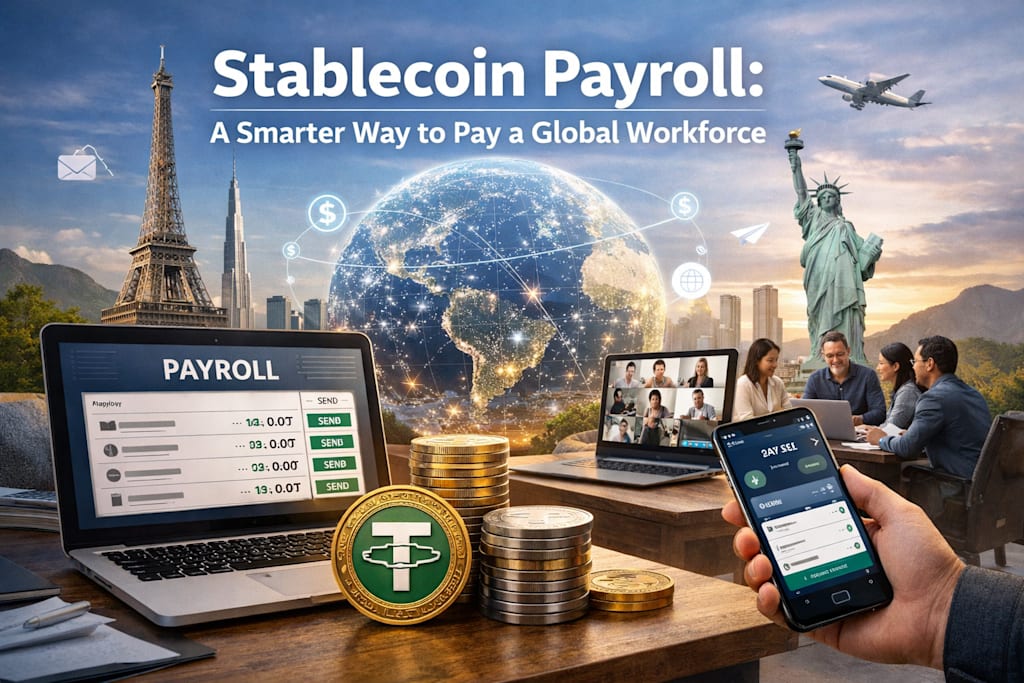
Global hiring has become a strategic priority for businesses of every size, but paying an international workforce remains one of the biggest operational hurdles. Traditional payroll systems rely on multiple banking intermediaries, regional clearing networks, currency conversions, and varying settlement timelines. As companies expand across continents, payroll complexity often grows faster than the workforce itself.
Stablecoins are beginning to reshape this landscape by offering a digital payment infrastructure that minimizes delays while maintaining predictable value. Unlike volatile cryptocurrencies, stablecoins are pegged to reserve assets, making them better suited for business transactions where financial consistency matters. Organizations managing remote teams, freelancers, contractors, and distributed employees are increasingly evaluating blockchain-powered payroll as an operational improvement rather than a financial experiment.
The conversation is no longer about replacing payroll systems overnight. Instead, it is about modernizing how money moves across borders. Stablecoin-based payroll combines blockchain settlement with programmable payments, enabling businesses to simplify international compensation while reducing friction in cross-border transactions.
Why Traditional Global Payroll Continues to Create Operational Challenges
International payroll involves far more than simply transferring salaries. Every payment passes through banking networks, compliance checks, foreign exchange conversions, local regulations, and intermediary institutions. Even when each step functions correctly, the overall process introduces unnecessary latency and administrative overhead.
For multinational organizations, these inefficiencies create several recurring challenges:
- Cross-border wire transfers often require multiple business days before funds reach employees.
- Currency conversion spreads increase payroll costs, especially when payments involve multiple jurisdictions.
- Banking holidays and regional settlement windows delay salary disbursements.
- Finance teams spend considerable time reconciling payments across different financial systems.
- Contractors in emerging markets may experience inconsistent access to international banking infrastructure.
These issues affect more than payroll departments. Delayed salary payments can reduce employee satisfaction, complicate contractor relationships, and create additional financial uncertainty for workers who depend on timely compensation.
How Stablecoin Payroll Improves Cross-Border Compensation
Stablecoin payroll introduces blockchain settlement into the payroll workflow without exposing businesses to the volatility associated with traditional cryptocurrencies. Employers convert payroll funds into regulated stablecoins, which are transferred directly to employees' digital wallets. Recipients can either retain the assets or convert them into local currency through supported financial platforms.
This model changes how payroll operates at an infrastructure level instead of simply digitizing existing banking processes.
Several operational improvements stand out:
- Near-instant settlement significantly reduces waiting periods for international salary payments.
- Blockchain transactions provide transparent payment records that simplify reconciliation.
- Programmable payment execution supports automated payroll scheduling.
- Reduced dependence on correspondent banking networks lowers transaction complexity.
- Digital wallets improve financial accessibility for workers in underbanked regions.
Modern Stablecoin payroll software is also evolving to integrate with enterprise payroll platforms, accounting systems, tax workflows, and compliance monitoring tools. Instead of replacing existing financial operations, these solutions increasingly function as an additional settlement layer that enhances payroll efficiency.
Business Advantages Beyond Faster Salary Payments
The most valuable aspect of stablecoin payroll extends beyond transaction speed. It enables organizations to rethink payroll as a strategic business process rather than an administrative obligation.
Finance departments gain greater visibility into payment execution through immutable blockchain records. Treasury teams can forecast liquidity with greater precision because settlement timelines become more predictable. Human resource departments spend less time resolving delayed international payments, allowing greater focus on workforce management.
For globally distributed companies, operational flexibility becomes equally important. Organizations hiring remote specialists across multiple countries no longer need to establish banking relationships in every jurisdiction before onboarding talent. This significantly shortens the time required to build international teams.
Stablecoin payroll also supports modern workforce structures where employees, consultants, freelancers, and decentralized contributors operate across different legal and geographic environments. As businesses increasingly embrace borderless hiring, payroll infrastructure must evolve accordingly.
Another important benefit lies in payment transparency. Every transaction generates a verifiable blockchain record, making audits, internal controls, and financial reporting more efficient. This traceability reduces reconciliation effort while improving confidence in payroll accuracy.
Although implementation requires careful planning, the long-term operational benefits can include lower administrative costs, improved payment reliability, and stronger financial visibility across global payroll operations.
Compliance, Governance, and Risk Management Still Matter
Despite its advantages, stablecoin payroll should not be viewed as a shortcut around financial regulation. Payroll remains one of the most highly regulated business functions, regardless of the payment method.
Successful implementation requires organizations to evaluate several governance considerations:
- Local labor regulations governing digital asset compensation.
- Tax reporting obligations in both employer and employee jurisdictions.
- Anti-money laundering and Know Your Customer compliance requirements.
- Data privacy standards for payroll records.
- Internal treasury policies for managing digital assets.
Companies should also establish clear payroll policies explaining payment options, currency conversion procedures, employee consent, and financial reporting responsibilities. Legal, finance, compliance, and HR teams should collaborate during deployment to ensure payroll modernization aligns with regulatory expectations.
Choosing stablecoins backed by transparent reserve management and supported by reputable financial infrastructure further reduces operational risk. Strong governance remains just as important as technological innovation.
The Future of Payroll Is Becoming More Borderless
Global employment is changing faster than traditional financial infrastructure can adapt. Distributed teams, remote-first organizations, digital nomads, and international contractors have transformed workforce management into a cross-border discipline. Payroll systems built for domestic banking environments often struggle to support these modern employment models efficiently.
Stablecoin payroll represents an evolution toward programmable, transparent, and globally accessible financial infrastructure. While it is unlikely to replace every conventional payroll process in the immediate future, it offers businesses a practical pathway to improve international payment efficiency without sacrificing financial control.
Organizations exploring payroll modernization should evaluate stablecoin solutions through the lens of operational efficiency, compliance readiness, employee experience, and long-term scalability rather than technological novelty. As blockchain infrastructure matures and regulatory clarity improves across major markets, stablecoin payroll is likely to become an increasingly important component of global workforce management.
Companies that understand this transition today will be better positioned to build payroll systems capable of supporting tomorrow's international workforce.
About the Creator
Enjoyed the story? Support the Creator.
Subscribe for free to receive all their stories in your feed.
Comments
There are no comments for this story
Be the first to respond and start the conversation.