
Real Estate Tokenization Development for Fractional Asset Trading
Transforming Property Investment Through Blockchain-Powered Fractional Ownership and Digital Asset Liquidity
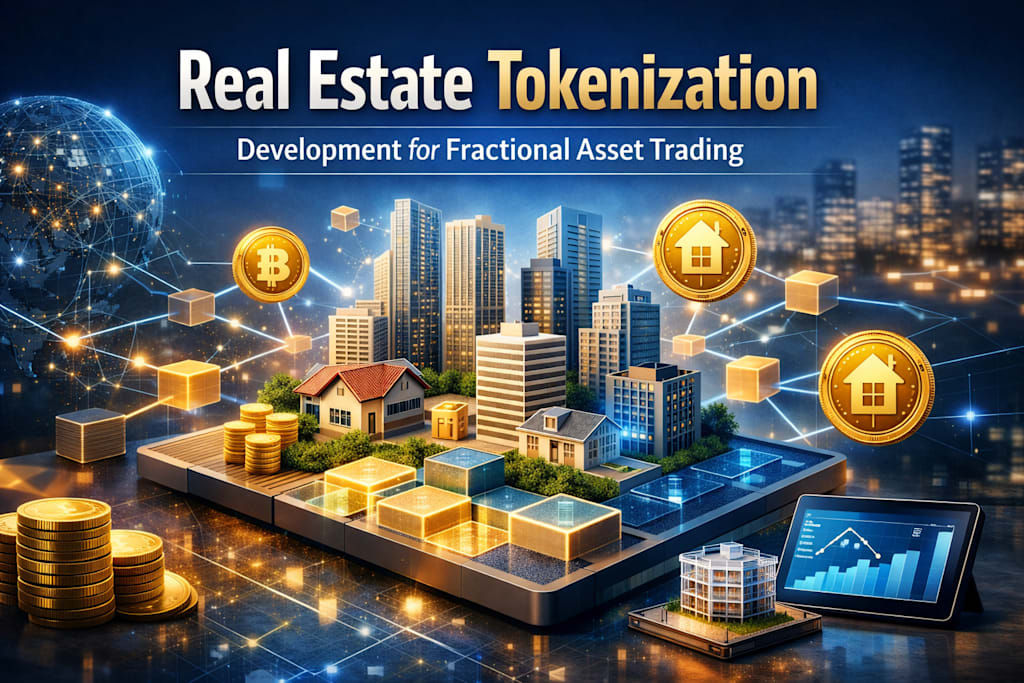
Real estate has traditionally been considered a capital-intensive asset class dominated by institutional investors, private equity firms, and high-net-worth individuals. The emergence of blockchain infrastructure is now transforming this structure through tokenized ownership models that divide physical assets into digital fractions. Real estate tokenization development is becoming a foundational mechanism for enabling fractional asset trading, increasing market liquidity, and modernizing property investment ecosystems.
Tokenization converts ownership rights of a real-world property into blockchain-based digital tokens that can be traded, transferred, or held by multiple investors. These tokens represent fractional stakes in residential, commercial, industrial, or mixed-use assets. Unlike traditional property syndication models, tokenized systems create programmable ownership structures supported by smart contracts, distributed ledgers, and automated compliance protocols.
As regulatory frameworks surrounding digital securities continue to mature globally, enterprises are increasingly investing in blockchain-powered real estate platforms capable of enabling transparent, secure, and scalable asset participation. This shift is creating new opportunities for investors seeking diversified exposure to real estate markets without the burden of full asset acquisition.
Core Components Behind Real Estate Tokenization Platforms
Developing a real estate tokenization ecosystem requires more than basic blockchain integration. It demands a multilayered architecture capable of handling legal ownership mapping, digital asset issuance, investor onboarding, and secondary market interoperability.
Several critical infrastructure components drive these platforms:
- Smart contract frameworks for ownership distribution and automated transactions
- KYC and AML verification systems for regulatory compliance
- Token issuance engines supporting fungible and non-fungible asset structures
- Digital wallet integration for secure token custody
- Secondary trading modules enabling peer-to-peer asset exchange
- Real-time cap table management and investor reporting systems
The underlying blockchain network also plays a significant role in operational efficiency. Networks such as Ethereum, Polygon, Avalanche, and Solana are commonly selected based on transaction throughput, scalability, gas optimization, and ecosystem maturity.
Modern tokenization platforms additionally integrate oracle systems that connect off-chain property data with on-chain asset records. This architecture ensures synchronization between physical property ownership documents and blockchain-based token representations.
Fractional Asset Trading and Liquidity Transformation
One of the most significant limitations of conventional real estate investing is illiquidity. Property assets often require long holding periods, complex legal processes, and substantial transaction costs. Fractional trading fundamentally changes this dynamic by enabling investors to buy and sell smaller ownership portions through digital marketplaces.
In a tokenized ecosystem, ownership units can be traded similarly to financial instruments, allowing greater flexibility in portfolio management. Investors no longer need to commit to acquiring entire buildings or large-scale commercial assets. Instead, they can diversify capital across multiple tokenized properties located in different geographic markets.
This model is particularly influential in the rise of Blockchain Technology driven investment ecosystems where accessibility and liquidity are prioritized. Platforms focused on commercial real estate tokenization are increasingly attracting institutional attention because they reduce entry barriers while improving transaction transparency.
Fractional trading mechanisms also improve price discovery. Traditional real estate valuation cycles are often slow and dependent on intermediaries. Tokenized marketplaces generate near real-time market sentiment through active digital trading environments, allowing asset prices to reflect current investor demand more accurately.
Regulatory Infrastructure and Compliance Mechanisms
Despite the technological advantages of tokenization, regulatory compliance remains one of the most complex aspects of platform development. Real estate assets are typically classified under securities regulations in many jurisdictions, making compliance architecture a mandatory component rather than an optional feature.
Effective tokenization systems incorporate multiple compliance layers, including:
- Jurisdiction-based investor eligibility checks
- Security token standards aligned with financial regulations
- Automated dividend and rental income distribution systems
- Identity verification and transaction monitoring protocols
- Smart contract restrictions preventing unauthorized token transfers
Regulated tokenization environments often integrate standards such as ERC-1400 or ERC-3643 for compliant digital securities issuance. These standards enable transfer restrictions, permissioned trading, and governance controls directly within the token contract structure.
Legal token mapping is equally important. Developers must ensure that digital tokens are legally connected to enforceable ownership rights through special purpose vehicles, trust structures, or asset-backed legal agreements. Without this linkage, token ownership may lack real-world legal enforceability.
As governments and financial authorities continue refining digital asset regulations, tokenization platforms capable of maintaining adaptive compliance frameworks will gain stronger institutional adoption.
The Future of Real Estate Investment Infrastructure
Real estate tokenization development is moving beyond experimental adoption and entering enterprise-grade implementation phases. Financial institutions, property developers, and investment firms are increasingly exploring blockchain infrastructure to improve capital efficiency and expand investor participation.
The future of fractional asset trading will likely be shaped by interoperability between decentralized finance ecosystems and regulated real estate marketplaces. Tokenized properties may eventually function as collateralized assets within broader financial networks, enabling lending, staking, and yield-generation opportunities tied to real-world real estate value.
Artificial intelligence and predictive analytics are also expected to enhance tokenized investment platforms by improving risk assessment, valuation modeling, and investor behavior analysis. Combined with blockchain automation, these technologies can create highly data-driven property investment environments.
Cross-border investment accessibility is another major growth driver. Tokenized ecosystems reduce geographic barriers by enabling investors from different regions to participate in global property markets through digital ownership structures. This capability introduces unprecedented scalability to real estate capital formation.
As digital asset infrastructure matures, real estate tokenization is expected to become a strategic component of next-generation financial systems. Platforms that combine regulatory resilience, scalable blockchain architecture, and efficient fractional trading mechanisms will play a critical role in reshaping how real estate assets are owned, traded, and monetized in the coming decade.
About the Creator
Enjoyed the story? Support the Creator.
Subscribe for free to receive all their stories in your feed.
Comments
There are no comments for this story
Be the first to respond and start the conversation.