
Prediction Markets and Perpetual Futures Are "Raiding" Each Other — What Does It Mean?
Hyperliquid, Polymarket, and Kalshi Are Blurring the Lines Between Two Big Crypto Trading Trends

If you’re active in crypto trading, you’ve probably noticed something interesting happening lately.
Prediction market platforms and perpetual futures platforms are starting to “raid” each other’s territory. Instead of staying in their own lanes, they’re launching products that directly compete with one another. This crossover is creating new opportunities — and raising big questions about the future of crypto trading.
Hyperliquid Launches Prediction Markets with a Twist
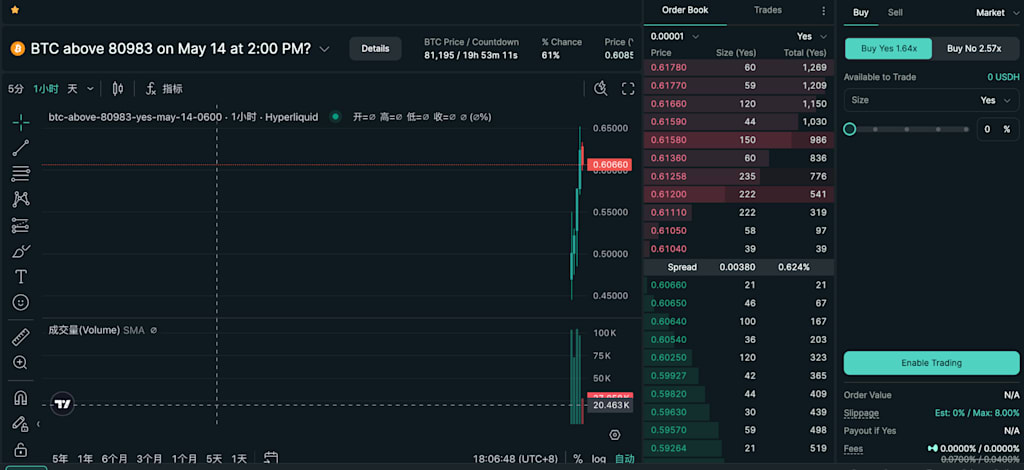
Hyperliquid recently introduced HIP-4 event contracts, bringing prediction market features called “Outcomes” to its platform. But they didn’t just copy existing models.
Instead, Hyperliquid treats prediction markets more like advanced financial derivatives. Traders buy contracts priced between 0.001 and 0.999 that reflect the real-time probability of an event happening. This approach feels closer to binary options and barrier options.
Here’s why Hyperliquid’s version stands out:
Lower Trading Costs — Opening and minting contracts is free. You only pay a small fee when closing or settling — much cheaper than Polymarket’s up to 2% winner fee.
High Capital Efficiency — Prediction markets share the same account, liquidity pool, and margin system as perpetual futures and spot trading. This makes hedging easier and capital use more efficient.
Advanced Trading Features — Traders can build complex strategies and combine positions in ways simple “yes/no” markets don’t allow.
The results speak for themselves. On the first day of launch, Hyperliquid’s prediction markets saw 6.05 million contracts traded. The flagship BTC price binary option alone hit $6.15 million in volume — surpassing comparable markets on Polymarket and Kalshi combined.
Polymarket and Kalshi Enter Perpetual Futures
Around April 21, 2026, both Polymarket and Kalshi made their own big move by launching CFTC-compliant perpetual futures products.
Polymarket’s Approach:
They now offer perpetual futures on BTC, stocks like Nvidia, and commodities like gold, with fixed 10x leverage. Before the official launch, they tested the waters with short-term “5-minute BTC up/down” prediction products.
Kalshi’s Approach:
Kalshi is focusing on compliant channels and traditional finance users. Their perpetual futures emphasize cryptocurrencies like BTC and have already integrated with Robinhood. They’re targeting American retail investors and institutional capital who prefer regulated products.
What Does This Mutual Invasion Mean?
This crossover between prediction markets and perpetual futures is more than just competition — it’s a sign of deeper integration in crypto trading.
For traders, it means more options and better tools. You can now combine event-based predictions with leveraged futures in more sophisticated ways. The line between “Will this event happen?” and “How will this asset’s price move?” is becoming much blurrier.
This trend shows that both crypto-native platforms and more traditional players see huge potential in blending these two markets. The competition is pushing innovation in fees, user experience, capital efficiency, and product design.
Looking Forward
The “raiding” between prediction markets and perpetual futures is likely just the beginning. As platforms continue to borrow features from each other, we could see even more hybrid products that offer the best of both worlds.
For ordinary traders, this means richer opportunities to express views on events, prices, and everything in between. For the industry, it represents an important step toward more mature and interconnected financial markets.
2026 is turning into a breakout year for creative trading products. The platforms that execute these crossovers best will likely capture the most users and trading volume in the months ahead.
About the Creator
Enjoyed the story? Support the Creator.
Subscribe for free to receive all their stories in your feed.
Comments
There are no comments for this story
Be the first to respond and start the conversation.