
Is Blockchain Finally Growing Up?
What's Happening Right Now Changes Everything — And Most People Are Missing It

There's a version of this story you've heard before.
Someone tells you blockchain is the future. You nod politely. Maybe you've even bought a little Bitcoin. And then... nothing changes. The hype fades. Life goes on.
But here's the thing nobody tells you after the hype dies down.
The real transformation usually happens then.
Not during the frenzy. Not when everyone's posting about it on Twitter. But in the quiet months afterward, when the speculators have left the room and the builders are still at their desks at midnight.
That's exactly where we are with blockchain right now. And if you're not paying attention to what happened in the last few months, you're about to be blindsided.
> The U.S. Government Just Picked a Side
For years, the relationship between Washington and crypto was basically one long cold war.
The SEC sued. The CFTC threatened. Congress debated. Nobody agreed on anything. And the industry sat in a kind of regulatory limbo that made serious institutional money deeply uncomfortable.
That's changing — fast.
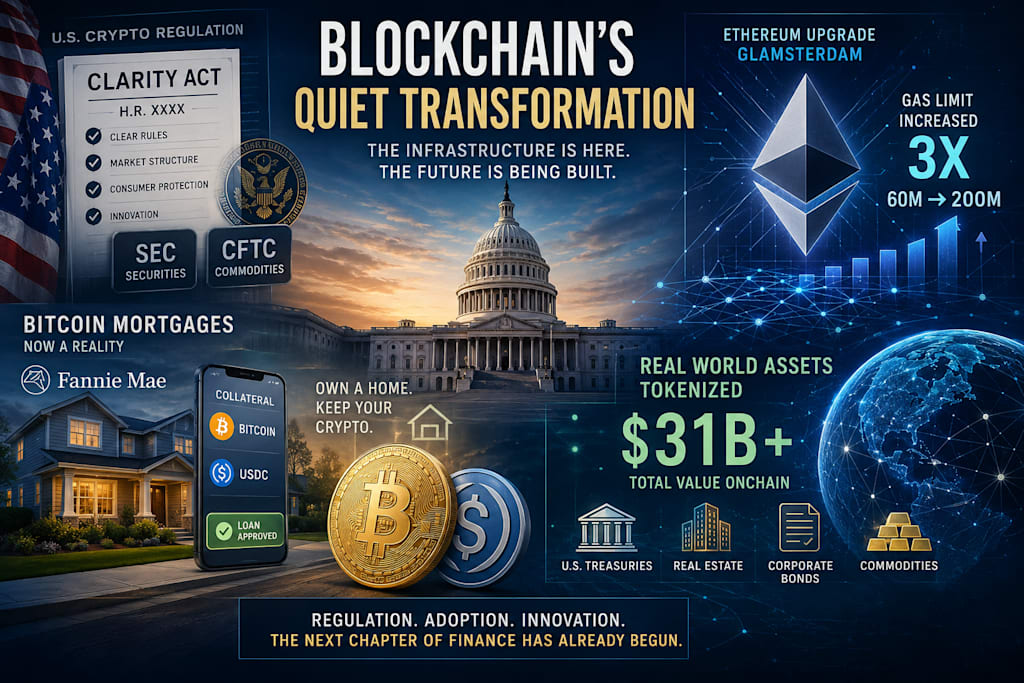
The CLARITY Act, a sweeping piece of crypto legislation, passed the House 294-134 and is now moving through the Senate. Its 309-page text, unveiled by the Senate Banking Committee in May 2026, draws a clear line between what falls under the SEC and what the CFTC regulates. Bitcoin lands firmly in the commodities column. Ethereum gets a more nuanced treatment given its role in decentralized finance.
Is this legislation perfect? Not even close. Senator Elizabeth Warren has issues with it. The banking industry has spent considerable energy fighting specific provisions around stablecoin yields. There are reportedly over 100 amendments in play before a Senate floor vote.
But here's what matters: Washington is no longer ignoring crypto.
They're writing the rules now. And when regulators write rules, it usually means the asset class is here to stay — because you don't regulate things you expect to disappear.
> A House. Bought With Bitcoin. Without Selling It.
Sit with that for a second.
Fannie Mae — the government-backed mortgage giant that underpins the American housing system — is now accepting Bitcoin and USDC as collateral for home loans.
This isn't some fringe crypto startup offering a sketchy product. This is the same institution behind the conventional 30-year mortgages millions of Americans have. Through a partnership with Coinbase and Better Home & Finance, borrowers can now pledge their digital assets as a down payment, take out a standard conforming mortgage, and close on a home — all without triggering a taxable sale of their crypto.
Think about what that means for a generation that put its savings into Bitcoin instead of a traditional brokerage account.
"People who are sitting on Bitcoin or USDC can put a roof over their head without needing to sell it, without needing to incur capital gains," explained Coinbase's head of consumer business development.
The structure is surprisingly straightforward. On a $500,000 home, a borrower can pledge $250,000 in Bitcoin to secure a $100,000 loan covering the down payment. The crypto stays locked in custody for the life of the loan. If Bitcoin drops in value, nothing changes — no margin calls, no forced liquidations. The rules follow standard mortgage logic: you stop paying, you lose the collateral.
Will this reshape the housing market overnight? No. But it's a signal — a loud one — that crypto is being woven into the fabric of mainstream financial infrastructure. Once Fannie Mae does something, every lender in America pays attention.
> Ethereum Just Got Three Times Bigger

While the price charts have been generating most of the headlines, something more significant happened quietly on May 1st, 2026.
Ethereum activated the Glamsterdam upgrade.
In practical terms, the network's gas limit — the maximum amount of work it can process in a single block — tripled. It went from roughly 60 million to 200 million. This isn't a minor tweak. It means the network can handle three times as many transactions, at a lower cost, without sacrificing security.
For anyone who ever tried to interact with an Ethereum application and paid $40 in fees to move $50 worth of tokens, this matters.
One of the most persistent criticisms of Ethereum has been that it prices out everyday users. High fees during peak demand periods made the network feel like first-class seating on a commercial airline — technically available, but not really for everyone.
Glamsterdam doesn't solve everything. The blockchain scalability problem is complex, and Layer 2 solutions like Arbitrum and Optimism are still doing heavy lifting. But tripling capacity while maintaining the security guarantees that make Ethereum valuable? That's not nothing. That's years of engineering work landing in a single upgrade.
The market hasn't fully priced this in. The ETH/BTC ratio hit a year-to-date low of roughly 0.027 in May, suggesting investors still favor Bitcoin during periods of macro uncertainty. But for developers building applications, Ethereum's technical trajectory matters more than its short-term price performance.
> Real World Assets Hit $31 Billion — And Most People Still Don't Know What That Is
Here's a term worth learning: RWA. Real World Assets.
It refers to the practice of representing physical or traditional financial assets — real estate, Treasury bonds, corporate debt, commodities — as tokens on a blockchain.
Why would anyone do this? Because blockchain enables something traditional markets struggle with: 24/7 trading, instant settlement, fractional ownership, and global accessibility.
The total value of tokenized real-world assets crossed $31 billion in 2026. Ethereum holds the dominant position, largely because of institutional trust built through projects like BlackRock's BUIDL fund and Securitize's tokenized securities. BNB Chain has quietly surpassed Solana in this specific category.
Think about what tokenized Treasury bonds mean in practice. Right now, if you want to invest in U.S. government debt, you typically go through a brokerage, wait for settlement, and deal with minimum investment requirements. A tokenized version of the same instrument settles in seconds, can be held in fractions as small as a few dollars, and can be traded at 2 AM on a Sunday.
Projects like Ondo Finance are making this accessible to retail investors who have never set foot in a traditional brokerage. This is DeFi finally delivering on its original promise — not just speculative yield farming, but access to boring, reliable financial instruments that previously required wealth, connections, or institutional status to access.
> What Does All of This Mean For You?
Here's where I'll be honest: most of what happens in crypto day-to-day is still noise.
The Bitcoin price swings. The altcoin rumors. The influencer predictions. The Twitter arguments about which chain is "winning." None of that is the story right now.
The story is infrastructure.
When Fannie Mae accepts Bitcoin as mortgage collateral, that's infrastructure.
When Congress writes a 309-page bill defining exactly how crypto fits into financial regulation, that's infrastructure.
When Ethereum triples its processing capacity in a single upgrade, that's infrastructure.
When $31 billion worth of real-world assets move onto blockchains, that's infrastructure.
Infrastructure is boring. It doesn't make for exciting YouTube thumbnails. But it's what comes before everything else. The internet had its own version of this moment — somewhere between the browser wars and the dotcom crash, while everyone was still arguing about whether it was real, the pipes were being laid.
Whether you're a longtime crypto holder, a curious skeptic, or someone who has no idea what a wallet address looks like, this is the moment worth watching.
The noise may have gotten quieter.
But the signal just got a lot stronger.
Sources: CoinDesk, Fortune, CNBC, CoinMarketCap, FinTech Weekly, TradingView — May 2026.
About the Creator
ELIAS PULIDO
Storyteller by necessity. The best stories don't live in headlines — they live in the details nobody notices. I write about people, ideas, and the moments when the world shifts direction. Sometimes without anyone realizing it.
Enjoyed the story? Support the Creator.
Subscribe for free to receive all their stories in your feed.
Comments
There are no comments for this story
Be the first to respond and start the conversation.