
How Trade Finance Tokenization Is Creating a More Inclusive Trade Ecosystem
Trade Finance Tokenization Is Creating a More Inclusive Trade Ecosystem

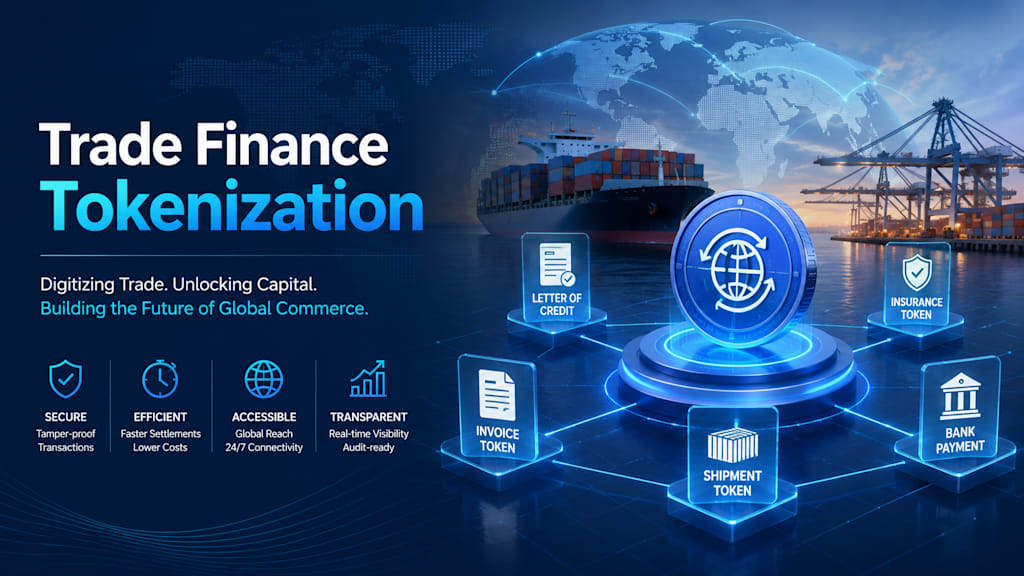
Trade finance has traditionally been one of the most structured and heavily intermediated areas of global finance. It supports international trade by providing credit, guarantees, and liquidity solutions to importers and exporters. However, despite its importance, the system has long been criticized for being slow, costly, and inaccessible to small and medium enterprises (SMEs).
Trade finance tokenization is emerging as a transformative solution to these limitations. By converting trade-related financial instruments—such as invoices, letters of credit, purchase orders, and receivables—into blockchain-based digital tokens, the trade ecosystem becomes more transparent, efficient, and inclusive.
This shift is not just a technological upgrade; it represents a structural rethinking of how global trade capital flows are accessed and distributed.
What Is Trade Finance Tokenization?
Trade finance tokenization refers to the process of digitizing trade-related financial instruments into blockchain-based tokens that represent real-world economic value.
These tokens can represent:
- Trade receivables and invoices
- Letters of credit (LCs)
- Export/import financing agreements
- Supply chain payment obligations
- Commodity-backed trade assets
Once tokenized, these instruments can be tracked, verified, traded, or financed on blockchain networks using smart contracts. This creates a programmable trade finance layer where transactions are no longer dependent on manual reconciliation or fragmented banking systems.
How Trade Finance Tokenization Works
The process begins when a trade transaction is initiated between a buyer and a seller. Instead of relying solely on traditional documentation systems, the transaction data is recorded digitally and verified. Next, the financial instrument associated with the transaction such as an invoice or letter of credit is converted into a digital token on a blockchain platform.
Smart contracts define the conditions of the trade, including:
- Payment terms and settlement dates
- Delivery verification conditions
- Credit risk rules
- Ownership transfer logic
Once conditions are met, the smart contract executes automatically, ensuring seamless settlement. These tokenized instruments can also be sold or financed in secondary markets, allowing liquidity to flow more efficiently across the trade ecosystem.
How Tokenization Is Making Trade Finance More Inclusive
1. Expanding Access for SMEs
One of the biggest challenges in traditional trade finance is that SMEs often struggle to access credit. Banks typically prefer large corporations with strong credit histories, leaving smaller businesses underserved. Trade Finance Tokenization changes this by enabling SMEs to tokenize their receivables and trade instruments. These tokens can be used to access liquidity from global investors without relying solely on banks. This democratizes access to trade financing and helps smaller businesses participate more actively in global commerce.
2. Reducing Dependency on Traditional Banking Intermediaries
Traditional trade finance involves multiple intermediaries, including issuing banks, confirming banks, clearing institutions, and insurance providers. Tokenization reduces this dependency by enabling peer-to-peer or platform-based financing models. Smart contracts handle verification and settlement, reducing operational friction and lowering costs. This streamlined structure makes trade finance more accessible to participants who may not have established banking relationships.
3. Unlocking Global Liquidity Pools
Tokenized trade assets can be accessed by investors worldwide, subject to regulatory compliance. This expands the liquidity pool beyond regional banking systems. Investors from different jurisdictions can participate in financing trade instruments, increasing funding availability for exporters and importers. This global accessibility plays a key role in making trade finance more inclusive and efficient.
4. Faster Settlement Cycles
Traditional trade finance transactions often take days or even weeks to settle due to manual verification processes and cross-border banking delays.Tokenization enables near real-time settlement through blockchain-based smart contracts. Once predefined conditions are met, payments are executed automatically.This improves cash flow for businesses and reduces uncertainty in trade cycles.
5. Improved Transparency and Trust
One of the persistent challenges in trade finance is lack of transparency. Fraud, duplicate financing, and document manipulation are common risks. Blockchain-based tokenization provides an immutable record of all transactions. Every trade instrument is traceable, verifiable, and auditable in real time. This increases trust between buyers, sellers, lenders, and investors across the ecosystem.
6. Lower Financing Costs
By reducing intermediaries and automating processes, trade finance tokenization significantly lowers transaction and financing costs. SMEs benefit the most, as they often face higher borrowing costs in traditional systems due to perceived risk and administrative overhead. Lower costs improve competitiveness and encourage broader participation in international trade.
7. Enhanced Risk Assessment and Credit Visibility
Tokenized trade data can be integrated with AI-driven analytics and blockchain transparency to improve credit risk assessment. Lenders and investors can evaluate transaction histories, payment behavior, and supply chain reliability in real time. This reduces information asymmetry and enables more accurate pricing of trade finance products.
8. Real-Time Supply Chain Financing
Tokenization enables dynamic financing models where suppliers can access liquidity at different stages of the supply chain. For example, once goods are shipped or verified, tokenized receivables can be immediately financed rather than waiting for final payment. This improves working capital efficiency across global supply chains.
9. Increased Participation from Non-Bank Investors
Traditionally, trade finance has been dominated by banks and large financial institutions. Tokenization opens the ecosystem to alternative investors such as hedge funds, fintech platforms, and decentralized finance (DeFi) participants. This diversification increases capital availability and reduces reliance on centralized banking systems.
10. Standardization of Trade Documentation
Trade finance involves complex documentation that varies across countries and institutions. Tokenization standardizes these processes by converting documents into structured digital assets on blockchain networks. This reduces errors, improves interoperability, and simplifies cross-border trade operations.
Challenges in Trade Finance Tokenization
Despite its transformative potential, trade finance tokenization faces several challenges that must be addressed for widespread adoption.
Regulatory uncertainty remains a major barrier, as different jurisdictions have varying rules for digital assets and financial instruments. Integration with legacy banking infrastructure is also complex and requires significant coordination.
Liquidity in secondary markets is still developing, meaning tokenized trade assets may not always be easily tradable. Additionally, standardization across platforms is limited, creating fragmentation in early-stage ecosystems.
Cybersecurity risks and smart contract vulnerabilities also remain important concerns that require robust technical safeguards.
Future Outlook: A More Connected Global Trade Ecosystem
The future of trade finance tokenization is closely tied to the broader digital transformation of global finance. As blockchain infrastructure matures and regulatory clarity improves, tokenized trade instruments are expected to become a standard component of international commerce.
Integration with decentralized finance platforms, AI-driven credit scoring systems, and IoT-based supply chain verification tools will further enhance efficiency and automation.
Over time, trade finance may evolve into a fully digitized ecosystem where capital flows seamlessly across borders, supported by transparent, programmable financial infrastructure.
This evolution will not only improve efficiency but also significantly expand access to global trade opportunities.
Conclusion
Trade finance tokenization is fundamentally reshaping the global trade ecosystem by making it more inclusive, transparent, and efficient. By digitizing trade instruments and enabling blockchain-based financing, it reduces reliance on traditional intermediaries and opens access to broader pools of capital.
While challenges related to regulation, adoption, and infrastructure remain, the long-term trajectory is clear. Tokenization is set to redefine how global trade is financed, enabling a more connected and inclusive financial system where businesses of all sizes can participate more effectively in international markets.
About the Creator
Gabrielle
Blockchain enthusiast and NFT writer dedicated to merging technology with art on decentralized platforms, driving innovation for a creative future. Embracing the potential of digital expression.
Enjoyed the story? Support the Creator.
Subscribe for free to receive all their stories in your feed.
Comments
There are no comments for this story
Be the first to respond and start the conversation.