
How Stablecoins Are Powering Cross-Border Payments in 2026
Exploring How Stable Digital Assets Are Redefining Speed, Transparency, and Efficiency in Global Transactions
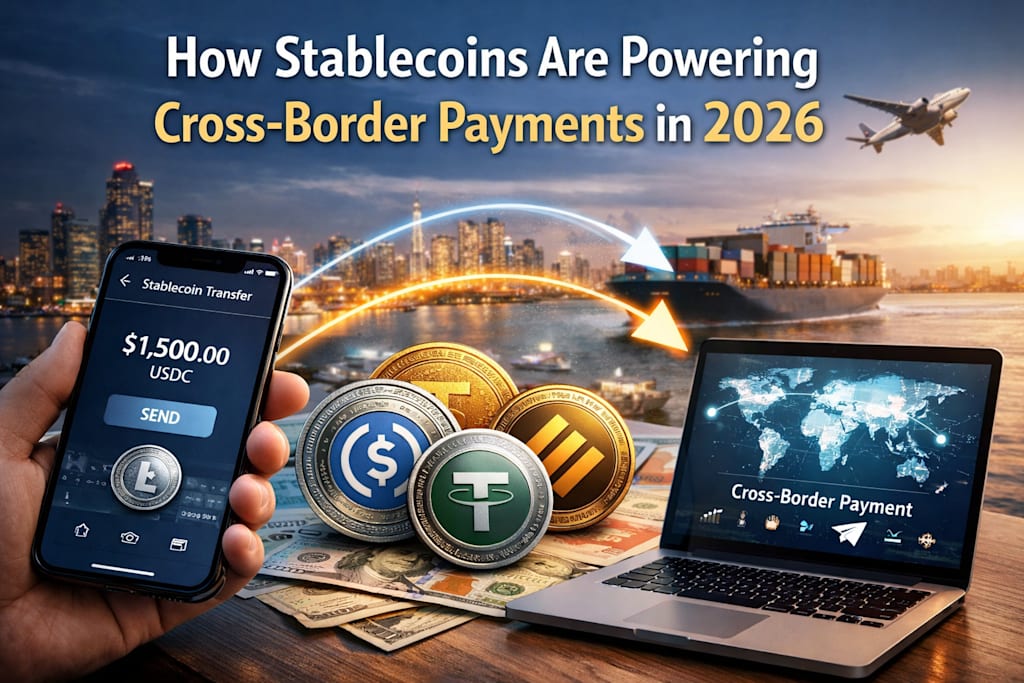
Cross-border payments have historically been one of the most complex components of global finance. Traditional international transfers often involve multiple correspondent banks, fragmented settlement systems, high transaction fees, and processing delays that can stretch from hours to several business days. As global commerce becomes increasingly digital, businesses are demanding faster, more transparent, and cost-efficient payment infrastructure.
In 2026, stablecoins have emerged as a significant force in reshaping international money movement. By combining blockchain-based settlement with price stability, stablecoins are addressing longstanding inefficiencies in cross-border transactions. Financial institutions, fintech companies, exporters, importers, and multinational enterprises are increasingly exploring stablecoin-powered payment rails to improve operational efficiency and reduce friction in global trade.
Why Traditional Cross-Border Payments Face Persistent Challenges
Conventional cross-border payment systems were designed for an era when financial transactions moved through centralized banking networks. While these systems remain reliable, they often struggle to meet the speed requirements of modern digital commerce.
Several challenges continue to impact international payments:
- Multiple intermediaries increase transaction costs and processing time.
- Currency conversion layers create additional settlement complexity.
- Banking hours and regional holidays delay payment completion.
- Limited transparency makes transaction tracking difficult.
For businesses operating across multiple markets, these inefficiencies can negatively affect cash flow management, supplier relationships, and treasury operations. As global transaction volumes continue to rise, organizations are seeking alternative infrastructure capable of supporting real-time value transfer.
Stablecoins Are Transforming Settlement Infrastructure
Stablecoins are digital assets designed to maintain a relatively stable value by being linked to reserve assets such as fiat currencies. Unlike highly volatile cryptocurrencies, stablecoins provide predictability that is essential for commercial transactions.
Their growing adoption stems from the ability to facilitate near-instant settlement across geographically distributed networks. Instead of relying on several financial intermediaries, value can move directly between participants through blockchain infrastructure.
This transformation is particularly important for cross-border payments because it introduces programmable settlement capabilities. Businesses can automate payment workflows, reduce reconciliation burdens, and improve visibility across international transaction chains.
As regulatory clarity improves across major jurisdictions, stablecoins are increasingly being viewed as a practical financial infrastructure layer rather than merely a digital asset innovation.
Enterprise Adoption Is Accelerating
Large organizations are beginning to recognize stablecoins as a strategic tool for treasury optimization and global liquidity management. Cross-border payment operations often require maintaining balances across multiple banking relationships and currencies. Stablecoins help streamline these processes by enabling faster movement of funds between regions.
Key enterprise use cases include:
- Supplier payments across international markets.
- B2B settlement for global trade transactions.
- Treasury transfers between regional subsidiaries.
- Payroll distribution for international workforces.
- Real-time liquidity management across business units.
Many organizations are now working with an Enterprise stablecoin development company to design payment ecosystems tailored to specific operational and regulatory requirements. These implementations focus on compliance, scalability, interoperability, and integration with existing enterprise systems.
The Role of Blockchain in Reducing Payment Friction
The underlying blockchain infrastructure plays a critical role in enabling efficient cross-border transactions. Distributed ledger technology creates a shared record of transactions that can be verified and updated in real time.
This architecture delivers several operational advantages:
- Faster settlement compared to conventional payment rails.
- Enhanced transaction traceability.
- Reduced dependency on intermediary institutions.
- Improved auditability and reporting capabilities.
For finance teams, the ability to track payment status throughout the transaction lifecycle represents a substantial improvement over legacy systems. Enhanced transparency reduces uncertainty while improving operational control.
Additionally, smart contract functionality allows businesses to automate payment execution based on predefined conditions. This capability is becoming increasingly valuable for international trade agreements, supply chain settlements, and recurring payment obligations.
What the Future Holds for Stablecoin-Powered Payments
The cross-border payments landscape is entering a period of significant transformation. Stablecoins are no longer viewed solely as a blockchain innovation; they are increasingly becoming part of broader financial modernization strategies.
Looking ahead, several developments are expected to influence adoption:
- Greater integration between banking systems and blockchain networks.
- Expansion of regulated stablecoin frameworks.
- Increased institutional participation.
- Enhanced interoperability across payment ecosystems.
- Growth of tokenized financial infrastructure.
As these trends mature, stablecoins may become a foundational component of global payment architecture. Organizations seeking faster settlement, lower operational costs, and improved transaction transparency are likely to continue exploring stablecoin-based solutions.
In 2026, the conversation has shifted from whether stablecoins can support cross-border payments to how quickly businesses can integrate them into their financial operations. Their ability to bridge traditional finance and blockchain technology positions them as one of the most influential developments in the future of international payments.
About the Creator
Enjoyed the story? Support the Creator.
Subscribe for free to receive all their stories in your feed.
Comments
There are no comments for this story
Be the first to respond and start the conversation.