
How Real Estate Tokenization Makes Fractional Property Ownership Easier
Fractional Investing Through Blockchain: Simplifying Access to Property Markets
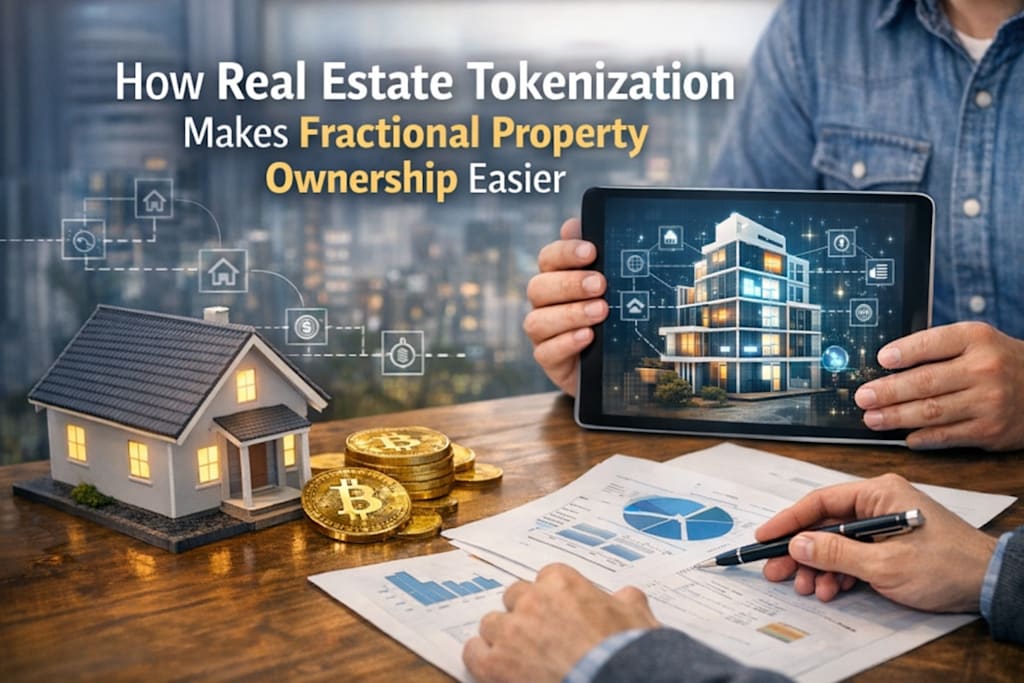
Real estate has traditionally been one of the most capital-intensive asset classes, often restricted to high-net-worth individuals and institutional investors. The emergence of blockchain-based tokenization is fundamentally reshaping this landscape by enabling fractional ownership, enhancing liquidity, and reducing entry barriers. Real estate tokenization refers to the process of converting ownership rights of a physical property into digital tokens stored on a distributed ledger. These tokens represent fractional shares, allowing multiple investors to own a portion of a single asset.
This transformation is not just technological—it is structural, altering how ownership, transferability, and value realization occur in property markets.
Understanding the Mechanics of Real Estate Tokenization
At its core, tokenization leverages blockchain protocols to digitize real-world assets. A property is legally structured—often through a Special Purpose Vehicle (SPV)—and its ownership is divided into tokens. Each token corresponds to a specific share of the asset, including associated rights such as rental income distribution or capital appreciation.
Smart contracts automate the governance layer. These self-executing codes manage compliance, ownership transfers, dividend payouts, and investor verification processes (KYC/AML). Unlike traditional real estate transactions that involve intermediaries such as brokers, banks, and legal agents, tokenization minimizes friction through decentralized execution.
From a technical standpoint, token standards such as ERC-20 or ERC-721 (depending on fungibility requirements) are used to define asset behavior. The integration of blockchain ensures immutability, transparency, and traceability, making ownership records tamper-proof and auditable in real time.
Why Fractional Ownership Becomes More Accessible
Tokenization significantly lowers the financial threshold required to invest in real estate. Instead of purchasing an entire property, investors can acquire smaller fractions, aligning investment size with individual capital capacity.
Key accessibility improvements include:
- Lower Capital Requirements: Investors can participate with minimal funds, sometimes as low as a few hundred dollars equivalent.
- Global Participation: Blockchain removes geographical constraints, allowing cross-border investment without traditional banking barriers.
- Portfolio Diversification: Investors can allocate funds across multiple properties rather than concentrating risk in a single asset.
- Simplified Onboarding: Digital identity verification streamlines investor entry into property markets.
This democratization is crucial in markets where real estate prices are otherwise prohibitive. By enabling micro-investments, tokenization broadens participation across retail investors.
Liquidity Transformation in Real Estate Markets
One of the most significant limitations of traditional real estate is illiquidity. Property transactions often take weeks or months to finalize, involving extensive documentation and regulatory approvals. Tokenization addresses this inefficiency by introducing secondary markets for trading property-backed tokens.
Token holders can buy or sell their shares on digital asset exchanges or specialized real estate marketplaces. This creates a quasi-liquid environment where ownership can be transferred without selling the entire property.
Liquidity advantages include:
- Faster Transactions: Token transfers occur almost instantly compared to traditional deed transfers.
- Continuous Trading Opportunities: Markets operate beyond standard business hours, depending on the platform infrastructure.
- Price Discovery Efficiency: Real-time trading enables dynamic valuation based on market demand and supply.
- Reduced Exit Barriers: Investors can partially liquidate holdings instead of exiting entirely.
However, liquidity is still evolving and depends heavily on regulatory frameworks and marketplace adoption.
Role of Blockchain Infrastructure and Compliance
While the technology enables decentralization, real estate remains a heavily regulated sector. Tokenized assets must comply with securities laws, property rights legislation, and jurisdiction-specific guidelines. This creates a hybrid ecosystem where blockchain innovation coexists with legal frameworks.
Compliance is enforced through programmable logic embedded in smart contracts. Transfer restrictions, investor accreditation requirements, and jurisdictional limitations can all be coded into the token lifecycle. This ensures that only eligible participants can transact, maintaining regulatory integrity.
Platforms offering real estate tokenization development services typically integrate legal structuring, token issuance, and compliance automation into a unified architecture. This alignment between legal enforceability and technical execution is critical for scalability and trust.
Operational Efficiency and Cost Optimization
Tokenization streamlines operational processes by reducing reliance on intermediaries. Traditional real estate transactions involve multiple layers—legal verification, escrow services, banking procedures, and brokerage fees. Each layer adds cost and time.
Blockchain-based systems consolidate these processes into a single digital workflow. Smart contracts replace manual verification, and decentralized ledgers eliminate redundant record-keeping.
Cost benefits emerge through:
- Reduced transaction fees due to disintermediation
- Lower administrative overhead
- Automated revenue distribution mechanisms
- Elimination of redundant reconciliation processes
This efficiency enhances overall asset performance, as more value is retained within the investment structure rather than lost to operational expenses.
Challenges and Market Maturity Considerations
Despite its advantages, real estate tokenization is still in a growth phase. Several challenges must be addressed before widespread adoption occurs.
Regulatory uncertainty remains a primary concern, as different countries interpret tokenized assets differently—some as securities, others as digital property rights. Additionally, market liquidity is not yet comparable to traditional financial markets, and investor awareness is still developing.
Technical barriers, such as platform interoperability and cybersecurity risks, also require attention. Moreover, valuation models for tokenized assets are still evolving, particularly in secondary trading environments.
The Future of Fractional Property Ownership
Real estate tokenization represents a convergence of financial engineering and blockchain technology. By enabling fractional ownership, it transforms property investment into a more inclusive, efficient, and liquid asset class. As regulatory clarity improves and infrastructure matures, tokenization is expected to integrate more deeply into mainstream real estate ecosystems.
The shift is not merely about digitization—it is about redefining ownership paradigms. Fractional access, automated governance, and decentralized liquidity mechanisms collectively position tokenization as a foundational innovation in the evolution of real estate markets.
About the Creator
Enjoyed the story? Support the Creator.
Subscribe for free to receive all their stories in your feed.
Comments
There are no comments for this story
Be the first to respond and start the conversation.