
How Blockchain Powers E-commerce inside Metaverse Virtual Worlds
Blockchain technology will play a key role in the Metaverse, along with other emerging technologies such as artificial intelligence and virtual reality. In futurism and science fiction, the metaverse is a hypothetical iteration of the Internet as a single, universal and immersive virtual world that is facilitated by the use of virtual reality (VR) and augmented reality (AR) headsets.


As industries across the globe begin to embrace the Metaverse, professionals must understand its potential, challenges, and future trends to stay ahead in this rapidly evolving landscape.
This article serves as a comprehensive guide to the Metaverse, offering actionable insights, real-world examples, and strategies for leveraging its capabilities.
This blueprint will equip you with the knowledge to navigate the Metaverse and capitalize on its opportunities.
NFTs have a lot of potential in the metaverse
They provide a way to represent ownership of assets, create scarcity, and monetize content.
While some challenges need to be considered, such as how to represent ownership and prevent inflation, there are already several projects working on solutions. However, if these challenges can be overcome, then NFTs could play a big role in the future of virtual worlds.
There is no doubt that Metaverse will take technology in a different direction. Studying on top of the latest metaverse trends can provide a significant advantage.
As you’ll soon see, the growing frontier of the metaverse is home to a wide variety of different trends and projects.
The metaverse is an expanding network of digital spaces that are gaining popularity in the realm of virtual environments. By utilizing digital representations known as avatars, users can interact and engage with each other in an immersive and interconnected space.
Driven by advancements in technologies such as virtual and augmented reality, artificial intelligence, and other technologies, the metaverse is unlocking new avenues for human interaction and innovation.
The metaverse presents a wide range of possibilities for the development of interactive experiences, including virtual social spaces, remote work, and novel forms of entertainment. However, it also faces significant challenges, including privacy and security concerns, issues of equitable access, and ethical and legal considerations.
Establishing a robust legal and ethical framework is crucial to ensure that the metaverse is utilized for the greater good, such as promoting social connection and fostering creativity.
The evolution of the metaverse is poised to shape the future of digital life and experience, offering new and exciting opportunities for human engagement and creativity.
Every executive should be preparing to combine virtual and physical worlds
Hype about the metaverse has obscured momentum for augmented reality (AR), artificial intelligence (AI), and virtual reality (VR), which combine to bridge the virtual and physical worlds.
- 70% improvement in problem resolution using simulation technology
- 50% increase in additions to cart when interacting with a 3D viewer
Top 10 countries metaverse market analysis by market size in $ bn
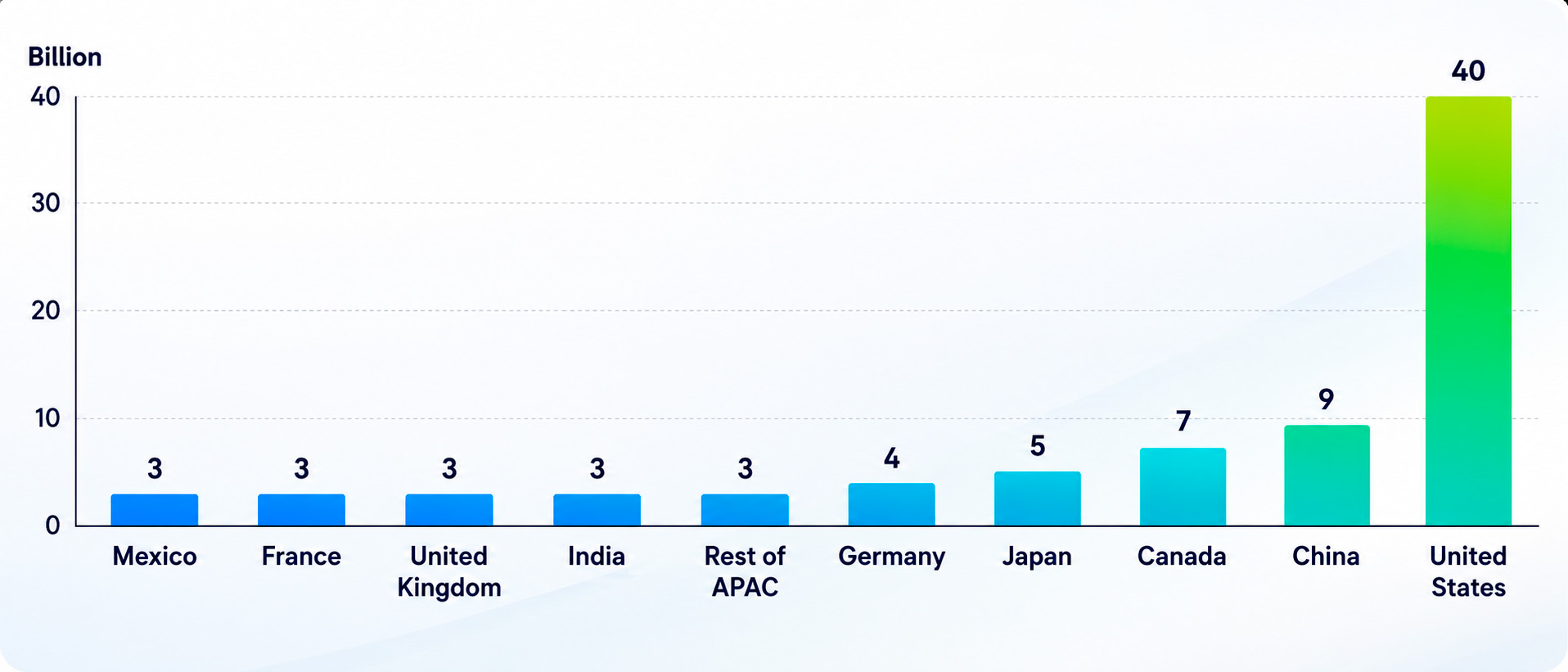
Metaverse trends
Metaverse trends and development are often linked to advancing virtual reality technology due to increasing demands for immersion. Recent interest in metaverse development is influenced by Web3, a concept for a decentralized iteration of the internet.
Information privacy, user addiction, and user safety are concerns within the metaverse, stemming from challenges facing the social media and video game industries as a whole.
Web3 and The Metaverse have been used as buzzwords to exaggerate development progress of various related technologies and projects for public relations purposes.
Meta in the term means “beyond” and verse refers to the “universe.” Moreover, some people also use the term metaverse to refer to virtual worlds in which players can roam around and interact with other players; for instance, a world where developers can build buildings, parks, signs and things that do not exist in reality.
It includes vast hovering overhead light shows and notable neighborhoods (where the rules of three-dimensional spacetime are ignored, and free-combat zones where people can go hunting and kill each other).
Metaverse development may magnify the social impacts of online echo chambers and digitally alienating spaces or abuse common social media engagement strategies to manipulate users with biased content metaverse market analysis by market size in $ bn.
Global metaverse market size by segments
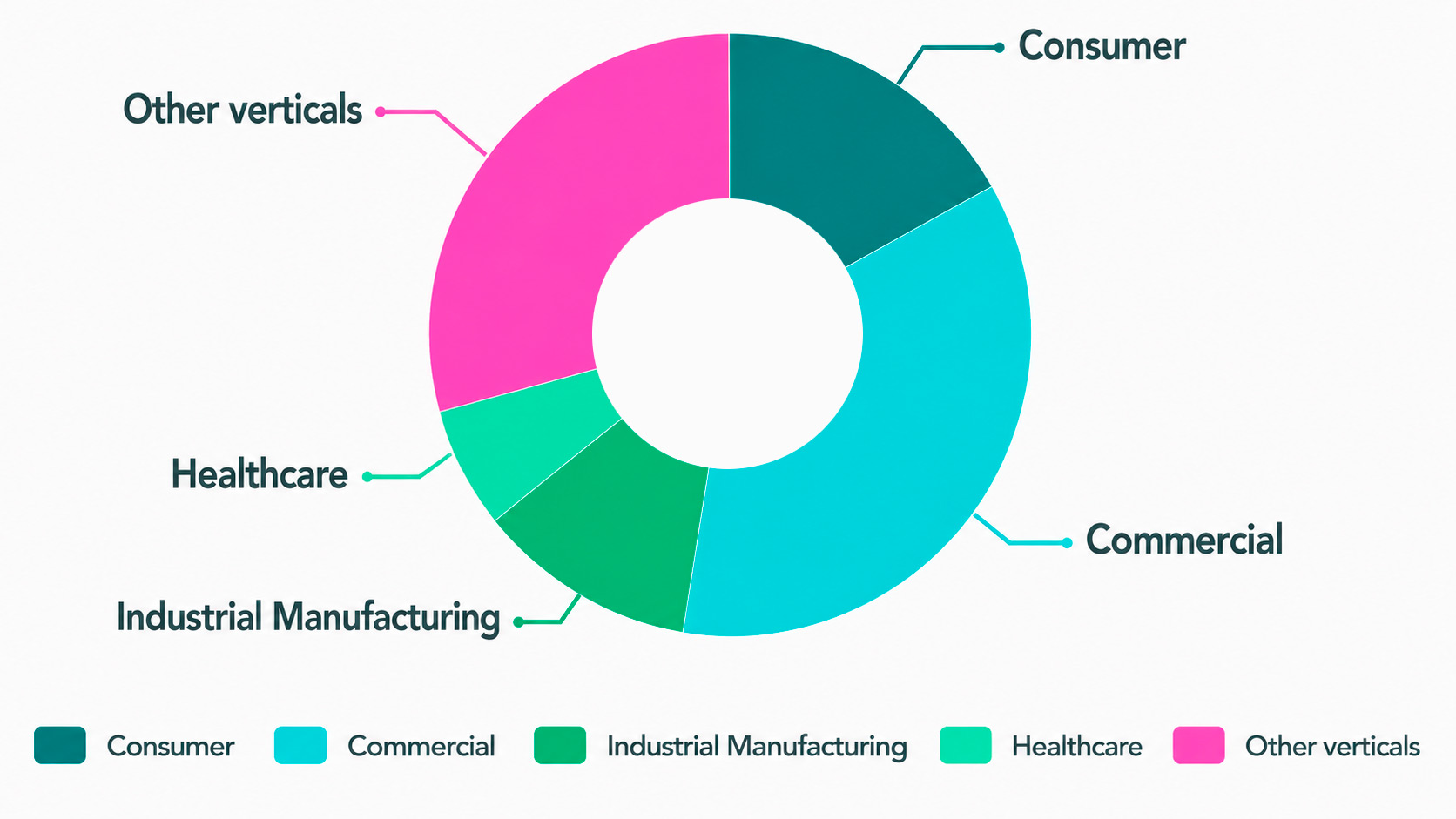
Researchers at Gartner expect that by 2026 one-quarter of us will spend at least one hour in a metaverse to work, play or learn every day. With such a vast potential customer pool (J.P. Morgan envisions a metaverse market opportunity of over USD 1 tn) enterprises can’t wait for some great platform shakeout to start making their metaverse ambitions real.
Building toward the metaverse in incremental steps makes the investment much less risky. Each step will generate return on investment - so much so.
Global metaverse market size by technology
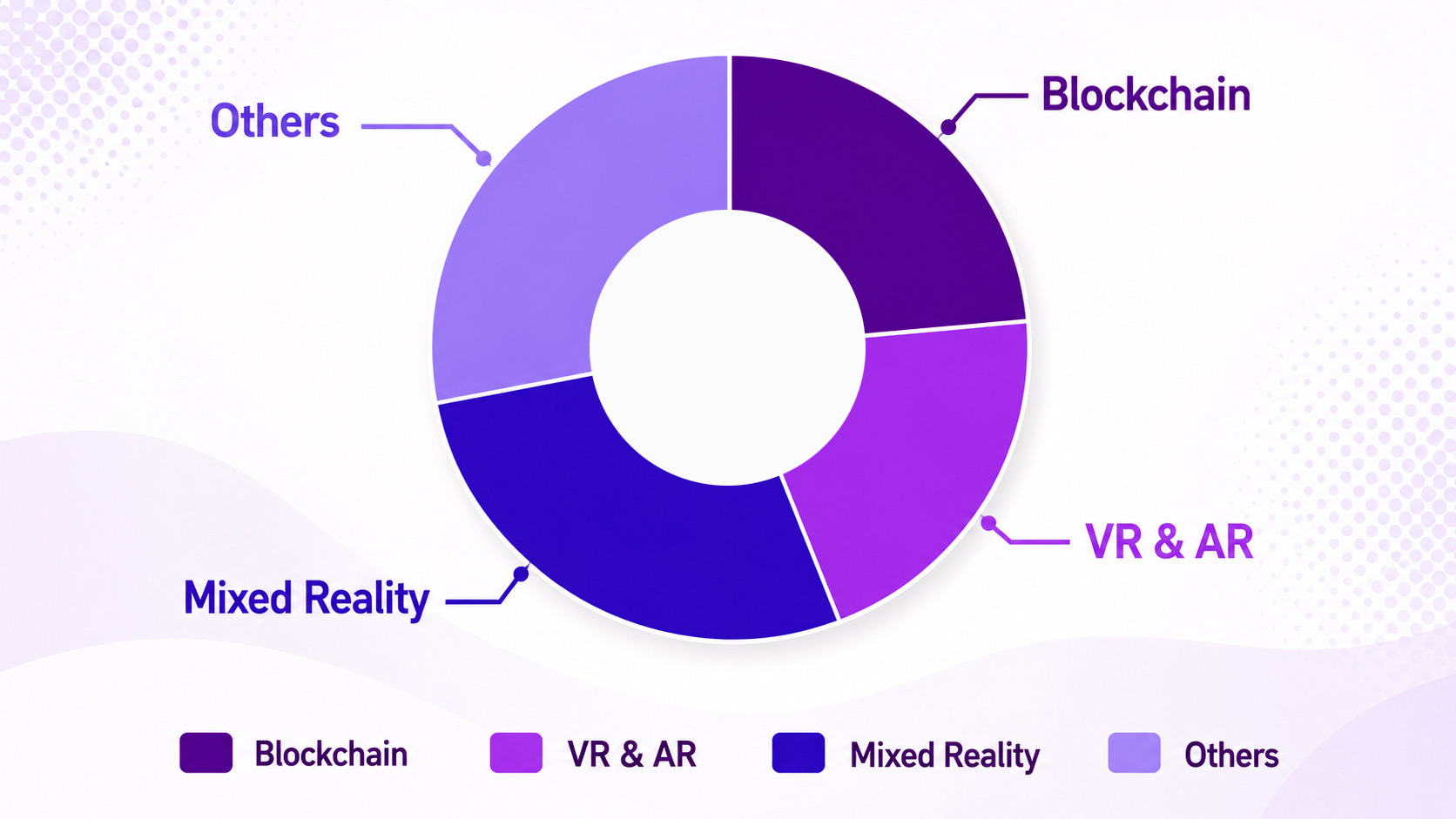
What is metaverse in blockchain?
The Metaverse’s goal is to provide people with an augmented reality experience that, in many ways, may surpass physical reality in terms of experiences and opportunities.
Let’s take a look at why the metaverse needs encryption to function correctly. The unhackability and immutability of blockchain are critical properties for any virtual reality technology to gain broad adoption.
Hacks and data breaches are common, but if people are supposed to operate in an entirely online and virtual environment, the underlying platform on which they will be operating must be secure.
Blockchain and crypto assets are a fundamental and integral aspect of how virtual reality will be deployed.
Building on the previous point, the Metaverse will want and require transactions to be completed on demand, which blockchain and crypto assets can help to enable. There will need to be transactions for an actual virtual reality environment to work and perform as stated.
These transactions must be secure and virtually fast. Individuals in this ecosystem, in particular, will need to be able to:
- transact and engage as readily as if they were in person
- have trust that these transactions will be completed.
Individuals and institutions can conduct transactions in a virtual, traceable and real-time manner via crypto transactions, which are feasible and proven methods.
However, even without the continued use of blockchain and crypto-asset technology, the trend toward virtual and online payments has been growing. Transacting and engaging in commerce in an online environment has become a mainstream evolution that has become even more commonplace with the adoption of crypto payments by Visa, Mastercard and PayPal.
Metaverse is an elusive term – various parties define it differently
Most agree, though, that it involves immersive three-dimensional virtual worlds with lots of games and role-playing. Bailenson, for his part, finds it useful to break the Metaverse down into people, places and things. In each of these areas, he sees a potential role for blockchain technology.
Peopleare avatars, the bodies we wear while immersed in the digital world. Here, blockchain technology can provide the “crypto DNA” that “ensures a one-to-one mapping of person to avatar.
For example, it could be used to guarantee that an individual can’t inhabit ten avatars simultaneously or enable someone else to “take my own avatar for a joy ride.”
While an obvious application of blockchain will be to verify clothes and jewelry for an avatar, I have always thought the killer app here is documenting and verifying human animations.
According to IBM Institute for Business Value (IBV) research, IBM views the metaverse primarily through the lens of the "enterprise metaverse"—a practical, purposeful, and persistent 3D evolution of the internet designed to drive tangible business results, rather than just consumer gaming or social networking.
The metaverse is the same - it’s about the connection points. This distinction is important: it doesn’t matter whether a hardware manufacturer releases a headset, or a technology platform goes crashing into flames - the cultural drivers are why companies are here, trying to find opportunity while they can.
We’re here to openly facilitate improve customer experiences through the lens of a cultural and paradigm shift.
Blockchain technology can be used to verify transactions without a centralized body overseeing the transaction and also ensure that items have unique value based on the supply – one can’t just make thousands of copies to counterfeit an asset.
Places are set areas in a grid of a virtual world. For the Metaverse to work, a world needs to be persistent: it is there, even when you aren’t, and consistent: if you buy a plot of land one kilometer from Snoop Dog, it can’t move farther away based on an arbitrary remapping of the world.
Some platforms are already using blockchain technology to document these maps, he noted.
The most obvious application of blockchain technology is in Bailenson’s realm of things, which includes three-dimensional models, two-dimensional images, sound files or any digital asset that can be housed within a virtual world.
What can you do in the Metaverse?
One can take a virtual trip, buy digital clothing, go to a virtual concert in the crypto metaverse projects. Amid the COVID-19 pandemic, the Metaverse could be a game-changer for the work from the home shift. Horizon Workrooms, a free open beta from Facebook, is now available for download on Oculus Quest 2 in regions where Quest 2 is supported.
Workrooms is a virtual meeting space that allows you and your coworkers to collaborate more effectively from any location. You can join a conference in VR as an avatar or make a video call from your laptop or PC to the virtual room.
You can collaborate on ideas using a sizable virtual whiteboard, bring your computer and keyboard into VR to collaborate with others, or have expressive discussions that feel more like you’re in person.
However, tech firms must yet figure out how to connect their various web channels. To make it work, competing technological platforms will need to agree on a set of standards to avoid switching between the Facebook metaverse, Microsoft metaverse, or others.
Metaverse as a new shopping experience
The second reason is the ability of the metaverses to offer a new shopping experience — and they already know how to do this. Examples are the purchase of hiking equipment in a metaverse-created national park and the purchase of comics with Batman as a consultant for a virtual comic book store.
High competition forces many brands to look for ways of deeper engagement with the customers and as a result they create promotions in the metaverse. Now is the time for the experience economy that creates a closer communication with consumers by engaging them into game-like interactions.
This makes it possible to increase brand loyalty. It is already clear that brands that ignore this important trend are depriving themselves of a significant competitive advantage.
Large and small companies place their showrooms not only in the metaverses, but also on sites where they experiment with augmented reality.
Brands create showrooms, enriching them with 3D elements that can be viewed in more detail, zoomed in, rotated, twisted. This is something the viewer easily understands, it is easy to perceive and it creates a wow effect.
This 3D visualization gives the customer a completely new buying experience. This trend is already present in the market and cannot be denied. The more brands switch to this format, the more dull and outdated 2D will start to look.
We are talking about ordinary clothing items that are easy to sell because they are not high-tech products. This also applies to everyday items. Entire virtual shopping districts are being created — for example, a Japanese shopping district has been recreated in Decentraland.
Features of Digital-commerce
The difference between Digital-commerce and classic E-commerce is the fact that Digital-commerce is customer-oriented (customer-centric).
It takes into account the fact that the customer likes relative autonomy and independence in the process of making purchases, this has become especially evident during the coronavirus pandemic.
That’s why touchpoints (interaction points) are so important, an intuitive website, chatbot and a mobile application.
These tools help the customer make purchases independently and quickly, without waiting for a consultation over the phone. Research shows that companies that use at least three touchpoints sell 287% more products than single-channel companies.
Currently, there is a strong trend of selling during streaming in China. A striking example of this is the case of a blogger girl who sold goods (cosmetics) worth $2 bn to 43 mn of her viewers during a stream last fall.
The Metaverse is the platform where a blogger can stream, demonstrate goods and sell them at the same time.
This allows the consumer, without disconnecting from the blogger to view and study products, interact with them and buy them right here and right now.
About the Creator
Oleg Parashchak
Entrepreneur, angel investor, seasoned media executive with 25+ years of experience in insurance, insurtech, investments, digital media, cyber, B2B sales, blockchain, AI, IoT, ML technologies. I'm a CEO & Founder of Finance Media / Beinsure
Enjoyed the story? Support the Creator.
Subscribe for free to receive all their stories in your feed.
Comments
There are no comments for this story
Be the first to respond and start the conversation.