
Crypto Debit Cards and Stablecoin Payments: Why Visa and OKX Are Racing for Offline Spending
A simple look at how crypto cards are moving from online wallets to everyday purchases

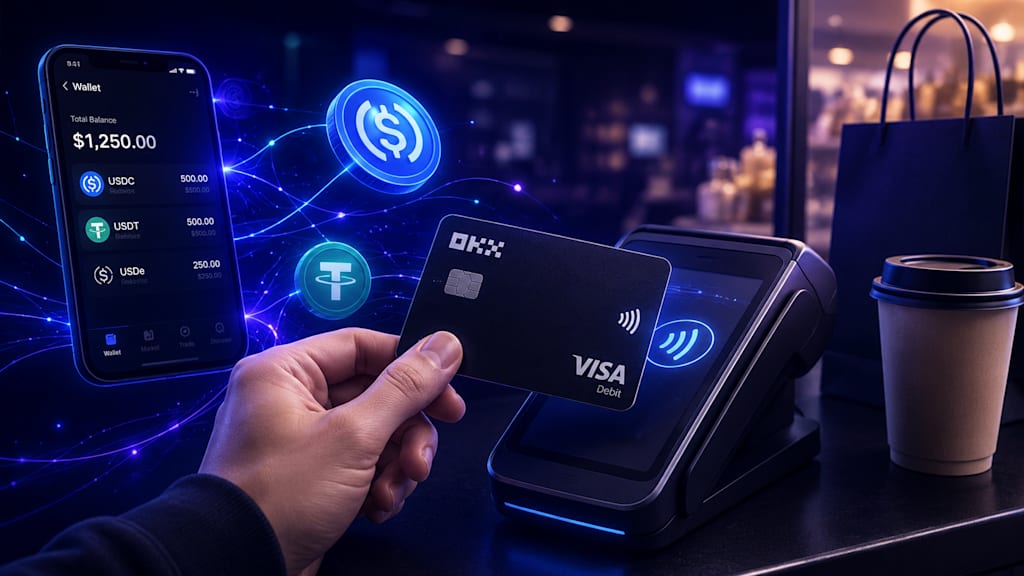
Crypto was once seen mainly as an investment tool. People bought Bitcoin, held tokens, traded on exchanges, or used wallets for on-chain transfers. But in 2026, the story is changing fast.
More users now want to spend digital assets in real life. They want to buy coffee, pay for groceries, book travel, or shop at local stores without first moving crypto back into a bank account. This is why crypto debit cards and stablecoin payments are getting more attention.
Recent market reports suggest that monthly payment volume on crypto-linked debit and credit cards has jumped by about 230% year over year, reaching billions of dollars in transaction volume. Visa is also reported to be leading a large share of this card-based crypto payment activity.
At the same time, companies like OKX are trying to make stablecoin spending easier for everyday users. OKX Pay and OKX Card show how exchanges and wallets can connect crypto balances with real-world merchants.
So what is really happening? And why are Visa and OKX both moving so quickly into offline consumption?
Let’s break it down.
What Are Crypto Debit Cards?
Crypto debit cards are payment cards that allow users to spend crypto or stablecoin balances at regular merchants.
From the user’s side, the experience can feel similar to using a normal debit card. They tap, swipe, or enter card details. The merchant receives money in fiat currency, such as dollars or euros. Behind the scenes, the user’s crypto or stablecoin balance is converted, settled, or used to fund the payment.
This is important because most offline merchants do not want to directly accept volatile crypto assets. A restaurant, supermarket, or clothing store usually wants local currency. They want simple settlement, clear records, and low payment risk.
That is where crypto cards become useful. They connect digital asset users with existing card networks and merchant systems.
For readers who follow crypto market infrastructure, platforms like crypto debit cards are becoming an important topic because they show how blockchain assets can enter daily consumption instead of staying only inside exchanges and wallets.
Why Stablecoin Payments Matter
Stablecoins are one of the main reasons crypto cards are growing.
Unlike Bitcoin or many other tokens, stablecoins are usually designed to track the value of a fiat currency, often the U.S. dollar. This makes them more practical for payments. A user may not want to spend an asset that could move 5% in one day. But they may be more willing to spend USDC, USDT, or another fiat-backed stablecoin.
Stablecoins also solve a real problem for global users. In many markets, people want access to dollar-based digital money. They may use stablecoins for savings, transfers, online payments, cross-border settlement, or daily spending.
This is why stablecoin payments are becoming more than just a crypto-native idea. They are becoming a bridge between digital wallets and real-world commerce.
Visa has already been expanding stablecoin settlement infrastructure, including USDC settlement programs. Its strategy is not to replace the card network, but to upgrade the settlement layer behind it.
OKX is taking a more user-facing approach. With OKX Pay and OKX Card, users can hold stablecoins and use them for everyday payments where supported. In Europe, OKX says card transactions are processed through Mastercard, while merchants receive fiat currency.
This shows a clear trend: stablecoins are moving from trading tools to payment tools.
Why Monthly Crypto Card Volume Is Rising So Fast
The reported 230% increase in crypto card monthly volume did not happen by accident. Several forces are pushing the market forward.
First, more users hold stablecoins than before. Many crypto users now keep part of their balance in USDT, USDC, or other stable assets. These balances are easier to spend than volatile tokens.
Second, the user experience is improving. In the past, spending crypto was complicated. Users had to move funds, convert assets, wait for transfers, and deal with fees. Crypto cards reduce that friction.
Third, card networks already have global acceptance. This is a major advantage. Users do not need every merchant to understand blockchain. If a card works through an existing card network, it can reach many offline and online merchants.
Fourth, exchanges and fintech apps are competing for user loyalty. A crypto exchange does not want users to only trade once and leave. It wants to become part of the user’s financial life. Cards and payments help exchanges stay connected to users every day.
This is why crypto debit cards are not just payment products. They are retention tools, wallet tools, and consumer finance tools.
How Visa Is Winning the Network Layer
Visa’s advantage is simple: acceptance.
Millions of merchants already support Visa payments. Users already understand how to use cards. Banks, fintechs, and payment companies already connect with Visa infrastructure.
So when stablecoins enter the card system, Visa does not need to teach the world a new behavior. It can plug stablecoin balances into a familiar payment experience.
This is a powerful position. Crypto may be new, but the checkout behavior is not. A user can pay with a card at a store, while the backend handles digital asset conversion or settlement.
Visa’s stablecoin strategy also shows that traditional payment giants are not ignoring crypto. They are trying to absorb the useful parts of blockchain into their existing systems. Stablecoins can improve settlement speed, cross-border movement, and treasury flexibility.
For Visa, the goal is not simply to support crypto. The bigger goal is to make sure that if stablecoins become part of mainstream payments, Visa still sits in the middle of transaction flows.
That is why Visa is racing for the infrastructure layer.
How OKX Is Competing for the User Layer
OKX is playing a different game.
While Visa focuses on the network layer, OKX focuses more on the wallet, account, and user experience layer. OKX already has crypto users. It already has trading accounts, wallet tools, and stablecoin balances. The next step is to make those balances spendable.
This is where OKX Pay and OKX Card become important.
A user may hold stablecoins inside an OKX account. Instead of withdrawing to a bank, the user can use supported payment tools to spend those funds in daily life. OKX has also expanded stablecoin payment use cases in markets such as Singapore, where OKX Singapore launched stablecoin payments at local GrabPay merchants.
This is a smart strategy because it keeps users inside the OKX ecosystem. If users can trade, hold, transfer, and spend from one platform, they have fewer reasons to move funds elsewhere.
For OKX, offline spending is not only about card revenue. It is about becoming a daily financial app for crypto users.
Why Offline Spending Is the Real Battleground
Online crypto payments are useful, but offline spending is much bigger psychologically.
When users can spend stablecoins at a physical store, crypto feels more real. It is no longer just something on a trading screen. It becomes money that can buy food, transport, travel, and services.
This matters for adoption.
Many people do not care about blockchain technology itself. They care about convenience. They ask simple questions:
Can I use it easily?
Can I pay where I already shop?
Can the merchant receive normal money?
Can I avoid extra steps?
Can I trust the payment process?
Crypto debit cards and stablecoin payments answer these questions better than many older crypto payment systems.
They do not require every merchant to run a wallet. They do not require every cashier to understand gas fees. They do not force users to manually convert assets before every purchase.
Instead, they make crypto spending look like normal card spending.
What This Means for the Future of Payments
The rise of crypto debit cards does not mean banks or card networks disappear. In fact, the current trend suggests the opposite.
Stablecoins may change the settlement layer, but card networks still matter at the checkout layer. Exchanges and wallets may control the user relationship, but merchants still want simple fiat settlement.
This creates a new payments stack.
At the top, users hold stablecoins in wallets or exchange accounts. In the middle, crypto platforms, issuers, and fintech companies manage access. At the bottom, card networks and merchant acquirers help payments move through existing retail infrastructure.
That is why Visa and OKX are both important, even though they are not doing the same thing.
Visa is building stablecoin access into global payment rails.
OKX is building stablecoin spending into the crypto user journey.
Both strategies point to the same future: digital assets will become more useful when they can be spent easily in the real world.
Final Thoughts
Crypto debit cards are becoming one of the clearest bridges between blockchain finance and everyday consumption. The reported 230% rise in monthly crypto card volume shows that users are not only holding digital assets. They are starting to spend them.
Stablecoin payments are a major reason for this growth. Stablecoins make crypto spending easier, more predictable, and more practical for both users and merchants.
Visa is moving fast because it wants to stay at the center of global payments as stablecoins grow. OKX is moving fast because it wants to turn crypto accounts into daily spending accounts.
For the market, this is only the beginning. The next stage of adoption may not come from complex DeFi products or speculative trading. It may come from a simple card payment at a local store.
That is why stablecoin payments are becoming one of the most important trends to watch in crypto. As more users look for real-world utility, the winners will be the platforms that make digital assets easy to spend, easy to settle, and easy to understand.
About the Creator
Enjoyed the story? Support the Creator.
Subscribe for free to receive all their stories in your feed.
Comments
There are no comments for this story
Be the first to respond and start the conversation.