
AI Agents and Stablecoins: Building Autonomous Financial Systems
AI Agents and Stablecoins: Autonomous Financial Systems
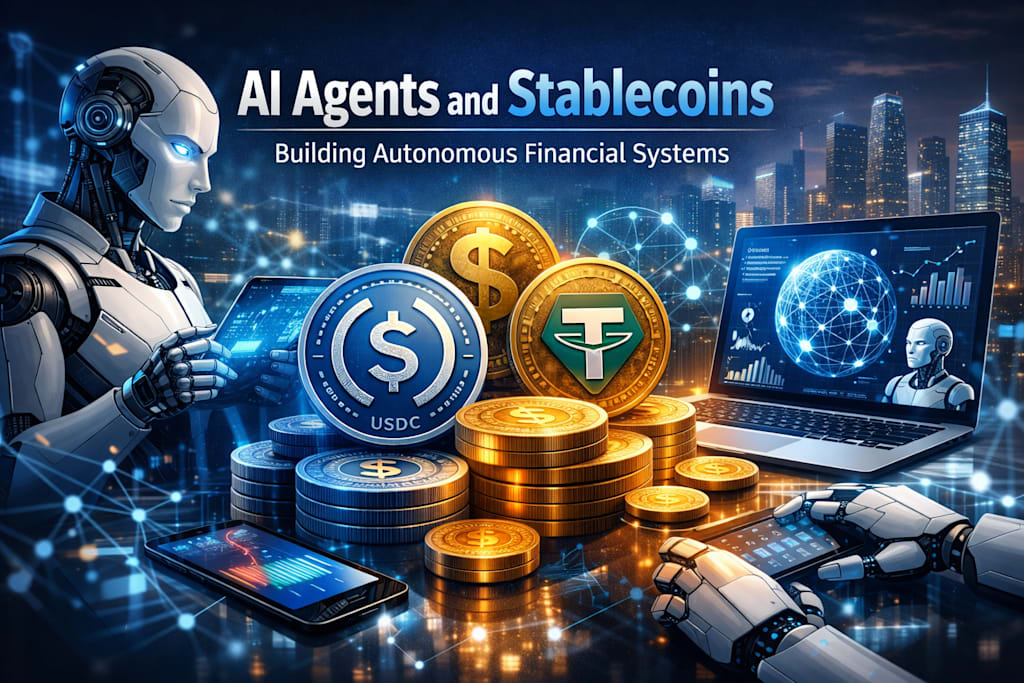
Artificial intelligence and blockchain technology are increasingly converging to create new forms of digital infrastructure. Among the most promising developments at this intersection is the emergence of autonomous financial systems powered by AI agents and stablecoins. While artificial intelligence enables decision-making, reasoning, and automation, stablecoins provide a programmable medium of exchange that can facilitate transactions without the volatility associated with traditional cryptocurrencies.
As enterprises explore automation beyond operational workflows, financial autonomy is becoming a significant area of innovation. AI agents are evolving from simple task-execution systems into intelligent entities capable of analyzing data, initiating transactions, managing resources, and interacting with decentralized financial ecosystems. When combined with stablecoins, these agents gain the ability to perform economic activities independently, creating a foundation for machine-driven financial networks.
The concept is no longer limited to theoretical discussions. Advances in large language models, decentralized finance protocols, blockchain interoperability, and digital asset infrastructure are accelerating the development of autonomous financial ecosystems where software systems can participate in economic activities with minimal human intervention.
The Rise of AI Agents in Financial Operations
AI agents differ from traditional automation tools because they possess contextual awareness, adaptive decision-making capabilities, and the ability to execute multi-step objectives. Rather than simply following predefined instructions, these agents can analyze situations, evaluate alternatives, and take actions based on changing inputs.
In financial environments, AI agents can perform tasks such as:
- Monitoring market conditions and liquidity movements
- Managing treasury allocations across digital assets
- Executing automated payments and settlements
- Optimizing yield-generation strategies
- Conducting risk assessments and compliance checks
The introduction of autonomous decision-making significantly expands the role of software in financial ecosystems. Organizations are beginning to evaluate how AI-driven systems can improve operational efficiency while reducing manual intervention in repetitive financial processes.
However, for AI agents to participate meaningfully in economic activities, they require access to a stable and programmable payment mechanism. This is where stablecoins become an essential component of the architecture.
Why Stablecoins Are Critical for Autonomous Finance
Stablecoins serve as digital assets designed to maintain relatively stable value by being pegged to external reference assets such as fiat currencies. Their stability makes them particularly suitable for machine-to-machine transactions and automated financial operations.
Unlike highly volatile cryptocurrencies, stablecoins enable predictable transaction values, making them practical for AI-driven financial systems. An autonomous agent managing resources or executing payments requires price consistency to make reliable decisions and avoid exposure to unnecessary market fluctuations.
Several characteristics make stablecoins particularly valuable in autonomous finance:
- Near-instant settlement capabilities
- Global accessibility across blockchain networks
- Programmable transaction logic
- Lower operational friction compared to traditional payment systems
- Enhanced transparency through on-chain verification
As organizations explore digital payment infrastructure, demand for specialized solutions such as Stablecoin Development Services continues to grow because businesses require secure frameworks for issuance, integration, compliance, and ecosystem interoperability.
Stablecoins effectively become the economic fuel that allows AI agents to execute financial actions independently while maintaining transactional predictability.
How AI Agents and Stablecoins Work Together
The combination of AI agents and stablecoins creates a closed-loop financial system capable of sensing, deciding, and acting without continuous human oversight.
A typical workflow begins with an AI agent collecting information from multiple sources, including market data feeds, enterprise systems, blockchain networks, and external APIs. The agent processes this information using machine learning models and predefined objectives.
Once a decision is made, the stablecoin infrastructure enables execution. For example, an AI agent responsible for treasury management may identify idle capital and automatically allocate funds to approved yield-generating opportunities. Similarly, a supply-chain agent could release payments when specific delivery conditions are verified through connected systems.
The operational cycle generally follows four stages:
- Data acquisition from internal and external sources.
- Analytical evaluation and objective-based reasoning.
- Financial decision generation.
- Stablecoin-powered transaction execution.
This model transforms financial workflows from reactive systems into proactive, self-operating environments. Instead of waiting for human approval at every stage, intelligent agents can perform authorized actions within predefined governance parameters.
The result is a financial architecture that operates continuously, adapts dynamically, and responds to changing conditions in real time.
Emerging Use Cases Across Industries
Autonomous financial systems are creating opportunities across multiple sectors. As AI capabilities mature and blockchain infrastructure becomes more scalable, practical implementations are beginning to emerge.
Treasury and Liquidity Management
Corporate treasuries often manage complex capital allocation decisions. AI agents can continuously monitor liquidity positions, evaluate market opportunities, and rebalance assets using stablecoins as settlement instruments.
Decentralized Finance Operations
In decentralized finance ecosystems, AI agents can optimize yield strategies, monitor collateral positions, and execute portfolio adjustments. Stablecoins provide a relatively stable base asset for managing exposure while enabling seamless protocol interactions.
Supply Chain Automation
Smart contracts combined with AI-driven verification systems can automate payments when predefined milestones are achieved. Stablecoins facilitate cross-border settlements without the delays typically associated with traditional banking networks.
Subscription and Usage-Based Services
Machine-to-machine economies are expected to expand as connected devices become more intelligent. AI agents representing devices or applications could autonomously purchase services, bandwidth, computing resources, or data feeds using stablecoins.
Digital Workforce Management
Organizations deploying autonomous AI systems may eventually compensate software agents based on completed objectives or resource contributions. Stablecoins create a programmable mechanism for tracking and distributing value within these emerging digital labor environments.
These applications demonstrate how autonomous finance extends beyond cryptocurrency trading and enters broader enterprise and industrial contexts.
Governance, Risk, and the Future of Autonomous Financial Systems
Despite the significant opportunities, autonomous financial systems also introduce governance, security, and regulatory challenges. AI agents capable of controlling financial assets require robust oversight mechanisms to prevent unintended actions and operational risks.
Organizations must address several critical considerations:
- Identity verification and agent authentication
- Transaction authorization frameworks
- Regulatory compliance requirements
- Smart contract security vulnerabilities
- Auditability and decision transparency
- Data integrity and privacy protection
Governance models will likely play a central role in determining how much autonomy organizations are willing to grant intelligent agents. Human oversight, multi-signature controls, risk thresholds, and real-time monitoring systems may remain necessary components of enterprise-grade deployments.
Regulators are also paying closer attention to AI-driven financial systems. Questions surrounding accountability, liability, consumer protection, and automated decision-making will shape future policy frameworks. The challenge will be balancing innovation with safeguards that protect participants and maintain financial stability.
Looking ahead, the convergence of AI agents and stablecoins represents a significant shift in how digital economies may function. Rather than simply automating individual tasks, organizations can build systems capable of independently managing financial resources, executing transactions, and optimizing economic outcomes.
As blockchain infrastructure matures and AI capabilities continue to advance, autonomous financial systems are likely to become an increasingly important component of the digital economy. The combination of intelligent decision-making and programmable money has the potential to redefine financial operations, enabling a future where software entities participate directly in economic activities alongside humans. Such developments may ultimately transform how value is created, transferred, and managed across global digital ecosystems.
About the Creator
Enjoyed the story? Support the Creator.
Subscribe for free to receive all their stories in your feed.
Comments
There are no comments for this story
Be the first to respond and start the conversation.