
Top Grain, Full Grain, and Genuine Leather Explained: What Really Separates Them?
Not all leather is created equal. Learn the real difference between top grain, full grain, and genuine leather so you never waste money on the wrong one again. Includes a quality comparison, jacket buying guide, and FAQs.

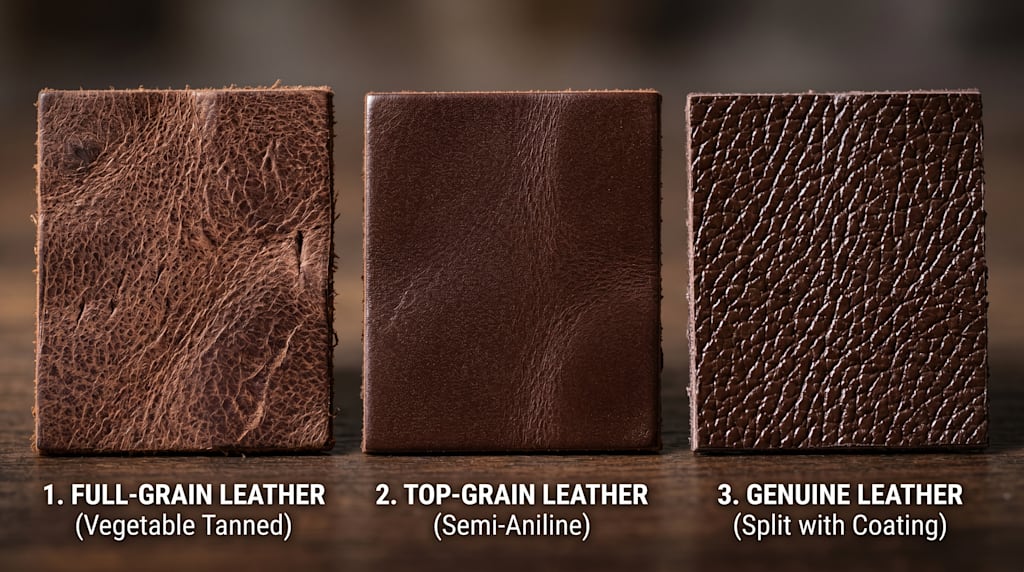
Walk into any leather store or scroll through any jacket brand and you will see these three terms thrown around like they all mean the same thing. They do not. And that gap in meaning is exactly where most buyers lose their money.
Full grain, top grain, and genuine leather come from the same animal hide. But after that, they go through very different processes. The result is leather that looks similar at first glance but behaves nothing alike over time. One gets better with age. One holds steady for years. One wears out fast.
If you are shopping for a black leather jacket, a wallet, boots, or a bag, the type of leather inside it matters more than the stitching or the hardware. This guide breaks it all down without fluff.
It All Starts With the Same Hide. Then Things Diverge.
A cowhide has layers. The outermost layer, the one that faced the world, is called the grain. Beneath it are softer, looser fiber layers. How much of the grain layer you keep and how much you sand away is what defines the three grades.
Think of it like this. The outer grain layer is to leather what the crust is to a sourdough loaf. Remove it and the inside is still edible. But the texture, the bite, the character are gone.
Quick facts worth knowing:
- Roughly 65% of all leather sold globally is corrected grain or genuine leather.
- Full grain leather represents the top 10 to 15% of any given hide due to scarcity.
- A quality full grain cowhide jacket can last 30 or more years with basic care.
- Genuine leather products, on average, show visible wear within 2 to 3 years of regular use.
Full Grain Leather: The Real Thing, Unchanged
Full grain leather is the whole top layer of the hide with nothing removed. No buffing, no sanding, no correcting. Whatever scars, pores, and natural marks the animal had, they stay. That is not a flaw. That is the point.
Those tight, dense fibers at the outer grain are what give full grain its strength. They are what allow it to develop a patina over time, that rich darkening and softening that makes a jacket feel like yours after a few years. No synthetic material or lower grade leather can replicate it.
What makes full grain leather worth it:
- Breathes naturally because the pores are intact, meaning less sweating inside a jacket
- Develops a patina that gets richer with every wear, not duller
- Highest tensile strength of any leather grade, resists tearing and cracking
- Ages into a softer, more supple feel over years
- Naturally moisture resistant without chemical coatings
- Higher price point, but the cost per year of use is actually lower when calculated long term
If you are specifically looking for a full grain cowhide leather jacket, you are looking at the kind of piece that becomes a family heirloom if you take care of it. The cowhide specifically has a thick, structured feel that holds shape well and softens into your body over time.
Top Grain Leather: The Middle Ground Most People Actually Buy
Top grain leather starts the same as full grain. Same hide, same outer layer. But before it is finished, the surface gets sanded or buffed to remove blemishes. Then it usually gets a finish coat applied to create an even, consistent look.
It is cleaner looking than full grain. More uniform. Easier to mass produce consistently. That is why most mid range leather goods at reputable brands sit in this category. It is a solid choice. Just not the best.
What top grain leather actually is:
- Sanded surface means the natural pore structure is partially disrupted
- Finish coat gives it a polished, consistent appearance right out of the box
- Still real leather but the dense outer grain fibers are gone, making it slightly weaker
- Will not develop the same deep patina as full grain since the surface is sealed
- Feels softer and more pliable from day one compared to full grain
- More affordable than full grain while still being genuine quality leather
Top grain sits in a sweet spot for buyers who want real leather without the premium price of full grain. A well made top grain jacket will give you years of good service. Just do not expect it to age the way full grain does.
Genuine Leather: The Name Is Technically True. The Quality Is Not.
This is where a lot of shoppers get burned. The word "genuine" sounds like a premium quality marker. It is actually the opposite. Genuine leather sits at the bottom of the real leather quality scale, just above bonded leather.
Genuine leather is made from the inner layers of the hide after the top grain has been split away. Those inner layers have loose, weak fiber structure. To make them usable, manufacturers apply heavy surface coatings, embossed textures to fake a grain pattern, and dyes to make everything look consistent.
The result looks fine in the store. But after a year or two of use, it peels, cracks, and flakes. That coating was holding everything together.
Reality of genuine leather:
- Made from the fibrous split layer left over after top grain is removed
- Requires heavy finishing to look presentable because the base material is not attractive on its own
- Peels and cracks within 2 to 4 years under regular use
- Holds no real patina and does not age gracefully
- Cheapest option in real leather but the worst long term value
- Still used in mass market fashion because it looks like leather at a low production cost
Side by Side: How the Three Grades Stack Up
Full Grain:
- Durability: Highest. Dense outer grain fibers intact
- Aging: Develops a rich patina over time
- Surface: Natural, may show minor marks and pores
- Typical lifespan: 20 to 30 or more years with basic care
- Price range: Premium
Top Grain:
- Durability: High. Slightly less than full grain due to sanding
- Aging: Moderate. Will soften but minimal patina due to surface finish
- Surface: Uniform and polished, no visible marks
- Typical lifespan: 8 to 15 years with regular care
- Price range: Mid to upper mid
Genuine Leather:
- Durability: Low. Loose inner fibers with heavy surface coating
- Aging: Peels and cracks rather than developing character
- Surface: Embossed or coated, looks uniform but artificial
- Typical lifespan: 2 to 4 years before noticeable breakdown
- Price range: Budget to lower mid
What About Distressed Leather? Where Does It Fit?
Distressed leather jacket styles have been popular for years. The worn in, broken down look reads as lived in and authentic. But distressed is a finish style, not a grade. You can have distressed full grain, distressed top grain, or distressed genuine leather.
The distressing is usually applied through wax rubbing, buffing, or intentional surface scuffing during finishing. On full grain or top grain, it leans into the natural character of the hide. On genuine leather, it is mostly cosmetic and tends to wear unevenly over time since the underlying material breaks down.
If you love the distressed look, buy it in full grain or at minimum top grain. The aesthetic holds up longer and the underlying leather has the structure to support years of wear.
How to Actually Use This When Buying a Leather Jacket
Most product pages and marketing copy will tell you the leather grade if they are proud of it. If a brand avoids naming the grade and just says "real leather" or "genuine leather," that is a signal.
Things to check before buying:
- Look for the specific grain type named in the product description, full grain or top grain
- Check if the leather type is named, cowhide, lambskin, buffalo. Vague descriptions are a yellow flag
- Read what happens to the leather over time in customer reviews, not just early impressions
- Higher weight generally means thicker, better quality hide, around 1.2mm and above for jackets
- Ask the brand directly if the listing is unclear, quality brands answer this without hesitation
- Avoid anything labeled only as genuine leather if longevity matters to you
Why Cowhide Specifically Works So Well for Jackets
Among hides used for jackets, cowhide strikes the best balance between thickness, structure, and durability. Lambskin is softer and lighter but more delicate. Sheepskin runs similar. Cowhide sits thicker and holds its shape under daily wear without becoming stiff over time.
Why cowhide stands out for jacket construction:
- Thicker fibers mean better wind resistance and structural integrity
- Takes dye and finish well, especially in classic black
- Develops one of the best patinas of any hide when in full grain form
- More widely available than exotic hides, making quality grades more accessible in pricing
- Handles moisture better than softer hides, critical for year round jacket use
The Bottom Line Before You Buy
Do not let the word genuine fool you. Do not assume that because something is labeled real leather it means quality. The difference between these three grades is the difference between a jacket you wear for three years and one you wear for thirty.
Full grain is the top of the pile. Top grain is a solid second. Genuine leather is usable but temporary. Once you know that, the marketing language stops working on you.
If you are ready to invest in something that actually lasts, look at what is being used in the construction before anything else. The grade of the leather will tell you more about the jacket than the price tag ever will.
Frequently Asked Questions
Is full grain leather worth the extra cost?
Yes, especially for jackets and bags you use regularly. When you divide the cost of a full grain piece by how many years it lasts, the per year cost is often lower than buying two or three cheaper pieces over the same period.
How do I know if my jacket is full grain or top grain?
Full grain leather usually has a slightly uneven surface texture with natural pore variations when you look closely. Top grain feels smoother and more uniform. If the surface looks too perfect and even, it is likely top grain or corrected grain. Also check the product listing or contact the brand directly.
Can genuine leather be good quality?
It is real leather but it is the lowest quality grade of real leather. It will look fine initially but will not hold up long term. For items you use daily, genuine leather is not a good investment compared to top grain or full grain.
What is the best leather for a black leather jacket?
Full grain cowhide is the gold standard for a black leather jacket that is meant to last and age well. The hide is thick enough to hold structure, the grain takes black dye beautifully, and over years it develops a deep, rich character. Top grain cowhide is a strong second option if budget is a consideration.
Does distressed leather mean lower quality?
Not at all. Distressed is a finish style applied during production. You can find distressed full grain leather that is exceptional quality. The key is checking what grade of leather sits underneath the distressed finish.
How long does a full grain cowhide leather jacket last?
With regular conditioning and proper storage, a quality full grain cowhide jacket can last 20 to 30 or even more years. Some people pass them down to the next generation. The key is basic care, occasional conditioning, and keeping it away from prolonged moisture and direct sunlight.
What is the difference between corrected grain and genuine leather?
Corrected grain leather usually refers to top grain that has been heavily sanded and embossed. Genuine leather refers to the split layers beneath the top grain. Both are lower than full grain in quality, but corrected grain still uses part of the original top surface while genuine leather is made entirely from inner layers.
About the Creator
Gwen Jorgensen
I’m Gwen Jorgensen, a fashion enthusiast and Marketing & PR Manager at Leather Jacket Black. I share insights on modern outerwear, style trends, and premium leather fashion, with a focus on what makes standout pieces truly timeless.
Enjoyed the story? Support the Creator.
Subscribe for free to receive all their stories in your feed.
Comments
There are no comments for this story
Be the first to respond and start the conversation.