
I Put Olive Oil on the Cat Scratch. Did I Ruin My Leather Jacket?
Used olive oil on cat scratches on your leather jacket? Find out what actually happens inside the leather over time, and exactly what to do right now to fix it.

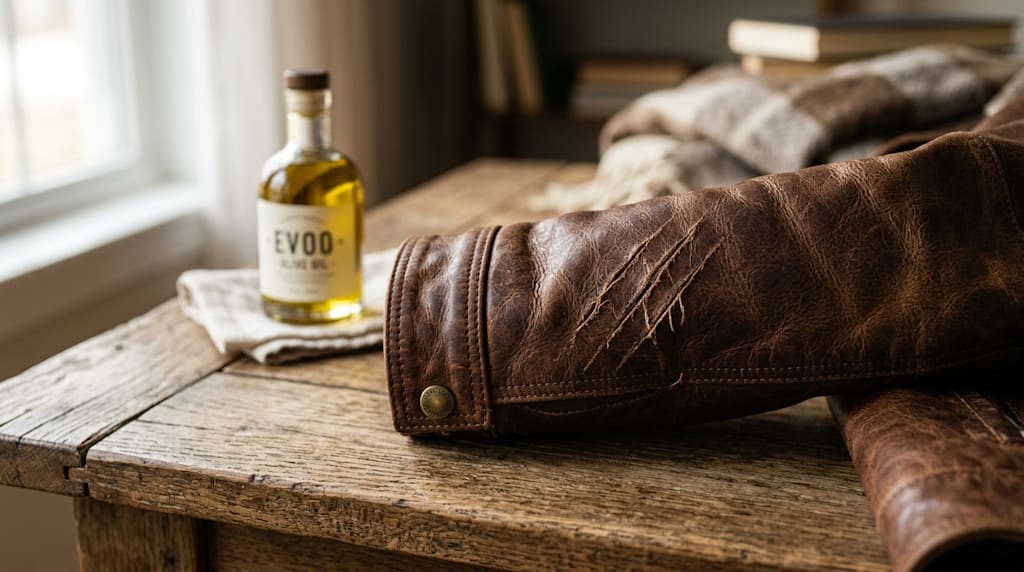
You saw the scratch. Your cat’s claws left a mark right across your leather jacket and you panicked. Someone on Reddit or Pinterest said olive oil fixes cat scratches on leather, so you grabbed the bottle from the kitchen and rubbed it in.
Now the scratch looks better. But something feels off. Was that actually the right move?
Here is the honest answer: short term, you probably made the scratch less visible. Long term, you may have started a slow process that will darken, stiffen, and eventually smell up your jacket.
Let me break this down.
What Olive Oil Actually Does Inside Leather
Leather is porous. When you rub olive oil on it, the oil soaks into the fibers and temporarily plumps them up. That is why the scratch looks better right after. The fibers swell, the surface smooths over, and you feel relieved.
But olive oil is an unstable oil. It oxidizes. Inside leather, away from air, that process takes months. Here is what tends to happen over time:
- The oil darkens as it oxidizes, pulling the leather color deeper and uneven
- Rancidity sets in and creates a faint but persistent smell
- Over-oiled leather loses its structure and becomes soft in a way that looks damaged, not broken in
- The scratch can reappear as the fibers settle back down after the oil dries out
This is not theory. Leather conservators and cobblers consistently flag olive oil as one of the worst home treatments for leather goods. Professional leather care products use stable oils like neatsfoot or mink oil for a reason.
How Bad Is the Damage Right Now?
It depends on how much you used and how recently you applied it. Ask yourself:
- Did the leather change color immediately? Lighter leathers absorb oil faster and show it more.
- Does it feel sticky or greasy after drying? That means excess oil is still sitting on the surface.
- Is there a smell already? That is early stage oxidation starting.
If none of these apply, you are likely fine for now. But act quickly regardless.
What to Do Right Now
Step one. Do not add more oil. Any kind. Not olive oil, not coconut oil, not baby oil. Stop completely.
Step two. Blot the surface gently with a dry cloth. Do not rub. You want to pull out excess surface oil, not push it deeper into the hide.
Step three. Let the jacket air out in a cool, ventilated space. Not in sunlight. Not near a heater. Leather needs steady airflow to release excess oil slowly.
Step four. After 24 hours, apply a small amount of a leather conditioner with stable ingredients. Look for products with neatsfoot oil, lanolin, or beeswax. These are balanced and will not speed up the oxidation problem.
Step five. For the scratch itself, if it is still visible after conditioning, use a color matched leather repair kit. These are made specifically for surface damage from cat scratches on leather and give far better results than any kitchen remedy.
Does Leather Type Change Everything? Yes.
Full grain leather handles cat scratches very differently than corrected grain or bonded leather. On full grain, surface scratches often respond to finger pressure alone. The heat from your finger compresses the fibers and the mark fades. That is the natural structure of a tight, dense hide.
Brands like Leather Jacket Black build their jackets from full grain and vegetable tanned hides, which means cat scratches on leather of that quality are far more forgiving. The fibers compress rather than break open. Cheaper coated or bonded leather has no such advantage. Cat scratches break the surface coating and no amount of oil or conditioner brings that back.
What Actually Works for Leather Repair Scratches
Here is what leather professionals actually recommend for scratches on a leather jacket surface:
- Finger buffing with light pressure on full grain leather for surface level marks
- A quality leather conditioner on minor surface scratches
- Leather filler or repair compound for deeper gouges
- Color matched leather paint for finish damage on coated leather
- Professional restoration for anything deeper than the surface layer
Olive oil is not on that list. It never was. The fact that it temporarily makes a scratch look better is exactly what makes it so misleading as a fix. You can also fully read about leather repair scratches
Quick Facts Worth Knowing
- Olive oil begins oxidizing inside leather within weeks, not years
- Full grain leather makes up less than 10% of global leather jacket production
- Most budget leather jackets use corrected grain or bonded leather, which cannot recover from surface scratches
- Professional leather repair costs between $50 and $200 depending on damage depth
- A quality leather conditioner applied twice a year can prevent most surface scratches from worsening
Frequently Asked Questions
Will the olive oil damage show up later even if the jacket looks fine right now?
Yes, it can. Oxidation is slow. Darkening and smell can develop months later, especially in warmer months or if the jacket is stored in a closed space with little airflow.
Can I use any oil to condition leather?
No. Use products made specifically for leather. Neatsfoot oil, lanolin, and beeswax based conditioners are stable and safe. Kitchen oils like olive, coconut, and vegetable oil are not made for this purpose.
My jacket already smells after using olive oil. What do I do?
Air it out for several days in a cool, ventilated space. You can lightly wipe the surface with a diluted white vinegar solution on a damp cloth, one part vinegar to two parts water, then apply a proper leather conditioner after it dries fully.
Is the scratch fully gone or will it come back?
If the scratch was surface level and the oil temporarily filled the fibers, the mark may reappear as the oil dries out. Condition with a proper product and use a leather repair kit if the scratch is still visible.
How do I stop my cat from scratching my leather jacket again?
Store the jacket in a garment bag or on a high shelf. A leather protector spray adds a thin surface barrier that reduces how deep new scratches penetrate. It will not make the jacket scratch proof but it does make a real difference on day to day contact.
About the Creator
Gwen Jorgensen
I’m Gwen Jorgensen, a fashion enthusiast and Marketing & PR Manager at Leather Jacket Black. I share insights on modern outerwear, style trends, and premium leather fashion, with a focus on what makes standout pieces truly timeless.
Enjoyed the story? Support the Creator.
Subscribe for free to receive all their stories in your feed.
Comments
There are no comments for this story
Be the first to respond and start the conversation.