
AI Image Models Are Starting to Feel Less Like Tools — and More Like Creative Personalities
AI image generation is no longer just about realism. It’s about mood, refinement, and creative identity.

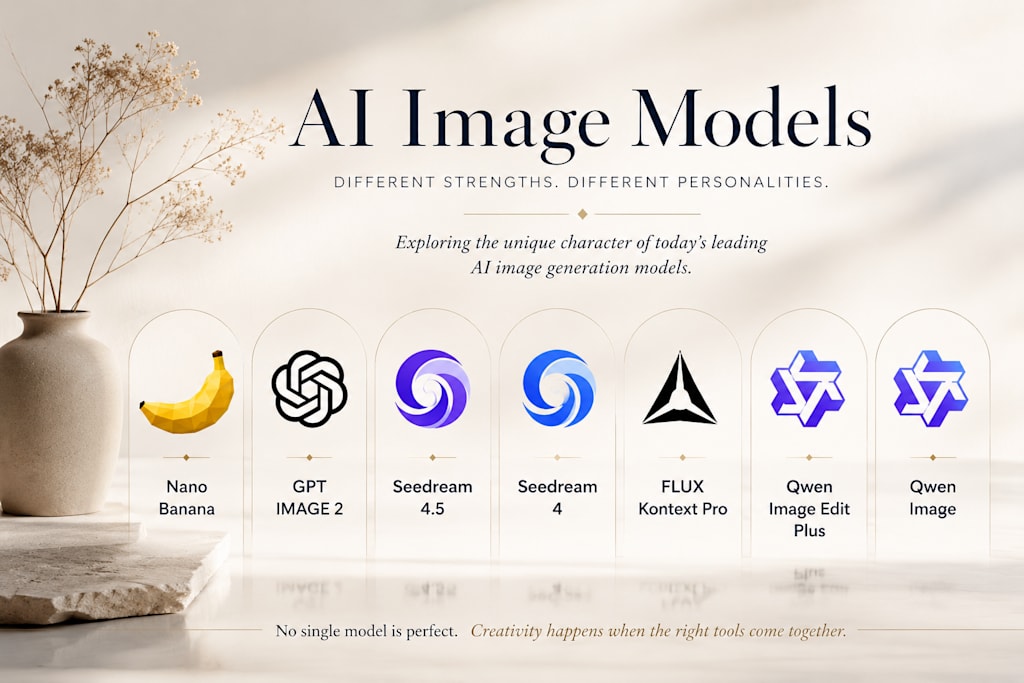
A year ago, most AI image discussions sounded the same.
Which model is the sharpest?
Which one generates the most realistic skin?
Which one follows prompts best?
But lately, after spending time across different image models, I’ve started to feel like we’re entering a different phase entirely.
The gap between “good” and “bad” image generation is shrinking.
Now the interesting part is personality.
Not human personality, exactly.
More like creative temperament.
Some models feel cinematic.
Some feel emotionally distant but technically precise.
Some are chaotic in a strangely inspiring way.
Some feel less like generators and more like collaborative editing tools.
That shift changes how people use AI image generation completely.
Nano Banana Feels Surprisingly Human
Nano Banana is probably the best example of this.
The name sounds unserious.
Almost meme-like.
But the images often feel incredibly alive.
There’s something about the lighting, framing, and color balance that immediately feels social-media-native. It understands “visual mood” extremely well.
Not necessarily realism.
Mood.
The outputs often look like they already belong on Pinterest boards, album covers, fashion campaigns, or late-night Instagram posts.
At the same time, the model still leaves traces of artificial polish.
Sometimes the perfection feels slightly too intentional.
But honestly?
That’s also part of the appeal.
Not every image needs to look indistinguishable from reality.
GPT IMAGE 2 Feels Practical in the Best Way
GPT IMAGE 2 impressed me for a different reason.
It feels less obsessed with generating “beautiful” images and more focused on helping you actually work.
That sounds small, but it matters.
A lot of AI image generation today is no longer:
prompt → final image
Instead, modern workflows look more like:
generate → revise → edit → upscale → refine
And GPT IMAGE 2 handles that transition remarkably well.
You can preserve compositions, change clothing, adjust environments, maintain facial consistency, or iterate on ideas without everything collapsing visually.
It feels stable.
Reliable.
Almost like working with software instead of gambling with prompts.
Ironically, that reliability might become more valuable than raw image quality over time.
Seedream 4.5 Understands Atmosphere
Some models generate images.
Seedream 4.5 generates atmosphere.
That was my strongest impression after testing it.
Neon lighting.
Dreamlike shadows.
Anime-inspired compositions.
Soft cinematic contrast.
Even when the realism isn’t perfect, the emotional tone often lands beautifully.
And honestly, that matters more than people admit.
Most viewers don’t zoom into pore-level texture analysis.
They react emotionally first.
They react to vibe.
That’s why some technically imperfect AI images still spread everywhere online.
Because they feel something.
Seedream 4.5 understands that instinct very well.
FLUX Kontext Pro Feels Like a Director
FLUX Kontext Pro feels less like an image generator and more like a visual planning engine.
It shines when scenes become complicated.
Multiple characters.
Worldbuilding.
Complex environments.
Poster compositions.
Long prompts with layered visual intent.
It rewards precision.
The downside is that it’s not especially beginner-friendly.
You can’t always throw random prompts at it and expect magic instantly.
But when carefully guided, it creates some of the most structurally coherent outputs among current models.
It feels deliberate.
Almost architectural.
Qwen Models Feel Calm
That’s honestly the best word I could think of.
Calm.
Qwen Image and Qwen Image Edit Plus don’t always create the loudest or flashiest outputs, but they often feel dependable.
Prompt adherence is strong.
Editing behavior is controlled.
Images stay consistent.
And in a landscape where many AI tools are trying extremely hard to impress you visually, that restraint becomes refreshing.
Especially for editing workflows.
Sometimes creators don’t want dramatic reinterpretation.
They just want the image fixed.
The Real Battle Is Quietly Moving Toward Refinement
One thing became very obvious while comparing all these systems:
AI image generation is no longer just about generation.
The industry is slowly shifting toward refinement.
That includes:
image upscaling
realism correction
texture balancing
facial refinement
lighting repair
natural detail restoration
In other words:
The future probably belongs less to models that create perfect images immediately…
…and more to ecosystems that let creators continuously improve images naturally.
That’s a very different philosophy from the early “one prompt solves everything” era.
Maybe There Won’t Be One “Best” AI Model
After spending time across these systems, I don’t think the future will revolve around a single dominant model.
Different models are becoming good at different emotional languages.
Nano Banana excels at visual mood
GPT IMAGE 2 excels at workflow stability
Seedream excels at atmosphere
FLUX excels at scene structure
Qwen excels at controlled editing
And honestly, that diversity feels healthy.
Because creativity itself isn’t singular.
Recently, platforms like AIEnhancer have started combining multiple models into unified workflows instead of forcing users into one ecosystem.
That direction makes more sense to me.
Not because people want infinite options.
But because creative work rarely happens in a straight line anymore.
Sometimes the best AI image isn’t generated by one model.
It’s shaped gradually across several different ones.
About the Creator
Violet
Exploring how AI reshapes memory and creativity.
Enjoyed the story? Support the Creator.
Subscribe for free to receive all their stories in your feed.
Comments
There are no comments for this story
Be the first to respond and start the conversation.