
A Bag’s Base Matters When You Set It Down
A practical way to separate visible construction from untested assumptions when choosing a handbag online.

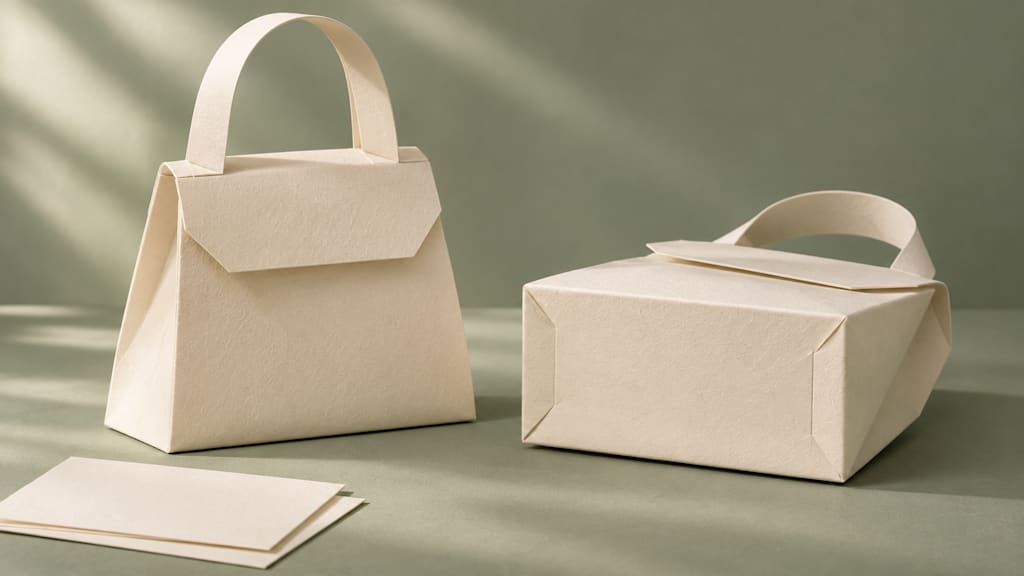
A bag spends part of its day off your shoulder. You put it beside a chair, on a desk or on a shelf while looking for something else. Its front view may have helped you choose the shape, but that view does not answer every question about what happens when you let go of the handle.
Before buying online, it helps to give the bottom of the bag its own small inspection. The aim is to identify what the photographs actually show and which question still needs a demonstration of the exact model.
Start with the place where you put it down
Think of one ordinary moment rather than every possible situation. Perhaps you set the bag on a worktable when you arrive, or leave it on a shelf beside the door.
What do you need to know in that moment? You might want the bag to remain upright, to occupy a predictable amount of space, or simply to have an underside you can inspect before placing it on a clean surface.
Write that requirement as a question. “What does the base touch?” is easier to investigate than “Is this a practical bag?” The narrower question also makes a reply from a seller more useful.
Separate the outline from the way the bag behaves
A product image can show a bottom edge, a panel or a visible support. It captures one arrangement at one moment.
That is different from showing how the bag settles after being placed down, how its shape changes with ordinary contents, or whether it remains upright without assistance. A polished photograph may not reveal what is inside the bag or how it was positioned for the shot.
Keep three notes separate:
Visible shape: what can be seen in the photograph.
Contact area: what is shown touching the surface.
Behaviour: what has actually been demonstrated under stated conditions.
When the third note is empty, leave it empty. There is no need to turn a plausible impression into a product claim.
What one real gallery can tell you
On the Lady Anne Tesoro Gray page at Ankobags, an angled gallery image shows a rounded body with a short straight lower edge; a side image shows a narrow profile. Maxi and Mini sizes are listed. These views do not confirm the pictured size, contents, support or behaviour under load.
Ankobags belongs to our Salestudia project network. This is an observation of published images, not a hands-on review. An underside view and an unsupported set-down demonstration of the chosen size would answer the remaining questions.
Ask for the underside, not just another front view
A clear underside image can answer questions that remain hidden in a standing photograph. Look for the outline of the base, seams crossing it, and any visible feet or other raised contact points.
Check that the image belongs to the model and variant being considered. If the page offers more than one size, ask which one is shown rather than assuming the construction is identical.
Visible feet do not establish how the bag behaves under load. A flat-looking panel does not prove that it is rigid. Neither detail, on its own, confirms protection from moisture or wear. Those would require separate information.
The underside view is still valuable: it turns an unseen part of the product into something you can inspect.
A short demonstration to request or carry out
If you can inspect a sample, use a clean, dry, level table and stay within the product’s stated use. The sequence below is a proposed check, not a report of a test performed for this article.
Show the exact model and size before starting.
Place the empty bag on the table and release the handle. Keep the full bag and its contact with the table visible.
Record how it settles without rearranging it between the set-down and the observation.
Repeat with a normal set of belongings, without overloading the bag. State what was added and how it was arranged.
Show the base from underneath separately, so its construction is not inferred only from the standing view.
A short continuous clip can show the transition from holding to resting. Still photographs are useful for comparing the shape in the two stated conditions. Keep the surface and camera position consistent so that a change in perspective is not mistaken for a change in the bag.
Describe the observation precisely
Useful notes are modest. “The bag remained upright on this level table with the listed contents” describes a particular observation. “It never tips over” claims far more than that check establishes.
Likewise, a bag leaning in one arrangement is a reason to examine that arrangement, not proof that it will behave the same way in every setting. Contents, their placement and the supporting surface all belong in the description of what was observed.
For an online purchase, a concise question might be:
“Could you show the underside of this model in the size I selected, and a short clip of it being set on a level table, empty and with a stated everyday load? Please indicate whether anything is supporting it during the demonstration.”
Decide with the known information and the open question
You do not need a laboratory report for every bag. You do need to know whether an important requirement is supported by an image, an actual demonstration or only an assumption.
If the base matters to your daily use, make that one question part of the selection process. A useful answer explains the exact item and conditions. If the relevant evidence is unavailable, keep that uncertainty in the decision instead of filling it with a promise the product page never made.
AI disclosure: This article was generated using AI. The cover is also AI-generated and does not depict an Ankobags product. No hands-on product test was performed.
About the Creator
Vladyslav Yanchenko
Marketer at Salestudia in Idstein, Germany. I write about websites, SEO, digital marketing and e-commerce, plus how people choose services and products.
Enjoyed the story? Support the Creator.
Subscribe for free to receive all their stories in your feed.
Comments
There are no comments for this story
Be the first to respond and start the conversation.